As part of the Museum’s Visions of Nature year in 2016, we have had the pleasure of hosting three poets in residence: John Barnie, Steven Matthews, and Kelley Swain. During the year the poets worked alongside staff in the collections and out in the Museum itself to gain inspiration for their writing. A small anthology of the resulting poetry is published at the end of 2016.
In this video John Barnie reads his poem The Grand Concourse, inspired by the Museum’s main space. Listen out for other references to the Museum in the poem. John is a poet and essayist from Abergavenny, Monmouthshire.
You can meet John on National Poetry Day on Thursday 6 October 2016, when he will be at the our special event during the morning.
Young volunteers Genevieve Kiero Watson and Poppy Stanton tell the tale of the Museum’s resident Wool Carder Bee and their investigative bee work in our Life Collections…
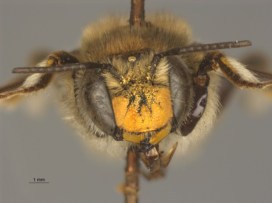
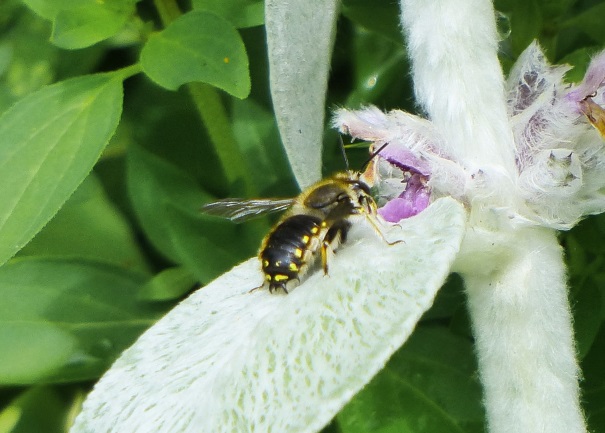
A small guardian patrols its territory among the luscious bed of Lamb’s-ears that grow at the front of the Museum. This feisty critter, the Wool Carder Bee (Anthidium manicatum), is just one of the roughly 270 bee species that buzz around Britain. Having spotted this unusual hovering bee we seized the opportunity to identify, photograph and explore the species a little further.
The male of this solitary bee species is fiercely territorial, fighting off other males as well as any other insects it considers to be intruders. Techniques used in combat vary from skilful aerial hovering to ferocious wrestling. But perhaps its greatest weapon is a series of stout spines found at the tip of the abdomen. These are used to bully an intruder into submission, or even to kill it. In so doing, the male protects the precious supply of pollen for the smaller females which in turn collect it on stiff bristles on the undersides of their abdomens.
Females, being slightly less aggressive, are in charge of constructing the nests, which are built in existing cavities such as beetle holes. Hairs shaved off plants, such as the favoured Lamb’s-ear, are used to create the brood cells for the next generation.
Male Wool Carder Bee on Lamb’s ear in the Museum’s front garden
The Museum houses many specimens of the Wool Carder Bee and our job was to pull out the data from each one to help with an ongoing online survey about this species. Although making friends with hundred-year-old bees was enjoyable, trying to comprehend the miniscule handwritten labels accompanying them was altogether more trying.
Every label explains where and when the bee was captured, who collected and identified it, and gives the reference for its current collection. All this on a slip of paper no bigger than half a stamp.
One of the Museum’s Wool Carder Bee specimens, circled, featured in a display of all 270 species of British bee in the Bees (and the odd wasp) in my Bonnet exhibition by artist Kurt Jackson
After recording data from 120 labels we began to find the grid reference of the location each was originally collected. This too was challenging as many place names have changed in the last hundred years. Ultimately, the information will be used by the Bees, Wasps & Ants Recording Society (BWARS) to improve the distribution map for the Wool Carder Bee.
Why not see if you can spot the Wool Carder Bee in your garden? Characteristics to look out for include small spines on the tip of the abdomen and lateral lines of yellow spots on either side of the abdomen. The bees themselves are about 11-13mm long for females, and 14-17mm for males. Good luck!
From the comfort of our own homes, or even on a mobile device, we are accustomed to watching video footage from the most remote environments on Earth, and beyond. It is easy to take for granted this kind of visual access but we don’t have to go too far back in time to reach a point when the uninhabitable parts of the world remained much more mysterious. Then, the only windows into the nature of exotic locations were through drawings, paintings or collected specimens.
In museums, illustrations of nature were – and are – used in teaching to show what certain animals or environments look like. Along with our biological specimens, the Museum’s collections contain representations of animals whose natural appearance is not preserved after death, including a set of beautiful glassworks of British sea anemones.
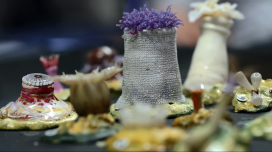
These delicate models were created by the Blaschkas, a family which specialised in glasswork and ran a business spanning 300 years and nine generations. But it was only from the late 19th century that Leopold Blaschka, later to be joined by his son Rudolf Blaschka, turned his skills to making models of microscopic organisms and soft-bodied invertebrates for museums and universities.
The only Blaschka models at the Museum today form a series of British anemones, many of which are recognisable as the species and even individual animals illustrated in British Sea-Anemones and Corals published in 1860 by Philip Henry Gosse
Inspired by zoological specimens, scientific papers, and observation of living animals, as well as artworks showing colours and structures that were difficult to preserve or too small to show, the Blaschkas created thousands of glass models before they accepted a contract in 1886 to work exclusively at Harvard University on the Ware Collection of plant models.
Plate from Philip Henry Gosse, 1860. British Sea-Anemones showing many of the species in the Oxford University Museum of Natural History series. Public domain image from the Biodiversity Heritage Library. http://www.biodiversitylibrary.org
It is somewhat surprising that these incredibly fragile specimens made their way to museums and universities across the globe back in the 19th century and even more surprising that any have survived 150 years later.
Anemones tend to lose their shape and colour when preserved in fluid
Earlier this year the Corning Museum of Glass published an interactive map of marine invertebrate models showing the known locations of collections, or records of collections, of Blaschka glass models.
The models at the Museum, acquired in 1867, are thought to be some of the oldest surviving Blaschka glass models. Even though they are over 150 years old, and in some cases slightly inaccurate representations of species, they still show the vibrant colours and alien shapes of British anemones in a way that can’t be seen outside their living environments.
This year the Museum is playing host to three poets in residence as part of ourVisions of Natureyear. The poets,John Barnie,Steven Matthews, and Kelley Swain,have been working alongside staff in our collections and out in the Museum itself to gain inspiration for their writing over the past six months. In the autumn, they will take part in a number of events and activities to present their work, and will be publishing a small anthology at the end of the year.
Here Steven Matthews reveals what has inspired his poems during one of his recent visits to the Museum.
Fossil in the Charles Lyell collection
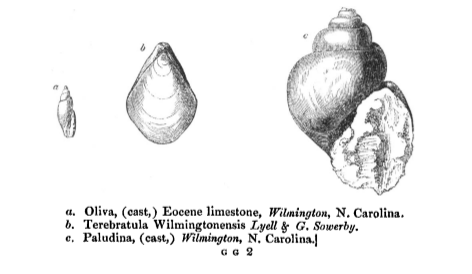
I was struck strongly, during our early visits as poets-in-residence behind the scenes at the Museum, by one particular aspect of the research being undertaken. The history of the Museum collections, their vast reach, is being traced in several instances by the identification of the particular individual specimen which was drawn and lithographed as part of a key scientific paper, in the nineteenth- or twentieth-centuries. Out of the many thousands of specimens held at the Museum, for example, we were shown the exact fossil in the Charles Lyell Collection which had helped, when reproduced in a paper, confirm the geological record of part of the United States.
‘Observations on the White Limestone and other Eocene or Older Tertiary Formations of Virginia, South Carolina and Georgia’ by Charles Lyell, 1845
The history of the Collections, in other words, is the history not just of their remarkable beauty or strangeness, but of their usefulness in advancing scientific thought; just as it is the history of the individual people who have recognised something new to say from the specimens they were studying. There is a firm analogy between this activity and what the making of poems involves. Concise comparison is, after all, what poetry also seeks to attain, bringing the multifariously divergent elements of the world into intense and new combinations with each other.
In preparing to write poems in response to the Museum building and Collections, I have kept that history in mind, researched it. I have read pamphlets by Henry Acland and John Ruskin, Victorians key to the impulse behind the creation of a Museum here to Science, and to defining what the nature of a building on these principles should look like. I have re-read much Victorian and Pre-Raphaelite poetry in order to steep myself in the kinds of language being used to describe Nature by poets at the time the Museum was becoming active. I have read in the work of scientists working at, or associated with, the Museum in its early days and subsequently.
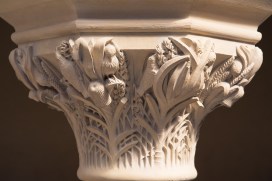
One of the capitals that adorn the Museum court carved by the O’Shea brothers
Out of this reading, but also out of the looking, the many hours spent with the Collections on public display or behind the scenes, have come what is a surprising variety of poems which reflects the wonderful and overwhelming reach of the items at the Museum. I have written about the O’Shea brothers who did much of the amazing carving of column-tops on the Ground Floor; there is a poem on the crystallographer Dorothy Hodgkin, whose lab I was privileged to spend some time alone in.
Nonsense verses have arisen from contemplating the presence of Lewis Carroll here; the astounding collection of multi-coloured marble blocks, the Corsi Collection, has impelled me to create blocks of prose-poetry in their shape. There is a poem ‘voiced’ by an ammonite. The sadness of some specimens, posed in isolation (or in glass jars) far from their original contexts, has moved me; as has the shocked intensified awareness that the history of the Collections is a history of accelerating losses, as more and more of the species gathered in the Museum are extinguished from the world each day.
This year the Museum is playing host to three poets in residence as part of our Visions of Nature year. The poets, John Barnie, Steven Matthews, and Kelley Swain, have been working alongside staff in our collections and out in the Museum itself to gain inspiration for their writing over the past six months. In the autumn, they will take part in a number of events and activities to present their work, and will be publishing a small anthology at the end of the year.
Here Kelley Swain reveals what has inspired her poems during one of her recent visits to the Museum.
In May, I had the opportunity to meet with several curators who had previously introduced me to their collections. This time, with the orientation they’d provided, I had more specific questions:
For Monica in Minerology, I wanted to know more about what people historically considered ‘sympathies’ of gemstones. She directed me to Nichols’ Faithfull Lapidary of 1652, the oldest book in English about the properties of gemstones. The Museum has a copy of the book on loan to the Bodleian, so I’m heading in the direction of that most famous library to get to see the book, perhaps on my next visit.
With Amo in Entomology, I was eager to pay another visit to the Orchid Mantis whom I’d named ‘Daphne’ on my last visit. In the interim, the Mantis had moulted to her final life stage – she has wings and is now fully adult, but we don’t know how long she’ll live. She might not be there when I next visit. (Amo said this is the reason she stopped naming the insects – she became too attached.)
Daphne the Orchid Mantis in March 2016
It was especially wondrous to see that Daphne’s colouring had changed from that of a bright pink-and-white orchid blossom to something darker, that looks just like a dying orchid blossom – and she seemed much less alert than before – almost sleepy. I know a bit about cryptography and camouflage, but that the lifespan of the Orchid Mantis directly correlates with the lifespan of the orchid blossoms on which it hunts is more than I might have imagined. I’ve been working on a poem about Daphne, which, by the time of our poetry-residency anthology is published, is likely to be ‘in memoriam’.
Daphne the Orchid Mantis in May after moulting
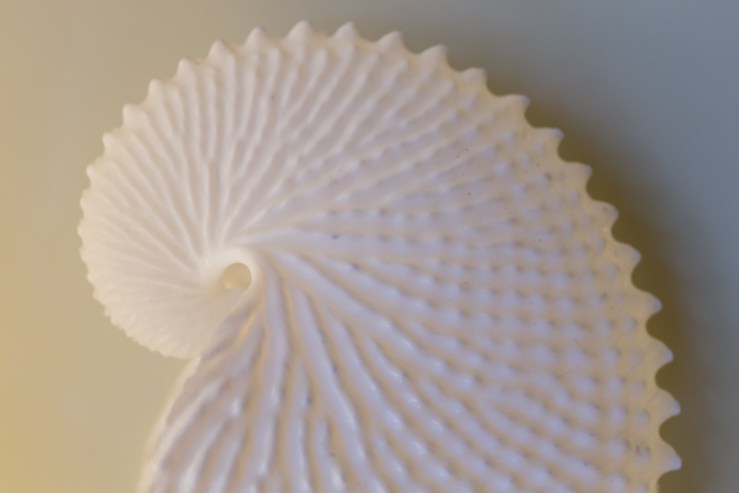
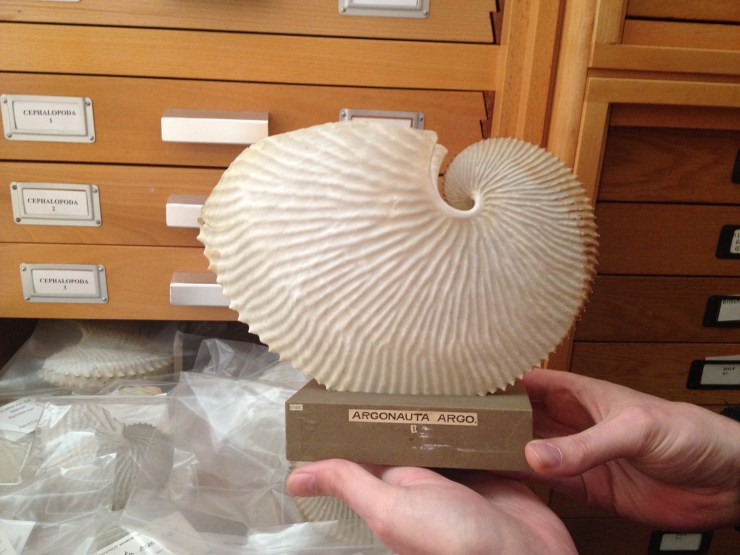
And thanks to Mark, Curator of Life Collections, I was able to finally see something that I’ve wanted to see for a very long time: not only one, but a large collection of fragile, mysterious Argonauta brood chambers. Cepalopods are a particular interest of mine, and while many people have collected marvellous ammonite fossils in Lyme Regis or admired the highly-polished specimen of a nautilus shell, Argonauta brood chambers are often mistaken for similar shells, when they are something rather different.
They are secreted by the female of the species (which is a type of octopus). Though this case is not attached to her body, she lives in it with her tentacles dangling out – she can spin it and turn it, but will never completely let go of it. This is the egg sac or brood chamber for her young: she lays her eggs in it, and when they hatch, they are in a safe, contained chamber in the sea. It’s likely that, as with many cephalopods, senescence sets in around the time the young are about to hatch – that is, the adults deteriorate and seem to have a kind of dementia, until they die and their bodies fall apart, just as the young hatch and need food.
An Argonauta argo specimen from the Museum’s collections
The thing about the Argonauta that most intrigues me is that, though this papery shell is not attached to the female, she will die without it. Studies have revealed that other species of octopus, placed in cages, would squeeze out of the bars of the cage to reach food; the Argonaut, on the other hand, would not let go of its shell, remained in the cage, and died.
Argonauts can direct their buoyancy and swimming, but seem to drift with tides, and there are a few videos online of scuba divers happening upon them: they seem quite directionless and cumbersome. Despite this, to me they are, without doubt, one of the most beautiful, mysterious, and poignant creatures in the ocean, and it was a great gift to be able to see so many Argonauta cases in the Museum stores.
The Argonaut is often called the ‘paper nautilus,’ though their beautiful remnants were also called ‘fairy boats’. The best chapter I’ve read so far on these creatures is ‘Flight of the Argonauts’ by Helen Scales in her book Spirals in Time. I’m working on a poem about these marvellous creatures for the Museum residency.
This year the Museum is playing host to three poets in residence as part of our Visions of Nature year. The poets, John Barnie, Steven Matthews, and Kelley Swain, have been working alongside staff in our collections and out in the Museum itself to gain inspiration for their writing over the past six months. In the autumn, they will take part in a number of events and activities to present their work, and will be publishing a small anthology at the end of the year.
Here John Barnie reveals what has inspired him during his residency as well his creative process.
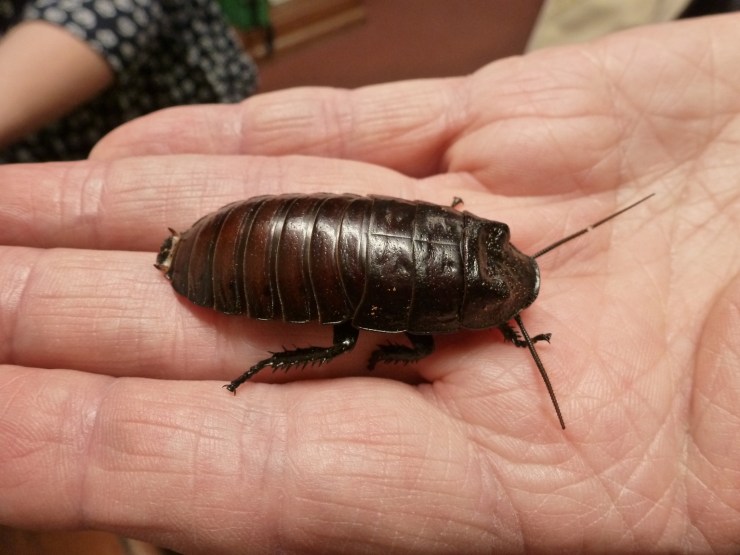
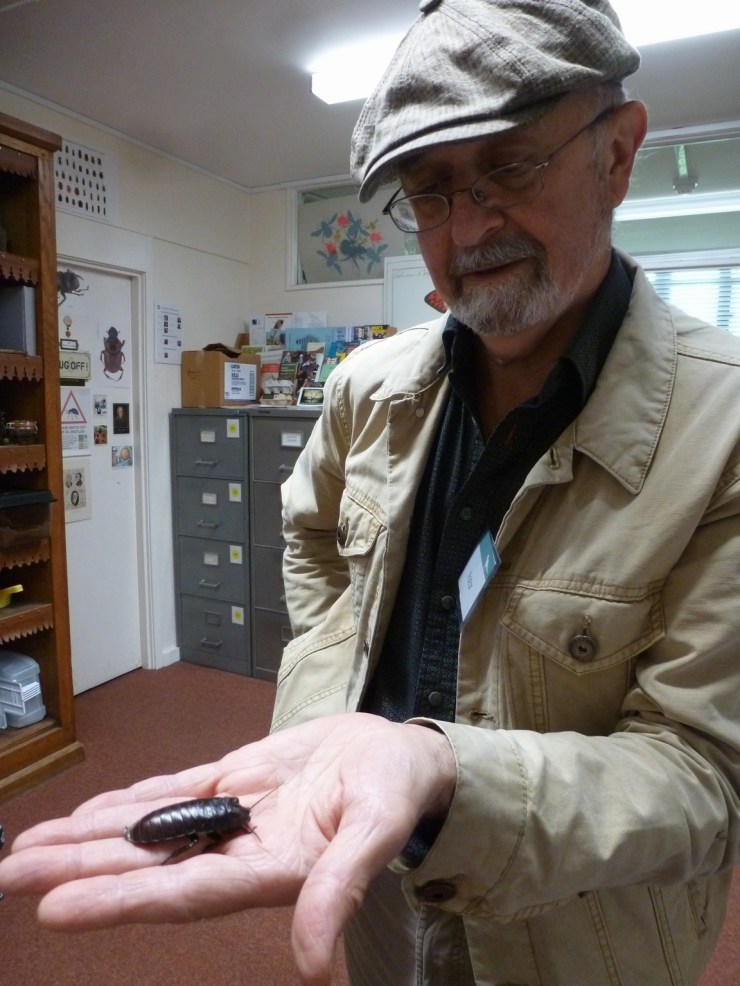
Recently, Kelley Swain and I were allowed to handle live tropical cockroaches at the Museum. They were much larger than the ones I knew when I lived for a time in Memphis, Tennessee. Those lived in the kitchen inside the stove and behind the fridge, waiting to crawl out if you turned your back for a moment while chopping vegetables or meat. Pest control officers came a few times, spraying foul-smelling insecticide everywhere, but next day the cockroaches were back, seemingly unaffected by the poison.
The tropical cockroaches at the Museum were beautiful, their exoskeletons gleaming as their antennae whirred, trying to identify what the palm of my hand might be, and I could see why some people keep them as pets.
My experience of writing poetry is that you can’t decide consciously what the subject of a poem is going to be. A poem ‘emerges’, shaping itself in the mind. Usually it is written quite quickly. There may be a good deal of revision later, but at this first stage the process is almost automatic.
I was apprehensive, therefore, about having to write poems to order as a poet in residence at the Museum. I needn’t have worried, though. During my visits so far, subjects for poems have crowded in, one on another.
Take cockroaches. Over the years I have read a number of books on the mass extinctions that have occurred during the past 650 million years and I’m aware that leading biologists and naturalists, Edward O. Wilson and David Attenborough among them, believe we are in the middle of one now, caused primarily by our own species. Mass extinctions create bottlenecks and it seems that it is a question of luck rather than ‘fitness’ that determines which species survive to radiate beyond.
This set me thinking about cockroaches, that seemingly indestructible group of insects I encountered in Memphis and now again at the Museum. I’d bet on them getting through the bottleneck to evolve and proliferate in a brave new world. As to humans, well that’s another matter.
These experiences and thoughts gradually fused into a poem, ‘Cockroaches on my Mind’, which I never could have thought up and which certainly would not have emerged without tropical cockroaches prickling my skin that day in the Museum.











 For Monica in Minerology, I wanted to know more about what people historically considered ‘sympathies’ of gemstones. She directed me to Nichols’ Faithfull Lapidary of 1652, the oldest book in English about the properties of gemstones. The Museum has a copy of the book on loan to the Bodleian, so I’m heading in the direction of that most famous library to get to see the book, perhaps on my next visit.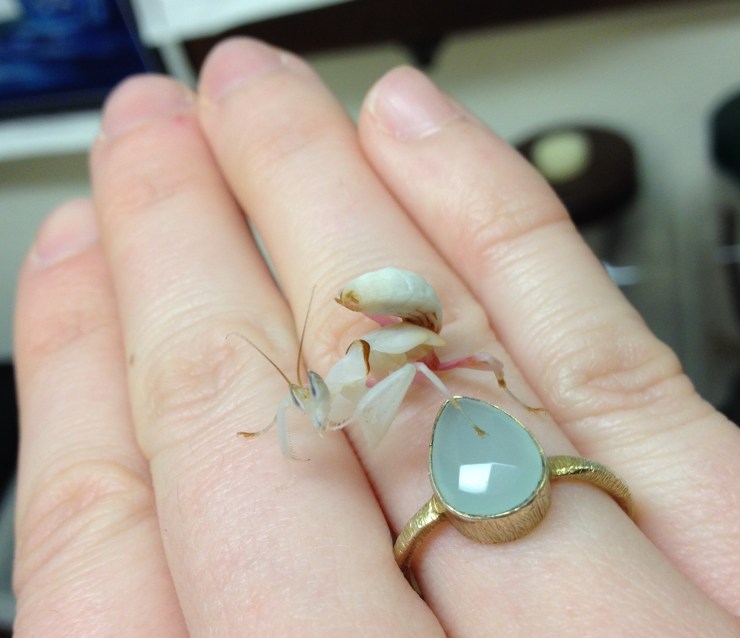

 More Than A Dodo