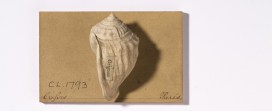
Is it real? – Fossils

One of the most common questions asked about our specimens, from visitors of all ages, is ‘Is it real?’. This seemingly simple question is actually many questions in one and hides a complexity of answers. 

In this FAQ mini-series we’ll unpack the ‘Is it real?’ conundrum by looking at different types of natural history specimens in turn. We’ll ask ‘Is it a real animal?’, ‘Is it real biological remains?’, ‘Is it a model?’ and many more reality-check questions.

This time: Fossils, by Duncan Murdock

Whether it’s the toothy grin of a dinosaur towering over you, an oyster shell in the paving stone beneath you, or a trilobite in your hand, fossils put the prehistory into natural history collections. Anyone who has spent a day combing beaches for ammonites, or scrabbling over rocks in a quarry will attest that fossils are ‘real’. It is the thrill of being the only person to have ever set eyes on an ancient creature that drives us fossil hounds back to rainy outcrops and dusty scree slopes. But fossils, unlike taxidermy and recent skeletons, very rarely contain any original material from living animals, so are they really ‘real’?

Megalosaurus
The Museum’s famous Megalosaurus jaw

Fossils are remains or traces of life (animals, plants and even microbes) preserved in the rock record by ‘fossilisation’.

This chemical and physical alteration makes fossils stable over very long timescales, from the most ancient glimpses of the first microbes billions of years ago to sub-fossils of dodos, mammoths and even early humans just a few thousand years old. They can be so tiny they can only be seen with the most high-powered microscopes or so huge they can only be displayed in vast exhibition halls, like our own T. rex. Among this is a spectrum of how much of the ‘real’ animal is preserved, and how much preparation and reconstruction is required to be able to display them in museums.

Trace fossils include footprint trackways like these, made by extinct reptile Chirotherium.

Generally, the more there is of the original material and anatomy, the rarer the fossils are. Among the most common fossils found are ‘trace fossils’: burrows, footprints, traces, nests, stomach contents and even droppings (known as ‘coprolites’). Most ‘body’ fossils also contain nothing of the living creature, rather they are impressions of hard parts like teeth, bones and shells.

This ammonite fossil, Titanites titan, was formed when a mould was filled with a different sediment, which later turned to rock.

When an organism is buried the soft parts quickly decay away. The hard parts decay much more slowly, and can leave space behind, creating a fossil mould. If this later gets filled with different sediment, it forms a cast.

These sediments are buried further still and eventually turned into rocks. Alternatively, the hard parts can be replaced by different minerals that are much more stable over geological time. Essentially bone becomes rock one crystal at a time.
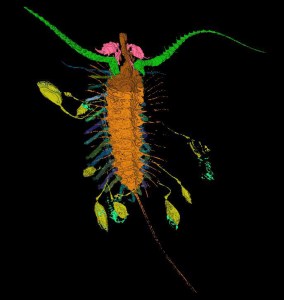
3D reconstruction of 430 million year old fossil, Aquilonifer spinosus. Found in Herefordshire Lagerstätte, which preserves ancient remains with superb detail.

Very rarely the soft parts of an organism get preserved, but in the most exceptional cases skin, muscles, guts, eyes and even brains can be preserved. If buried quickly enough an animal can be compressed completely flat to leave behind a thin film of organic material, or even soft parts themselves can be replaced by minerals, piece-by-piece. These mineralized fossils can be exquisitely preserved in three dimensions, even down to individual cells in some cases. This is about as ‘real’ as most fossils can be, except the few special cases where the remains of an organism are preserved virtually unaltered, entombed in amber, sunk into tar pits or bogs, or frozen in permafrost. The latter push the boundaries of what can really be called a fossil.

Bambiraptor feinbergi

The final step in the process, from the unfortunate demise of a critter to its eventual study or display, involves preparation. In most cases the fossil has to be removed from the surrounding rock with hammers, chisels, dental tools and sometimes acids. This preparation can be quite subjective, a highly skilled preparator has to make judgements about what is or isn’t part of the fossil. The specimen may also need to be glued together or cracks filled in, so not everything you see is always original.

As with modern skeletons, there are often missing parts, so a fully articulated dinosaur skeleton may be a composite of several individuals, or contain replica bones. This is, of course, not a problem as long as it is clear what has been done to the fossil. This is not always the case, and there are examples of deliberately forged fossils, carved into or glued onto real rocks, or forgeries composed of several different fossils to make something ‘new’, like a ‘cut n shut’ car.

So, if you see a fossil that looks too good to be true, then it just might be worth asking, “is it real”?

Next time… Models, casts and replicas
Last time… Skeletons and bones
Fossil-finding

By Jack J Matthews, research fellow

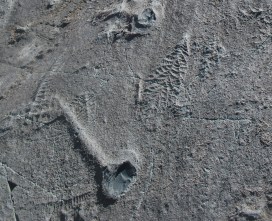
On the southern shores of Newfoundland in Canada lie rocks containing the oldest known evidence of large, architecturally-complex life. Deposited within the Ediacaran Period, some 565 million years ago, these deep marine deposits have been the focus of palaeontological research since the first discovery of fossils there in 1967, and the locality – Mistaken Point Ecological Reserve – now sits in the UNESCO World Heritage list.

As part of my research on these rocks, alongside colleagues from Memorial University of Newfoundland, and the University of Cambridge, I created a new geological map of the area, covering 35 km of coastline in and around the Reserve. As well as providing new insights into the rocks themselves, and what environments they were deposited in, this mapping had an unexpected outcome – the discovery of some totally new fossil sites.

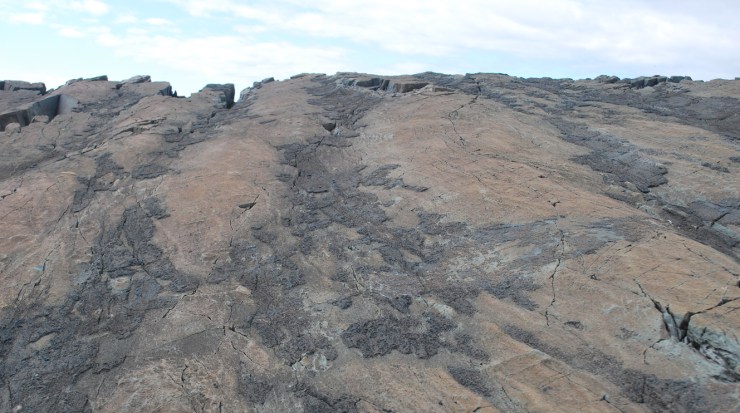
Overview of the Mistaken Point outcrop of the famous ‘E’ Surface

One site in particular, dubbed the ‘E’ surface, is the focus for Ediacaran fossils in Newfoundland. It is an area about the size of three Olympic boxing rings, containing more than 3,000 fossil organisms. Through the mapping we found a number of other outcrops of this same surface, but each shows slightly different types of fossils.

This is a mystery: if all the outcrops are from the same geological surface, why do they show different fossil assemblages?

The clue to the answer came while photographing the fossils and overlying volcanic ash at Mistaken Point, when I heard a loud, deep boom: a freak wave had struck the bottom of the cliff below the outcrop, sending a large splash of salty spray over much of the surface.

This got me thinking – how are processes such as weathering and erosion affecting the fossil surfaces now? Closer observation revealed those outcrops of ‘E’ with pristine beautiful fossils tended to be further from the sea, have a shallower dip, and the overlying ash tended to fall away in little flakes revealing beautiful, crisp, fossils. Other outcrops with scruffy fossils were usually close to the sea, battered by waves and rocks, steeply dipping, and the overlying ash, and often the fossils below it, would gradually abrade away as they are attacked by the sea.

Looking along the ‘E’ surface showing areas still covered in ash (black) and revealed fossil surface (red and grey)

Palaeontologists often discuss how changes during the fossil preservation of an organism can affect what we discover today, but they rarely discuss how processes occurring after preservation – metamorphism, exhumation, weathering, erosion, and even the time, manner, and conditions in which the fossil is recorded – might all affect how we analyse and interpret the original community of life which became fossilised.

Our new paper, published by the Geological Society of London, talks about these Post-Fossilization Processes, and recommends that when researchers are collecting fossil data they consider how their measurements might have been biased by such factors.

For 50 years now, the coastline of Newfoundland has yielded some of the most important finds in understanding the rise of the early life of the Ediacara, and through that the first evidence of animal life. Discoveries over the past few years show there is still much more to be found, and we’ll just have to hope that the post-fossilization processes fall in our favour to allow for many more significant discoveries.

A moving story

img_0737

For the past nine months there has been a lot of moving going on around here. Imagine moving house endlessly for weeks on end, but where your house is full of bones, insects, fossils, rocks, and weird and wonderful taxidermy. And the location of everything has to be precisely recorded. The museum move project was a bit like that.

Project assistant Hannah Allum explains…

The museums are migrating, we declared in May 2016. And so they have. The first major stage of the stores project has been completed. After we had created inventories for the largely unknown collections held in two offsite stores, the next stage was to pack them safely and transport them to a new home nearer the museum, a job which demanded almost 70 individual van trips! We now have over 15,000 specimens sitting in vastly improved storage conditions in a new facility.

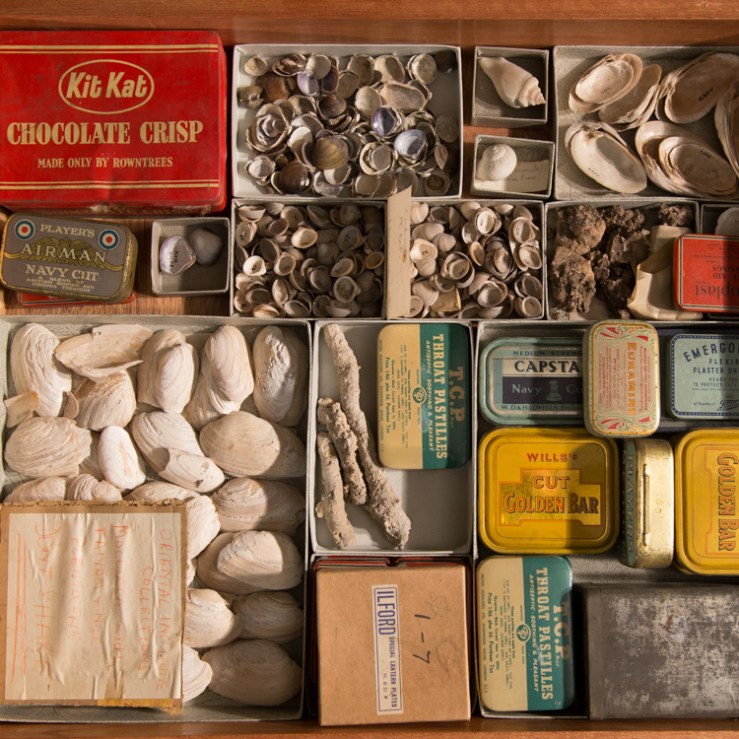
A miscellany of boxes for a collection of shells

Let’s revel in some numbers. All in all there were over 1,000 boxes of archive material, mostly reprints of earth sciences and entomological research papers; over 1,300 specimens of mammal osteology (bones); and more than 1,000 boxes and 650 drawers of petrological and palaeontological material (rocks and fossils).

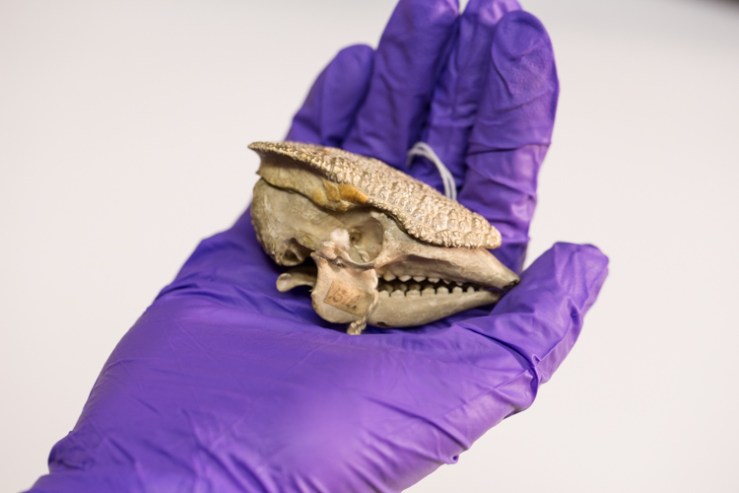
Some of the more memorable specimens include old tobacco tins and chocolate boxes filled with fossils and shells; a beautifully illustrated copy of the ‘Report on the Deep-Sea Keratosa’ from the HMS Challenger by German naturalist Ernst Haeckel; and the skull of a Brazilian Three-banded Armadillo (Tolypeutes tricinctus), complete with armour-plated scute carapace.

img_0756
The skull and carapace of a Brazilian Three-banded Armadillo (Tolypeutes tricinctus)

There were also a few objects that have moved on to more unusual homes. A 4.5 m long cast of Attenborosaurus conybeari (yep, named after Sir David) was too large to fit in our new store and so made its way to another facility along with a cornucopia of old museum furniture. A set of dinosaur footprint casts, identical to those on the Museum’s lawn, have been gifted to the Botanical Gardens for use at the Harcourt Arboretum in Oxford.

And last but not least, a model of a Utahraptor received a whopping 200 applications from prospective owners in our bid to find it a suitable home. After a difficult shortlisting process it was offered to the John Radcliffe Children’s Hospital and following a quarantine period should soon be on display in their West Wing.

Footprint casts, attributed to Megalosaurus, queuing for a lift to Harcourt Arboretum. Credit: Hannah Allum
Casts of footprints by made Megalosaurus, queuing for a lift to Harcourt Arboretum. Image: Hannah Allum

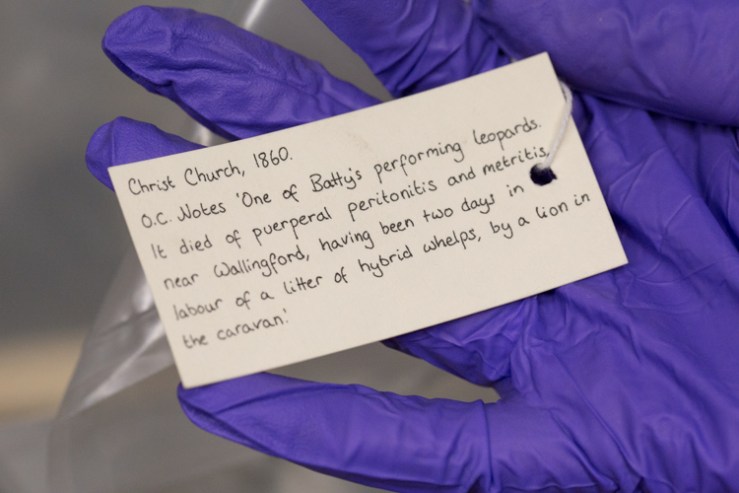
Fittingly, the final specimen I placed on the shelf in the new store was the very same one that had been part of my interview for this job: The skeleton of a female leopard with a sad story. It apparently belonged to William Batty’s circus and died of birthing complications whilst in labour to a litter of lion-leopard hybrids before ending up in the Museum’s collections in 1860.

img_0760
The sad story of a performing leopard

Though the moving part of this project is now complete there is still plenty of work to do. We are now updating and improving a lot of the documentation held in our databases, and conservation work is ongoing. The new store will also become a shared space – the first joint collections store for the University Museums, complete by April 2018.

To see more, follow the hashtag #storiesfromthestores on Twitter @morethanadodo and see what the team at Pitt Rivers Museum are up to by following @Pitt_Stores.

Nature’s medals

By Sarah Joomun, Documentation officer

In the 1820s a young geologist named Charles Lyell travelled around France studying the landscape and rock formations to try and work out the processes that created them.

In between these field-trips, he met the people who had been studying the geology of France and from these discussions and his observations he created The Principles of Geology, one of the first significant popular science books on the subject and a foundation for the methods of modern geology.

pal_cl01718_01

Lyell collected many samples from the rocks he studied, amassing thousands of fossils during his lifetime. The Museum has a collection of some 16,000 of them, around 90 per cent of which are shells, mostly gastropods (snails) and bivalves (clams), many collected during his travels in France.

The reason for this prodigious collection of fossil shells, or testacea as they were then known, was that Lyell believed them to be the most useful clue to understanding the Earth’s history.

The testacea are by far the most important of all classes of organic beings which have left their spoils in the subaqueous deposits : they are the medals which nature has chiefly selected to record the history of the former changes of the globe.

– Lyell’s Principles of Geology, Vol III, 1833.

Fossil shells can show how the animal that lived inside the shell behaved, and whether it lived on the land, in freshwater or in the sea. Species of shelled animals have a wide geographical range and individual species survive for a long time, so they can be compared across time and space.

pal_cl01742_02

This allowed Lyell and his colleagues to determine the relative ages of the rock layers that the fossil shells came from. He looked at the proportion of shells that belonged to living species and determined that the rock layers with the lowest proportion of living species were likely to be older than rocks with higher proportions of living species.

And so three main groups of rock layers were found: the Eocene, containing fewer than 4% living species; the Miocene, with fewer than 18% living species; and the Pliocene, with more than a third of living species.

Although what is now known as the Eocene (from 56 to 34 million years ago), Miocene (23 to 5.3 million years ago) and the Pliocene (from 5.3 to 2.6 million years ago) don’t denote exactly the same periods as Lyell described, we still use these terms for some of the youngest geological epochs today.