Wasp Faces: Power Struggles and Royal Drama


By Kristian Suszczenia, Intern


The second you step into the Museum of Natural History you will notice a remarkable thing about nature: its diversity. Instantly, you see huge whale bones, a distant elephant skull, birds, fish, dinosaurs, and a mounted kaleidoscope of colourful insects. This variation is what many of us love most about biology.

But diversity occurs at a much finer scale than the magnitudes of difference that exist between species. Often there is ‘Individual Variation’ — differences that occur within species. Person to person, specimen to specimen, each organism is unique, just like us humans!

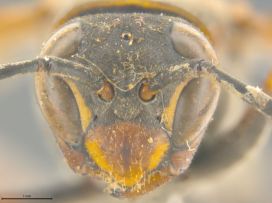
Buried under the 5 million other insects of the HOPE collection is a drawer that houses a species of the genus Polistes, a social paper wasp collected from Brazil. A close look at their faces reveals staggering individual variation. Before getting confirmation from specialists, the Museum staff found it hard to believe that these four faces could even belong to the same species. The question is, why are they so different? Is there an evolutionary benefit to all these wasps having their own style of eyeliner?

Variation in the faces of paper wasps

It is well-known that individual variation can give certain members of a species an edge over others, especially when it comes to dating! From guppies to fruit flies, females often prefer mates that stand out with unique colours and patterns, perhaps because they are simply more noticeable.

Yet dating is not a sufficient explanation for our fashionable paper wasps. They get a very different benefit from their unique looks — not so much standing out, but being memorable. For them, a memorable identity is a way to remember who goes where in a critical pecking order.

Thanks to a lot of elegant work by Polistes specialists, we understand that bespoke face markings tend to evolve in species that have multiple queens in a linear hierarchy. A Polistes queen can start a hive alone but often benefits from forming a group of queens that can all cooperate together in a single hive. In order to cooperate, the queens must decide on a dominance hierarchy amongst themselves. To do this they take part in brutal one-on-one battles as they assess each other’s prowess.

After they establish an initial order, each wasp will constantly test the adjacent ranks (their closest match) with darts and lunges as they try to climb the ladder for extra reward and simultaneously defend their place. Four punishes Three for transgressions and plots against Five’s downfall. It’s a royal reality show.

This part-insect, part-spartan society is certainly fascinating, but what does it have to do with the wasps’ faces?

In order for queens to defend their rank from their adjacent competitors, they need to know exactly who’s who. Unique faces are more recognisable and more memorable. Being able to recognise and recall every individual wasp allows queens to track their rivals based on their faces and avoid a lot of violent misidentification. Imagine if a queen were to look forgettable; every other queen in the hive would see her as a potential challenge to their power. She wouldn’t last long. But having a memorable face allows individuals to avoid unnecessary scraps and make for a more efficient hive overall.

After learning the story of the wasps, it seems plausible that humans may have evolved our fantastically recognisable faces for societal advantages too — perhaps to avoid getting mistaken for an enemy, perhaps so we can trade favours, or maybe just to avoid general confusion. It would certainly make life difficult if all your co-workers had the exact same face. Remembering names is hard enough already!


Four Museum staff willing to volunteer their faces!

The Beginning of the End: Do locusts still spell danger for humanity?


By Ella McKelvey, Web Content and Communications Officer


A few days ago, I was working from home when a delivery driver arrived with a strange parcel – a cardboard box stamped with the letters FRAGILE that seemed to be producing a peculiar, scratching sound. Tentatively, I opened the cardboard box and pulled out a plastic punnet filled with newspaper, old egg cartons, and… wait! Was that an antenna? 

The parcel turned out to be a box of locusts, ordered by my housemate who uses them to feed her pet reptiles. I set the punnet down beside me and tried to continue with my morning’s work. But over the next few hours, the locusts grew increasingly restless, bouncing against the walls of their punnet like hot, microwaved popcorn. The sight and sound of the insects began to return memories of the infamous locust swarms of 2020 — one in a series of near-apocalyptic events that befell us that fateful year. Worryingly, climate change is set to make locust swarms increasingly common, with Sardinia currently facing its worst locust swarm in thirty years.1 

Left: A poster for The Beginning of the End (1957) about a fictional invasion of giant, mutant locusts in Illinois. Right: A real-life locust swarm near Satrokala, Madagascar (2014).

Throughout history, locusts have been widely understood as symbols of maleficence and misfortune. One of the oldest written references to locusts is, of course, the Biblical story of the ten plagues of Egypt, in which locusts were sent as a punishment from God. Since then, these infamous insects have been featured in art, books, music, and films as harbingers of destruction. Americans of the mid-twentieth century were somewhat obsessed with giant locusts and grasshoppers which were featured everywhere from cartoons to postcards. 1957 saw the release of the movie The Beginning of the End – a schlocky Hollywood sci-fi tale about a swarm of giant, mutant locusts invading Illinois. The film’s principal Entomologist describes locusts as “deadly killer[s]”, both “intelligent and strong”. Real-life locusts are, indeed, very strong for their size, with back legs that can catapult them up to a metre from standing. This means that it would be feasible for the human-sized locusts in The Beginning of the End to jump as far as forty metres — a terrifying thought!2  

While The Beginning of the End is ridiculous both in premise and execution, I can’t deny that I find the concept of giant locusts pretty nightmarish. Earlier in the week, I sent an email to the Life Collections team to enquire about the possibility of looking through our pinned locusts and snapping a few photos of the biggest and grisliest specimens. As I walked upstairs to entomology, I braced myself for an encounter with some fearsome insects. But what I found were a few drawers of modest-sized locusts that looked about as benign as garden grasshoppers. Many of them were even stuffed with wool; more like teddy bears than agents of Armageddon. 

Left: Anacridium aegyptium or Egyptian Locust from the Collections at OUMNH. Right: Underside of a locust specimen showing cotton wool stuffing.

According to Collections Assistant Rob Douglas, stuffing large insect specimens with cotton wool used to be a common entomological practice. Insects with fatty insides, like locusts, must be gutted to ensure good preservation. Following the removal of the insects’ insides, cotton was often used to return their abdomens to their usual size and shape. Locusts’ ample fat stores contribute as much to their physical prowess as their powerful hind legs; sustaining them through migrations of up to 310 miles a day.3 Such migrations occur when locusts are exposed to a dry spell followed by wet weather, allowing for the sudden regrowth of vegetation. These conditions will cause locusts to switch their solitary lifestyles for gregariousness, coming together to chomp their way through crops and vegetation at a density of 80-160 million insects per square mile. A large migrating swarm of locusts has been estimated to need as many calories in a day as 1.5 million human males, explaining why even ordinary-sized locusts are capable of causing agricultural annihilation.

If it weren’t for government and international interventions, the 2020 locust swarms in East Africa could have caused up to $8.5 billion in economic damages by the year-end.5 But locusts can do much worse. One of the most notorious locust swarms on record was that of the Rocky Mountain locust in the USA between 1874 and 1877. According to some accounts, the swarm caused damages to agriculture equivalent to $116 billion in today’s money, leaving behind piles of locust carcases up to six feet high.6 

When it comes to protecting crops from locusts, prevention is better than cure. Likely locust outbreaks can be pre-empted by studying weather patterns and using satellite imagery to keep an eye on vegetation growth.7 Once a (potential) locust swarm has been identified, traditional methods of locust management involve the use of pesticides to wipe out the insects as soon as possible. Back in the 1950s, this meant dowsing locusts with DDT. But as the drawbacks of synthetic pesticides become increasingly apparent, chemical interventions are being replaced with the application of naturally occurring ‘pesticides’ like the fungus Metarhizium acridum.  

Our understanding of locusts has come a long way since the release of The Beginning of the End. One of my favourite news stories of the past month was the announcement by a laboratory at Michigan State University that locusts have been successfully used to ‘sniff out’ mouth cancer.8 It turns out that locusts no longer just spell danger for humanity — they can smell danger for humanity too! These cancer-detecting locusts are, in my opinion, far more ‘sci-fi’ than the giant bugs imagined by scriptwriters of the 1950s, reminding us that, when it comes to science, the truth is often stranger than fiction. Reports like these demonstrate that scientific research has the power to transform our relationship with the pests that have tormented us for thousands of years.


[1] Sardinian farmers suffer worst locust invasion in over 30 years | Reuters 

[2] https://www.st-andrews.ac.uk/~wjh/jumping/perform.html

[3] https://www.nationalgeographic.com/animals/invertebrates/facts/locusts

[4] Weis-Fogh T. 1952 Fat combustion and metabolic rate of flying locusts (Schistocerca gregaria Forskål)Phil. Trans. R. Soc. Lond. B2371–36http://doi.org/10.1098/rstb.1952.0011

[5] Dominy, Nathaniel J., and Luke D. Fannin. “The sluggard has no locusts: From persistent pest to irresistible icon.” People and Nature 3, no. 3 (2021): 542-549.

[6] Lockwood, Jeffrey A. Locust: The Devastating Rise and Mysterious Disappearance of the Insect that Shaped the American Frontier. London: Hachette (2004).

[7] Zhang, Long, Michel Lecoq, Alexandre Latchininsky, and David Hunter. “Locust and grasshopper management.” Annu. Rev. Entomol 64, no. 1 (2019): 15-34.

[8] https://www.technologyreview.com/2022/06/21/1054532/cyborg-locust-brain-hacked-sniff-out-cancer/

A grasp of the past

by Ricardo Perez-De-La Fuente, research fellow

Few creatures look weirder – or are cooler, in my opinion – than mantidflies. There are around 400 species of these small predatory insects known worldwide – a scarce diversity by insect standards.

Like praying mantises, mantidflies have long ‘necks’ and forelegs armed with powerful spines and other structures used to hunt their prey with a sudden lethal grasp. The unfortunate victims become immobilised until they are meticulously eaten alive – not the best way to spend your last minutes on Earth!

Mantidflies belong to the Neuroptera order of insects and so aren’t actually related to praying mantises, but to insects such as lacewings and antlions.

A new paper that a colleague and I have published presents a new fossil mantidfly from Spanish amber that is important in understanding the evolution of their gripping – or raptorial – forelegs. The finding is presented in the open access journal Scientific Reports today.

Although the discovery has just been published, we excavated the new fossil during the scorching summer of 2010 in Teruel, northeastern Spain.

Amber excavations are very romantic – while they take place we carefully store the amber, piece by piece, into muddy plastic bags, remaining oblivious of what creatures are being unearthed because the amber surfaces have become opaque during fossilisation. Later, in the laboratory, the surfaces of the amber pieces are polished and screened for inclusions. Then a first glimpse is gained into what has remained frozen in time for millions of years.

It is only when the amber inclusions are carefully examined and studied that the implications of the specimens that were dug up years earlier start to be revealed. In this case, a specimen that was preserved in fragments, nothing spectacular at first look, ended up being truly exceptional.

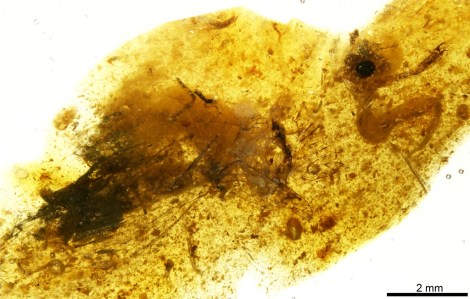
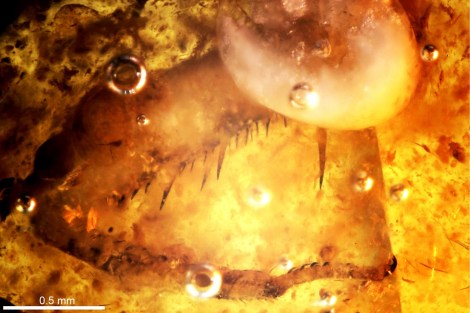
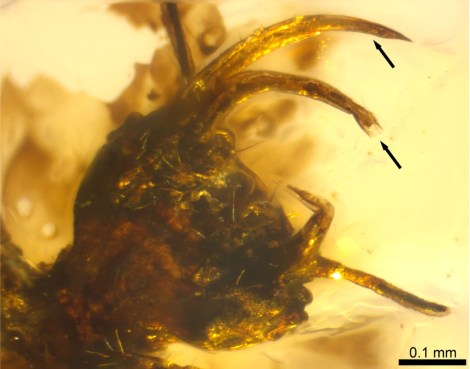
Foreleg of Aragomantispa lacerata, showing powerful spines and other structures adapted to strike and hold prey.

Extinct true mantidflies, particularly those preserved in amber, are extremely rare. Our new fossil, pictured above at the top of the article, is 105 million years old, from the Cretaceous period. It currently stands as the oldest true mantidfly known in amber. The new extinct species, named Aragomantispa lacerata, has allowed us to compare the structures of the raptorial forelegs between extinct and extant mantidflies with an unprecedented detail.

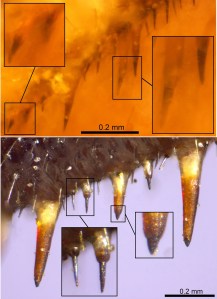
Comparison between the foreleg spine-like structures of the new fossil mantidfly (up), with those from a close modern species (bottom).

Present-day mantidflies have forelegs with spines that bear minute cones at their tip. These cones are sensory organs that elicit the striking reflex and feel the prey’s movements once captured and restrained by the mantidfly’s tight embrace.

The forelegs of Aragomantispa lack these cones at the spines’ tip, instead having larger, icicle-shaped tips. We do not know how sensitive the mantidfly forelegs were in the Cretaceous, but the spines of at least some of these insects seem to be not as specialised as those from their present-day relatives.

Some mantidflies have smaller, reclined hair-like structures forming an edge on the leg’s surface opposing the spines. These reinforced edges create a scissor effect that stuns prey when the forelegs strike. Although Aragomatispa has these structures on the forelegs, they are also different in shape to those found on extant mantidflies.

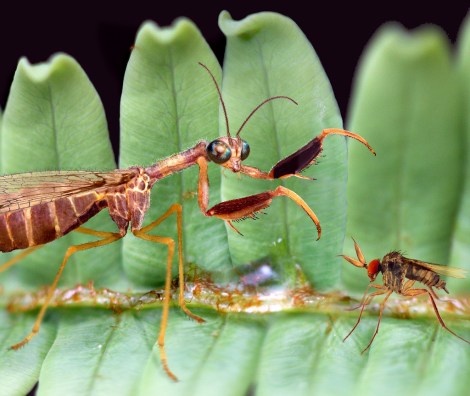
Reconstruction of Aragomantispa lacerata striking at a hypothetical prey on a fern in the Cretaceous Spanish forest.

The fossil record offers the only direct means to assess when and how the traits characteristic of a given animal group originated in time. However, this kind of fossil evidence appears very occasionally. Our discovery shows that the foreleg spine-like structures of recent mantidflies were not fully developed in at least some of their Cretaceous ancestors.

The most exciting part is to think that this story and literally thousands more lie waiting to be discovered – or otherwise forgotten forever – buried underground.

Bursting into life

By Ricardo Pérez-de la Fuente, Museum Research Fellow

One of the earliest and toughest trials that all organisms face is birth. In egg-laying animals, the egg shell that has protected the embryo during its early development ultimately becomes a hard barrier between the animal and its life out in the world. The bursting of the egg is literally a threshold moment, and there are many ways to crack an egg…

Some animals break the egg membranes using dissolving chemicals; others physically, mechanically tear their way through the shells. Among the latter, a great diversity of animals use specialised devices called egg bursters. These vary greatly among the many arthropods and vertebrates that use them, but perhaps the most famous example is the ‘egg tooth’ that is present on the beak of newborn chicks.

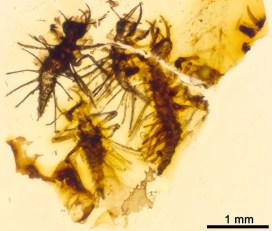
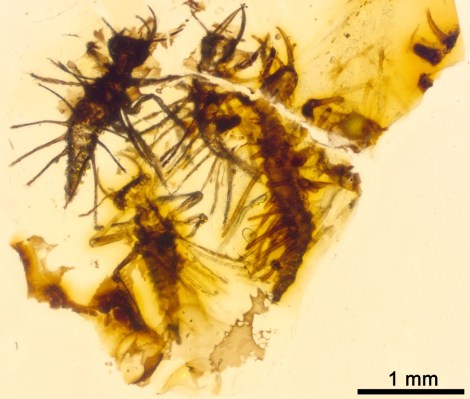
Four complete Tragychrysa ovoruptora newborns preserved together with egg shell remains and one egg burster. Modified from the open access Palaeontology paper.

My colleagues and I have found an exceptional fossil in 130 million-year-old Lebanese amber. Inside, trapped together are newborn larvae from Green Lacewings, the split egg shells from where they hatched, and the minute egg bursters that the hatchlings used to crack the egg. This is a first: no definitive evidence of these specialised egg-bursting structures had been reported from the fossil record of any egg-laying animals, until now.

The finding has been recently published as open access in the journal Palaeontology. Because multiple newborns were ensnared and entombed in the resin simultaneously, the fossil larvae have been described as the new species Tragichrysa ovoruptora, meaning ‘tragic green lacewing’ and ‘egg breaking’. A sad event, indeed, taking place in an ordinary day 130 million years ago in the Cretaceous forests of Lebanon, yet a happy circumstance now that we can take a privileged glimpse into the adaptations and behaviours of these fascinating tiny creatures.

The hatchlings from modern Green Lacewings open a slit on the egg with a ‘mask’ bearing a saw-like blade. Once used, this ‘mask’ is shed together with the embryonic cuticle and is left attached to the empty egg shell.

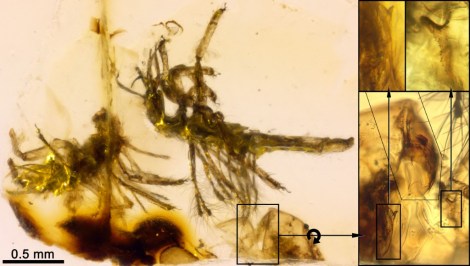
With the help of Amoret Spooner, Collections Manager at the Museum, egg clutches from modern green lacewings were found in the Museum collections. These eggs happened to have the intact egg bursters still attached to them, and proved to be crucial to understand that we had the same structures preserved in the amber together with the newborn larvae.

Two Tragychrysa ovoruptora newborns preserved together with egg shell remains and two visible egg bursters (right inset). Modified from the open access Palaeontology paper.

Green Lacewing larvae are small predators that often carry debris as camouflage, using their sickle-shaped jaws to pierce and suck the fluids of their prey. Whereas the larvae trapped in amber differ significantly from modern-day relatives, in that they possess long tubes instead of clubs or bumps for holding debris, the studied egg shells and egg bursters are remarkably similar to those of today’s green lacewings.

The larvae were almost certainly trapped by resin while clutching the eggs from which they had freshly emerged. Such behaviour is common among modern relatives while their body hardens and their predatory jaws become functional. Indeed, the two mouthparts forming the jaws are not assembled in most of the fossil larvae, which indicates, together with the large relative size of the head and legs, that they were recently born.

Detail of a head with the jaws still dislodged, indicating that the larva was recently hatched when it was ensnared by amber and the jaws had not yet had time to fully assemble.

It may seem reasonable to assume that traits controlling a life event as decisive as hatching would have remained largely unchanged during evolution. In fact, we see in very closely related insect groups different means of hatching that can entail the loss of the egg bursters. So the persistence of a hatching mechanism in a given animal lineage through deep time can’t be determined without direct proof from the fossil record.

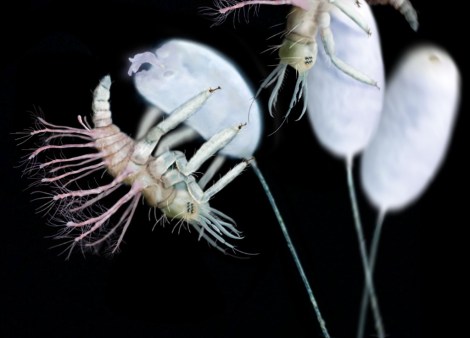
Reconstruction of two Tragichrysa ovoruptora newborns clutching the eggs from where they recently hatched, moments before they were trapped by resin. Larvae colour and egg stalks are conjectural. Extracted from the open access Palaeontology paper.

This new discovery shows that the mechanism green lacewings use to crack the egg was already established 130 million years ago. Overall, it represents the first direct evidence of how insects hatched in deep time, egg-bursting their way through into life.

*

The hatching mechanism of 130-million-year-old insects: an association of neonates, egg shells and egg bursters in Lebanese amber by Ricardo Pérez-de la Fuente, Michael S. Engel, Dany Azar and Enrique Peñalver is published as open access in Palaeontology this month.

Bee beautiful

Our conservator Bethany Palumbo tells us how she restored a beautiful 19th-century papier-mâché model of a honeybee hive, created by master model-maker and anatomist Louis Thomas Jérôme Auzoux

Louis Thomas Jérôme Auzoux

Although the Museum’s collections are mostly of organic specimens, we also hold a fascinating collection of scientific models made to represent the natural world, made from all types of materials, from wax and cardboard to plaster and paint.

We are lucky enough to own a model made by esteemed French anatomist Louis Auzoux (1797-1880), who in the late 19th century developed a method of building strong yet light papier-mâché models that could be taken apart and rebuilt, allowing internal elements such as tissues and organs to be studied in detail.

Model of a honeybee hive in box with six bees, by Louis Auzoux

While Auzoux made many models demonstrating human anatomy, he later expanded his business to include magnified models of plants and insects. The model we have is of a honeybee hive, containing six beautiful bees.

The hive, painted with a protein-based paint and varnished with gelatine, is large enough to allow the viewer to see the fine details of the hive, including individual chambers containing tiny larvae.

As you can see in the image at the top of the article, the bees themselves are also intricately painted, with rabbit hair used to simulate their natural fuzz, and delicate wings constructed from metal wire.

While there was much to admire about this model, it was in received in poor condition. Previous restoration attempts had introduced many materials that were now failing. There were fills, constructed of paper, applied to areas in an attempt to hide cracks in the original model. These were covered in oil paint, which was dripping over the original paintwork and had become brittle and discoloured.

Oil paint layers were peeling from the model

The whole hive was coated in a layer of cellulose nitrate film, a popular coating in the mid-20th century which was used as protection and to create a gloss finish. This coating doesn’t age well, resulting in peeling. It had also been applied to the bees themselves, clumping together the bee ‘fuzz’ and disguising the paintwork underneath.

The priority for treatment was to return the model to its original form while stabilising it for the future.

I undertook treatment in several stages over the course of six months. First, the cellulose nitrate film was removed from all areas using acetone, which could be applied with a cotton bud and fortunately didn’t affect the paint layer beneath.

Fill material used to cover previous damage had become discoloured

The next stage was to remove the discoloured oil paint from the hive. This was done manually using metal and wooden tools lubricated with white spirit, which were used to gently scrape the surface under magnification. This revealed old fills on the hive, made from a combination of plastic tape, paper and old adhesives which also needed to be removed. They were easily softened with water and gently peeled away.

Once all unstable introduced materials were removed, work began to stabilise the original model. The bees were suffering from paint cracking and peeling, as seen in the magnified photograph below.

Peeling paint at 6x magnification

We decided to consolidate this using gelatine as it would be in keeping with the original construction and could easily be reversed if necessary. Gelatine was mixed in water and warmed to make it a thin consistency, and then applied with a paintbrush. Once the paint flakes had softened they could be gently pressed down. Gelatine was also used with acid-free tissue to stabilise the cracks and areas of surface loss on the hive.

With the hive and bees now clean and stable, the quality of this piece and its incredible paintwork can really be admired. We hope to put it on display soon for all our visitors to enjoy!

Marvellous Mantodea

In the latest display in our Presenting… series, collections manager Amoret Spooner takes a look at the wonderful and sometimes strange world of the praying mantis.

Praying mantis is the common name given to an order of insects called Mantodea, a word which derives from mantis meaning prophet, and eidos meaning form or type. The more familiar ‘praying mantis’ refers to the striking way that they hold their large forelimbs, in a ‘praying’ posture.

Display of different mantis species

There are over 2,400 species of mantis worldwide, split into 21 different families. The image above shows their incredible diversity of colour, shape and size. But while they may differ in appearance, their biology and many behavioural traits are the same.

Mantis are predators of insects, including other mantis, but larger species will eat small lizards and birds. But they are perhaps best known for being cannibalistic. This behaviour is most commonly seen in nymphs straight out of the egg case, or ootheca, but it can also occur when the female eats the male after mating. However, cannibalism is not required to mate, so when it happens it’s usually because the female is hungry!

The egg case, or ootheca, of mantis vary greatly depending on the size and behaviour of the species.

Revisio Insectorum Familiae Mantidarum was one of John Obadiah Westwood’s greatest works. Thankfully he kept all of his drawings, annotated pages and notes for the publication, allowing us an insight into the years of work he put into its production.

Praying mantis are ambush hunters, either camouflaging themselves while waiting for their prey to approach, or actively stalking prey. Their compound eyes are specialised in perceiving motion, and are widely spaced giving them a wide field of vision. Along with powerful front legs and an ability to move the head up to 180°, this makes them successful predators.

The Museum’s archive contains original drawings and annotations by John Obadiah Westwood (1805–1893), the first Hope Professor of Zoology. As a renowned scientist Westwood described many new mantis species, and he was also a talented artist.

The Presenting… Marvellous Mantodea case is on display at the Museum until 1 November 2018.