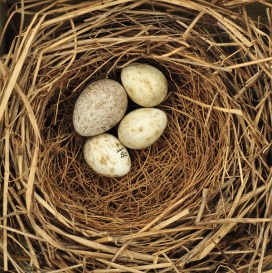
Odd egg out

This is a great time of year to hear the distinctive call of the Cuckoo (Cuculus canorus) as it spends the summer in the UK. Collections Manager Eileen Westwig recently shared Cuckoo specimens with the public in one of our Spotlight Specimens sessions. You missed it?! No problem, here she is with the fascinating story of this threatened bird…

Cuckoos could be described as absent mothers, laying their eggs into the nest of a ‘host bird’, such as Dunnocks, Meadow Pipits, Garden Warblers, Whitethroats or Flycatchers. When she finds a suitable nest, the female Cuckoo will remove one of the host’s eggs and lay hers in its place. She lays between 12 and 22 eggs in a season, all in different nests. No worries befall her about building a nest, brooding out any eggs or raising her young as she leaves it all to strangers. One challenge for the Cuckoo is to make sure her trickery is not discovered.

When the female host returns to her nest, she will inspect it for any changes and if she discovers the intruder’s egg, she will simply toss it out. So the female Cuckoo has to be pretty good at forgery and mimic the host bird’s egg ‘signature’, copying the colour, pattern and shape of the original eggs. This is the only way to get away with her ‘brood parasitism’. Around 20% of Cuckoo eggs never make it. In the top picture, you can see the nest of a Garden Warbler with three Warbler eggs and one larger Cuckoo egg, on the top left.

An adult Garden Warbler (Sylvia borin borin) can reach a weight of 16-22g with a wingspan of 20-24.5cm

After twelve days, the Cuckoo hatches and pushes the other nestlings out. As the single remaining occupant of the nest, it has the full attention of the host parents, which try to feed a nestling soon outweighing. An adult Cuckoo is more than 6 times the weight of an adult Garden Warbler. The Cuckoo young will leave the nest after 19 days, but gets fed by the parents for a further two weeks. That is one busy summer.

OUMNH.ZC.11868_Cuculus_canorus_canorus_Eileen_Westwig
An adult Cuckoo (Cuculus canorus) can reach a weight of 105-130g with a wingspan of 55-65cm.

According to the RSPB, there are about 15,000 breeding pairs in the UK and Cuckoos are now included on the Red List, giving them the highest conservation priority. Ten years ago, numbers of this migrant bird fell by 21% and more than half of the population has disappeared in the past 25 years. Threats include damage to the bird’s winter habitats and a decline in large insect species that are its major food source.

Cuckoos migrate to West Africa over the winter months and can be seen in the UK from late March or April through July or August. Young birds leave a month or so later to give them time to grow and prepare for the long journey ahead. Wintering grounds are not exactly known but include Cameroon, Gabon and other African nations.
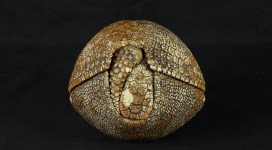
Amour for armour

If you pop in to the Museum at 2.30pm on a Monday-Thursday afternoon, you’ll meet one of our Museum experts with some of their favourite specimens. Here Eileen Westwig, Life Collections Manager, shares one of her recent Spotlight Specimens.

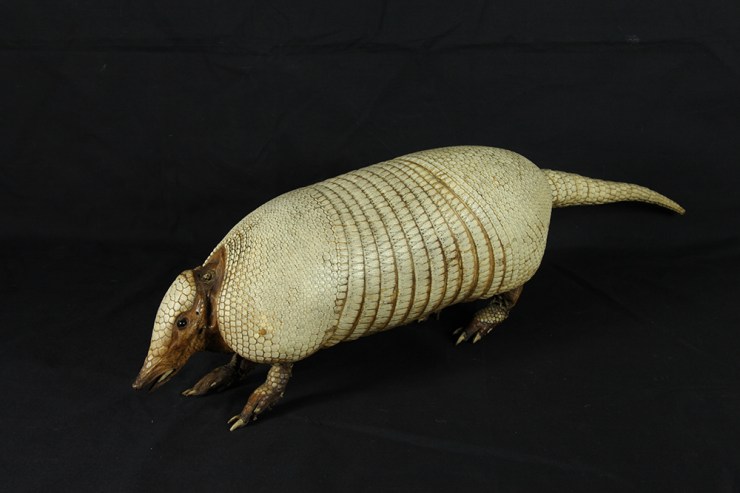
Last month, as part of our regular Spotlight Specimens activity, I chose to highlight armadillo specimens. They got lots of attention, which is not surprising considering how amazing armadillos are. The word armadillo is Spanish meaning ‘little armoured one’. It is true that all armadillos have armour wrapping around their body as protection. Their size, however, varies a lot. The smallest one is the Pink Fairy Armadillo (Chlamyphorus truncatus), which grows up to 18cm (including tail length) and weighs up to a tiny 100g. At the other end of the spectrum, the aptly named Giant Armadillo (Priodontes maximus) is the largest, and can grow up to 150cm (head to tail) and weigh up to 60kg.

Giant Armadillo from the OUMNH collection. Sharp, big claws help to scratch and dig for food, such as tubers and termites, and dig burrows for sleeping.

Armadillos are found in South and Central America. However, the common Nine-banded Armadillo (Dasypus novemcinctus) has spread over the last hundred years, all the way into the southern United States. What makes it so successful is its varied diet of tubers, termites, ant larvae and other insects, as well as snails and bird eggs found on the ground. The expanse of ranching and the absence of natural predators such as cougars have made it easy for this long-nosed armadillo to spread as far as Texas and Florida.

Beside their stiff protective armour, all armadillos are capable of curling up their body to some extent, in order to protect the soft and vulnerable underside. Only one armadillo is the true champion when it comes to rolling up tightly into a perfect sphere. This astonishing achievement can be found in the Southern Three-banded Armadillo (Tolypeutes matacus). In the picture at the top of this page, you can see two armoured triangles in the middle, which are its head (on the left) and tail (on the right).

Common Nine-banded Armadillo showing its body plates, which usually lie underneath a layer of horn.

The armour of armadillos is made out of two layers. There are bony scute plates (visible in white in the picture above) that are overlaid with horny plates. The horny plates are made of keratin, the same material as hair and fingernails.

Nine-banded Armadillo made into a basket as souvenir

Sadly the existence of this amazing creature is threatened by loss of habitat and hunting. Not only are armadillos widely eaten, they are also made into tourist souvenirs, such as this basket.

According to the Centers for Disease Control and Prevention, some armadillos from the southern USA are naturally infected with the bacteria (Mycobacterium leprae), that cause leprosy (Hansen’s disease). Most people (95%) are immune to it, but please use caution if you’re ever in a position to handle an armadillo!

A moving story

img_0737

For the past nine months there has been a lot of moving going on around here. Imagine moving house endlessly for weeks on end, but where your house is full of bones, insects, fossils, rocks, and weird and wonderful taxidermy. And the location of everything has to be precisely recorded. The museum move project was a bit like that.

Project assistant Hannah Allum explains…

The museums are migrating, we declared in May 2016. And so they have. The first major stage of the stores project has been completed. After we had created inventories for the largely unknown collections held in two offsite stores, the next stage was to pack them safely and transport them to a new home nearer the museum, a job which demanded almost 70 individual van trips! We now have over 15,000 specimens sitting in vastly improved storage conditions in a new facility.

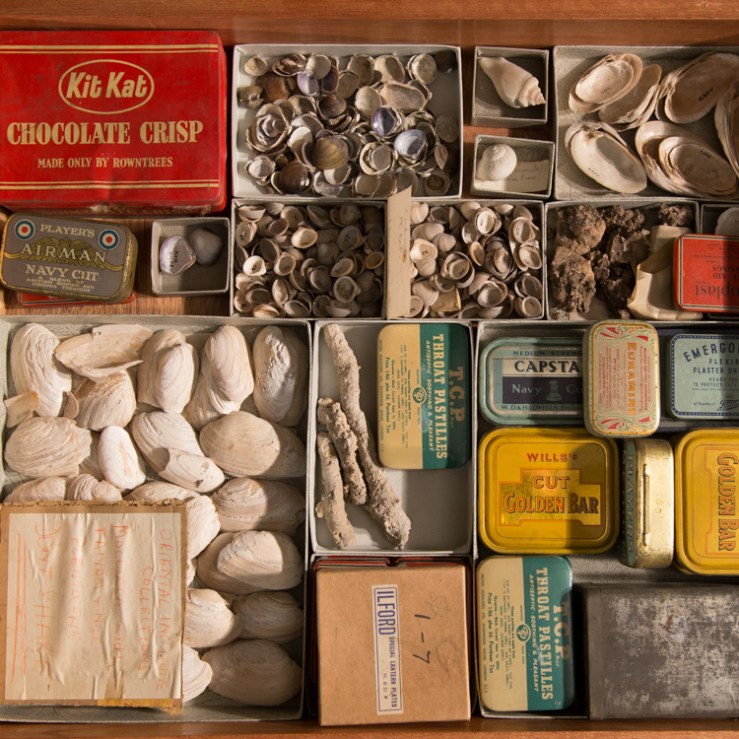
A miscellany of boxes for a collection of shells

Let’s revel in some numbers. All in all there were over 1,000 boxes of archive material, mostly reprints of earth sciences and entomological research papers; over 1,300 specimens of mammal osteology (bones); and more than 1,000 boxes and 650 drawers of petrological and palaeontological material (rocks and fossils).

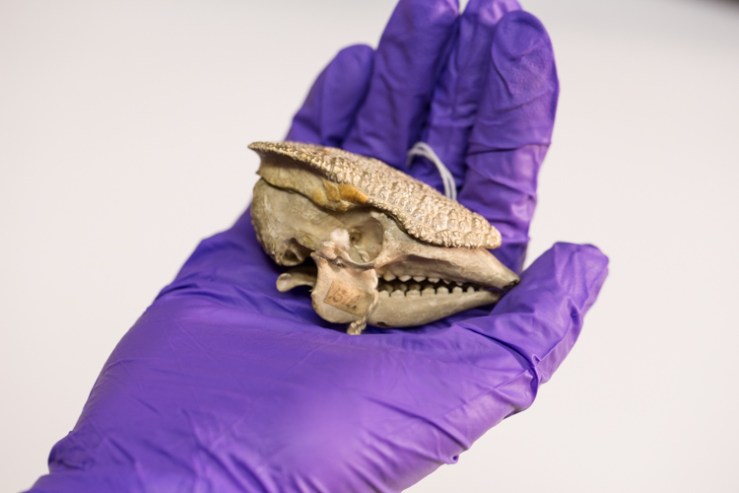
Some of the more memorable specimens include old tobacco tins and chocolate boxes filled with fossils and shells; a beautifully illustrated copy of the ‘Report on the Deep-Sea Keratosa’ from the HMS Challenger by German naturalist Ernst Haeckel; and the skull of a Brazilian Three-banded Armadillo (Tolypeutes tricinctus), complete with armour-plated scute carapace.

img_0756
The skull and carapace of a Brazilian Three-banded Armadillo (Tolypeutes tricinctus)

There were also a few objects that have moved on to more unusual homes. A 4.5 m long cast of Attenborosaurus conybeari (yep, named after Sir David) was too large to fit in our new store and so made its way to another facility along with a cornucopia of old museum furniture. A set of dinosaur footprint casts, identical to those on the Museum’s lawn, have been gifted to the Botanical Gardens for use at the Harcourt Arboretum in Oxford.

And last but not least, a model of a Utahraptor received a whopping 200 applications from prospective owners in our bid to find it a suitable home. After a difficult shortlisting process it was offered to the John Radcliffe Children’s Hospital and following a quarantine period should soon be on display in their West Wing.

Footprint casts, attributed to Megalosaurus, queuing for a lift to Harcourt Arboretum. Credit: Hannah Allum
Casts of footprints by made Megalosaurus, queuing for a lift to Harcourt Arboretum. Image: Hannah Allum

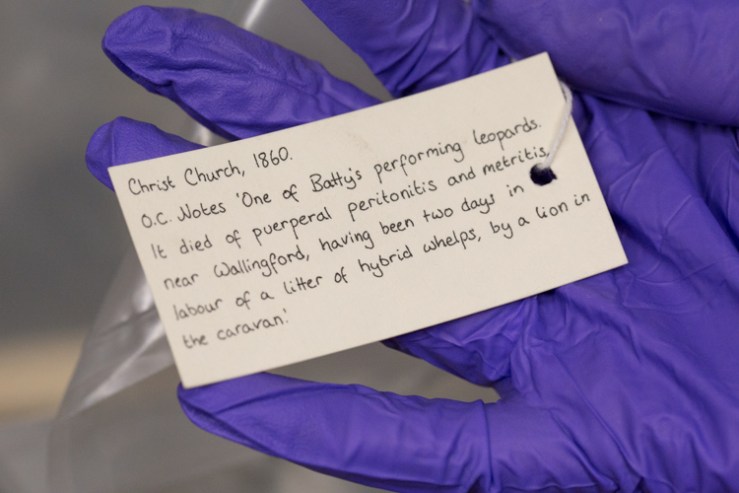
Fittingly, the final specimen I placed on the shelf in the new store was the very same one that had been part of my interview for this job: The skeleton of a female leopard with a sad story. It apparently belonged to William Batty’s circus and died of birthing complications whilst in labour to a litter of lion-leopard hybrids before ending up in the Museum’s collections in 1860.

img_0760
The sad story of a performing leopard

Though the moving part of this project is now complete there is still plenty of work to do. We are now updating and improving a lot of the documentation held in our databases, and conservation work is ongoing. The new store will also become a shared space – the first joint collections store for the University Museums, complete by April 2018.

To see more, follow the hashtag #storiesfromthestores on Twitter @morethanadodo and see what the team at Pitt Rivers Museum are up to by following @Pitt_Stores.