Tongue-testing fossils, Victorian-style
IMG_9692

by Anna Dewar, Museum intern

Victorian geologist William Buckland had an impressive knack for finding fossils. He named the first dinosaur, Megalosaurus bucklandii, in 1824 after its discovery in Stonesfield near Oxford. You can see the Megalosaurus fossils on display in the Museum today.

Working as an intern here over the last few weeks, I have been confronted with hundreds of Buckland’s specimens, many of which have never been catalogued.

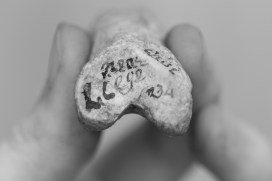
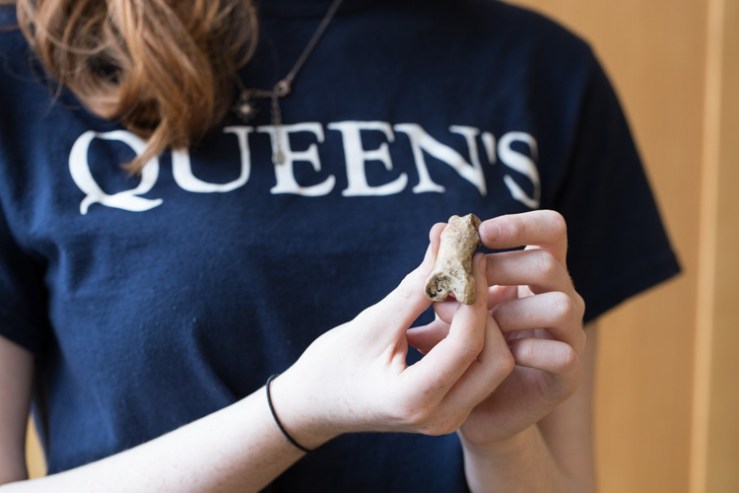
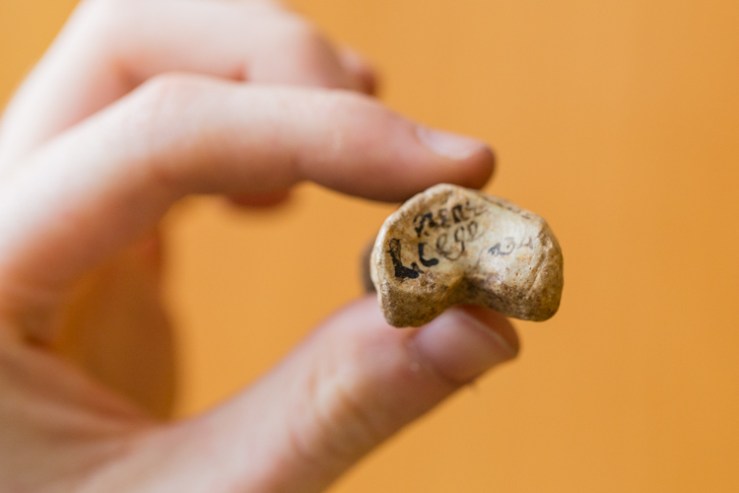
A couple of weeks ago I stumbled upon a cave bear toe bone, or phalanx, with a very unusual label. Written in Buckland’s handwriting was ‘Cave Bear Liège’ and the number ‘234’. No other fossils in this collection were numbered, and after a database search not one other specimen had been found near this Belgian city.

I then discovered something that, while it could be coincidence, demanded further investigation. On page 234 of Lyell’s Principles of Geology, Vol. II, published in 1832, appears the only mention of Liège in the entire book:

In several caverns…near Liège, Dr. Schmerling has found human bones in the same mud…with those of the…bear, and other… extinct species.

The mysterious ‘234’ perhaps references this page number; if so, it would indicate that the specimen was one of those Philippe-Charles Schmerling had discovered. But if this is the case, how did this fossil end up in Buckland’s possession?
IMG_9687
Anna holds the fossilised cave bear phalanx, or toe bone, showing the word ‘Cave Bear Liège’ and ‘234’ in William Buckland’s handwriting

After some further research, I learned that Schmerling presented his Liège findings to a group of naturalists including Buckland in 1835. Schmerling argued that the human bones he had discovered were also fossils, and so the same age as the bones of extinct animals.

Buckland countered Schmerling’s claim by saying that “these animals lived and died before the creation of man” and that, instead, the human remains found alongside extinct species could be explained by burial. French geologist Élie de Beaumont, who was present at the meeting, remembered how Buckland chose to voice this opinion:

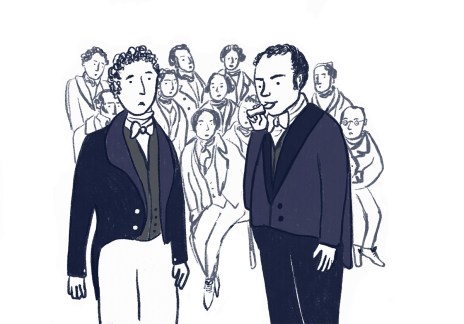
Mr Buckland took a bear bone, and put it on the tip of his tongue, to which it remained suspended…and, turning to…the assembly, Mr Buckland repeated many times…: ‘You say that it does not stick to the tongue!’ Mr Schmerling tried a few times to stick to his own tongue several human bones, but he did not succeed.
Buckland tongue test illustration_Ellena Grillo

An entirely speculative artist’s impression of William Buckland’s ‘tongue test’ demonstration

Whilst speaking to a crowd with a fossil on your tongue seems odd, Buckland did have reason. It was difficult to estimate the age of a specimen, and this ‘tongue test’ supposedly related to the mineralisation of the bone: if it stuck to your tongue, it was a fossil; if it didn’t stick, it was bone.

While Schmerling was left humiliated, it was realised after his death that he had found human fossils after all, including those of a Neanderthal. Obviously the tongue test was not as foolproof as Buckland believed.

While we’ll never know for sure, Buckland, by writing ‘234’, may have linked this bone from Liège to Schmerling.  It also happens to be a bear bone, small enough that it could conceivably adhere to a tongue. Could Buckland have slipped it into his pocket after his demonstration? Or perhaps for Schmerling, the bone, after having been coated in Buckland’s saliva while he himself stood humiliated, may have somewhat lost its appeal.

Whether or not this bone is THE bone at the heart of this spectacle, it does seem that life as a palaeontologist in the 19th century certainly wasn’t boring.

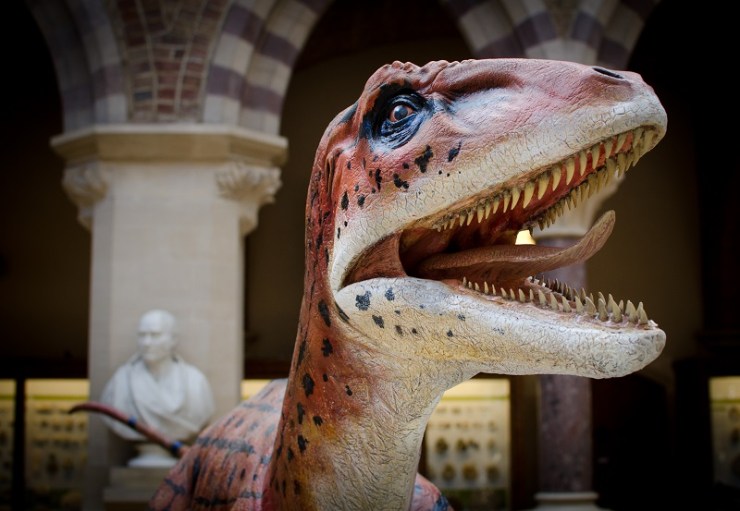
Dinosaur WLTM friendly new carers

DSC_8255 small

It’s not often that one of our residents flees the roost to take up home elsewhere: usually once you’re in the Museum that’s it, accessioned for life (or, more accurately, death). However, one of our former dinosaur aisle characters is now looking for a new home…

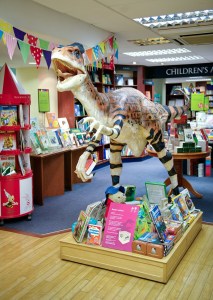
The four-metre long Utahraptor model has been with the Museum since 2000, during which time it escaped to take up temporary residence in Blackwell’s book shop in Oxford city centre as part of the award-winning Goes to Town project. This time, however, the Utahraptor will be leaving us for the last time as part of a reorganisation of the Museum’s offsite store, where the model is currently residing.

The Utahraptor model in Blackwell's bookshop as part of the Goes to Town project. Photo: Mike Peckett
The Utahraptor model in Blackwell’s bookshop as part of the Goes to Town project. Photo: Mike Peckett

But rather than just ditch this Cretaceous creature unceremoniously we’d like to offer it out to new keepers, ideally somewhere with a public space where the model can be enjoyed by others. So, fancy yourself as a dinosaur owner? If so, check out our selection form for details of what it takes to keep such a pet.

We’re asking people to make a case for the Utahraptor to move to their venue and we will donate the model free of charge to whoever is selected. The closing date for submissions is 5 August and the selected venue will be announced by 12 August. We need to deliver the model to its new home on or before 23 September.

Get me outta this place!
“Get me outta this place!” – the Utahraptor is currently in the Museum’s offsite storage

At this point you probably want some Utahraptor facts to help with your decision, right? Well, here you go:

Utahraptor means ‘Utah’s predator’ and the animal is known from fragmentary fossils found only in Utah in the United States. There is just one known species, Utahraptor ostrommaysorum, which was alive in the early Cretaceous period, around 125 million years ago.

It is thought that like most dinosaurs of its type (dromaeosaurids) the Utahraptor was feathered, although no direct evidence has yet been found. The Museum’s model, made by Crawley Creatures, does not represent a feathered example of this species. It’s likely the beast was not bright orange too, but who knows?

We looking forward to reading your submissions…

www.bit.ly/utahraptor

For more information email communications@oum.ox.ac.uk.

Art of glass

Spotlight Specimens by Mark Carnall

From the comfort of our own homes, or even on a mobile device, we are accustomed to watching video footage from the most remote environments on Earth, and beyond. It is easy to take for granted this kind of visual access but we don’t have to go too far back in time to reach a point when the uninhabitable parts of the world remained much more mysterious. Then, the only windows into the nature of exotic locations were through drawings, paintings or collected specimens.

In museums, illustrations of nature were – and are – used in teaching to show what certain animals or environments look like. Along with our biological specimens, the Museum’s collections contain representations of animals whose natural appearance is not preserved after death, including a set of beautiful glassworks of British sea anemones.

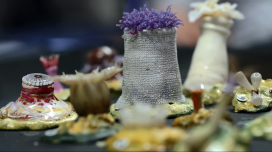
These delicate models were created by the Blaschkas, a family which specialised in glasswork and ran a business spanning 300 years and nine generations. But it was only from the late 19th century that Leopold Blaschka, later to be joined by his son Rudolf Blaschka, turned his skills to making models of microscopic organisms and soft-bodied invertebrates for museums and universities.

Blaschka anemones still
The only Blaschka models at the Museum today form a series of British anemones, many of which are recognisable as the species and even individual animals illustrated in British Sea-Anemones and Corals published in 1860 by Philip Henry Gosse

Inspired by zoological specimens, scientific papers, and observation of living animals, as well as artworks showing colours and structures that were difficult to preserve or too small to show, the Blaschkas created thousands of glass models before they accepted a contract in 1886 to work exclusively at Harvard University on the Ware Collection of plant models.

historyofbritish00goss_0299
Plate from Philip Henry Gosse, 1860. British Sea-Anemones showing many of the species in the Oxford University Museum of Natural History series. Public domain image from the Biodiversity Heritage Library. http://www.biodiversitylibrary.org

It is somewhat surprising that these incredibly fragile specimens made their way to museums and universities across the globe back in the 19th century and even more surprising that any have survived 150 years later.

Anemones tend to lose their shape and colour when preserved in fluid

Earlier this year the Corning Museum of Glass published an interactive map of marine invertebrate models showing the known locations of collections, or records of collections, of Blaschka glass models.

The models at the Museum, acquired in 1867, are thought to be some of the oldest surviving Blaschka glass models. Even though they are over 150 years old, and in some cases slightly inaccurate representations of species, they still show the vibrant colours and alien shapes of British anemones in a way that can’t be seen outside their living environments.

Climbing down the primate family tree

This is the first in a short series of articles to accompany the new Stone Age Primates temporary display at the Museum, created with the Primate Archaeology group at Oxford University. Here, Michael Haslam, ERC Senior Research Fellow in Primate Archaeology, outlines the importance of this emerging field of study.

Humans evolved over millions of years. You can see displays about this in natural history museums all over the world, usually with skulls of extinct ancestors such as Homo erectus. Alongside these bones there are often stone tools of various shapes and sizes, showing how our technology has also changed over time. Ultimately, human tool use has led all the way from sticks and stones to the computer, phone or tablet that you’re using to read these words.

However, for all those millions of years other members of our family were evolving too. What if we had an archaeological record for non-human animals as well? The Primate Archaeology project at Oxford University exists to answer this question.

Rise of Modern Humans display
‘The Rise of Modern Humans’ display in the Museum

Primates, the group that humans belong to, also includes apes and monkeys, as well as more remotely related animals such as lemurs. Yet when we see these animals in museums, they very rarely have a set of their own extinct ancestors on display, or any examples of the technologies that they have developed.

Why not? For one thing, it is difficult to find fossil ancestors of animals that live mostly in tropical forests because their bones aren’t preserved well in that environment. And most primates, like most animals, don’t use tools in the wild, so there is nothing left behind to tell us about their past behaviour.

But there is another reason. We view the human past as a series of ancestors evolving towards the way we are now; yet we tend to see monkeys and apes as unchanging over time. If asked to imagine a chimpanzee three million years ago, you would probably picture something that looks like a chimpanzee today. But modern chimpanzees didn’t exist back then, just as modern humans didn’t.

Wild chimpanzee at Bossou, Guinea. Photo by Michael Haslam.

The main reason we think of humans as changing and evolving is because of the archaeological evidence that we’ve collected. As we discovered more and more bones and stones it became clear that dozens of human ancestor species have lived on Earth, including close relatives such as the Neanderthals in Europe and Asia.

A hammerstone used by a capuchin, on display in the Museum

So what would we find if we looked for the archaeology of other primates? They don’t build cathedrals, or use pottery or metal, and they don’t leave behind written messages like the Egyptians, Maya or Romans did. That’s a problem. But the solution to the problem is actually the same one that archaeologists have always used for human ancestors: find the stone tools.

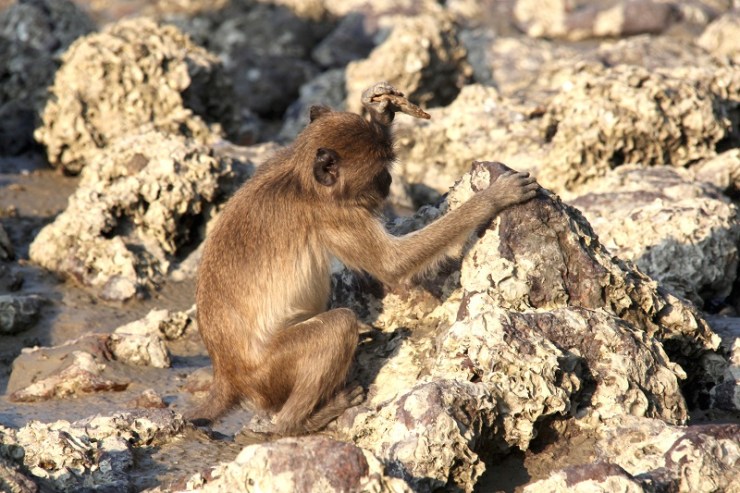
There are three types of wild primate that use stone tools: the chimpanzees of West Africa (Pan troglodytes verus); the Bearded Capuchin monkeys of Brazil (Sapajus libidinosus); and the Burmese Long-tailed Macaques of Southeast Asia (Macaca fasciaulria aurea). They mainly use stones as hand-held hammers, to break open hard foods such as nuts and shellfish. The capuchins also use stones to dig in the hard ground, which helps to protect their fingers when searching for roots or spiders to eat.

Wild long-tailed macaque using a stone tool at Laem Son National Park, Thailand. Photo by Michael Gumert.

The Primate Archaeology Project was set up at Oxford University in 2012, supported by the European Research Council. Since that time, our team has spent many months watching these animals use stone tools in the wild. We record how they select certain sizes and types of stones (you wouldn’t use a soft sponge as a hammer, and neither would they!), and how they carry their tools around from job to job like a modern tradesman. We used these observations to work out what primate tools look like today, and then we went digging into the past.

We found macaque tools buried in beach sands in western Thailand, and ancient capuchin tools in the forests of northeast Brazil. In both cases, we recognized the tools because they were similar to ones still in use today. Importantly, we also found that the tools were damaged in very particular ways by the monkeys that had used them, because hitting hard things together usually means that one of them gets broken.

Primate archaeology excavation, Serra da Capivara National Park, Brazil. Photo by Michael Haslam
Primate archaeology excavation, Serra da Capivara National Park, Brazil. Photo by Michael Haslam.

We used radiocarbon dating to work out that the archaeological capuchin tools were at least 600 years old. That means that there were monkeys sitting around in Brazil with stone hammers, cracking and eating nuts, before Christopher Columbus ever left Europe. Previous excavations in the Ivory Coast have found even older primate tools – chimpanzees there were using stone hammers more than 4,000 years ago!

Primate archaeology is still a new research field, with more questions than answers, but then so was human archaeology when it began. We really don’t know what technology apes and monkeys were using during the millions of years that they have evolved, but we are taking the first steps towards solving that mystery.

Stone Age Primates display in the Museum

Working with the Museum, the Primate Archaeology project team has put together a new temporary display, ‘Stone Age Primates’, to sit alongside the current human evolution cases in the Museum. In the display you can learn more about the research and see tools used by primates past and present. You can also follow the group on Twitter @primatearch.

Cicada serenade

A Spotlight Specimens special for Oxford Festival of Nature

by Leonidas-Romanos Davranoglou, DPhil student, Animal Flight Group, Department of Zoology, University of Oxford

Anyone walking on a summer day in hot places such as the Mediterranean or the tropics will have heard cicadas singing. Cicadas actually are among the loudest of all animals, singing at up to 120 dB – as loud as a passing freight train. In fact, you can damage your ear if a particularly loud species starts singing next to your head.

Some countries even have health and safety policies which prevent people from working outdoors when cicadas are singing. If a single cicada can sing that loud, you can imagine what a forest filled with them sounds like!

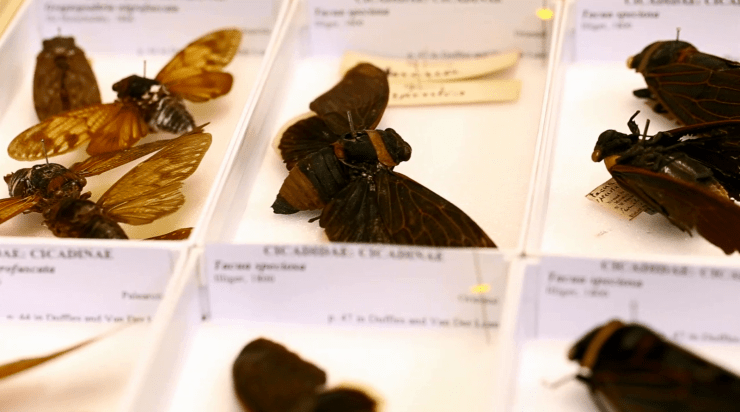
Tropical cicadas from the Museums' collections
Tropical cicadas from the Museums’ collections

Only male cicadas sing, primarily to attract females, much like a Romeo singing to his Juliet. Females are mute, but they respond to males of their liking by flicking their wings, generating a loud click. Entomologists often mimic the female response by snapping their fingers under a tree containing cicadas. In this way, they can collect males eager to mate, which would otherwise be too high in the tree to reach.

An unpleasant parasitic fungus capitalises on this arrangement: The fungus basically consumes the innards of the male cicadas, causing their private parts to fall off – in effect castrating them. A castrated male may stop singing and as a result, other males try to mate with it, and in this way the fungus is transmitted from male to male.

But how do these famous (or notorious, if you find them annoying) cicadas produce these incredible sounds? This has remained a mystery since the time of the ancient Greeks, who admired these animals. But the matter was settled through a collaboration between Oxford University and Australian scientists. The physical process is not too complex and you can get a good idea how it works by using an empty plastic bottle.

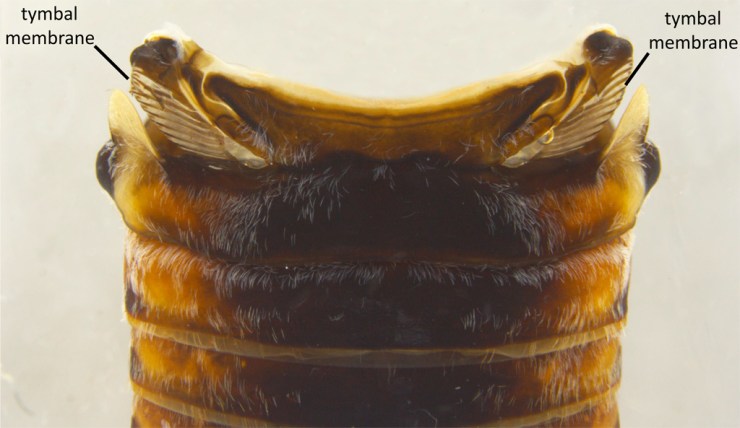
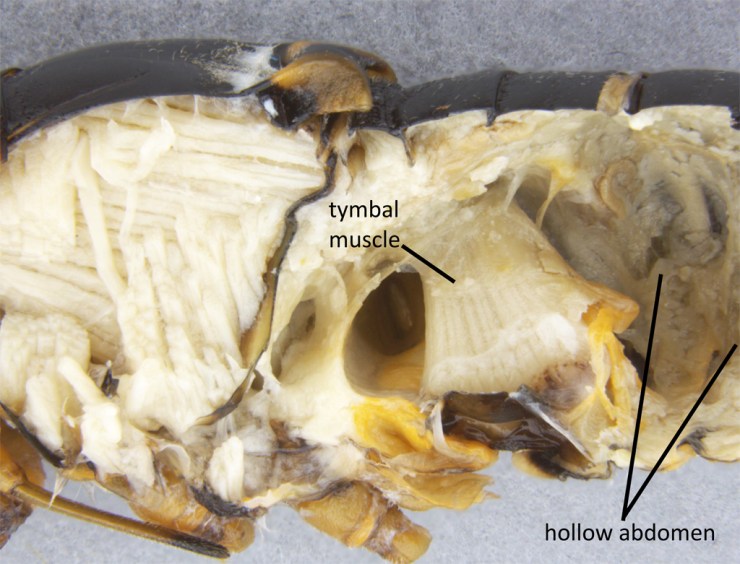
Cicadas have a unique membrane on the sides of their abdomen called the tymbal membrane, which is strong but flexible. Internally, two huge muscles attach to this membrane. When the muscles contract, they pull and buckle the membrane inwards to produce a strong popping sound. You can imitate this by squeezing an empty plastic bottle in and out. Speed up this process by a few hundred buckles per second and you get a cicada’s song.

PowerPoint Presentation
Dorsal view of the abdomen of the cicada Cicadetta flaveola, showing the two membranes on the sides of the abdomen (tymbal membrane).
Lateral view of a dissected cicada, Tibicen plebejus. The huge muscle attaches to the tymbal memembrane, and pulls it inwards to generate a loud click. Note that after the large muscle, the abdomen is largely hollow.
Lateral view of a dissected cicada, Lyristes plebejus. The huge muscle attaches to the tymbal memembrane, and pulls it inwards to generate a loud click. After the large muscle, the abdomen is largely hollow.

Producing sound however, is not enough. Just like we have to talk with a particular loudness so people can hear us, cicadas must find ways of amplifying their sound, so females can hear them from very far away. The way cicadas achieve this is via something called Helmholtz resonance. You can create this phenomenon by blowing air across the top of the empty bottle you just used to create the pop.

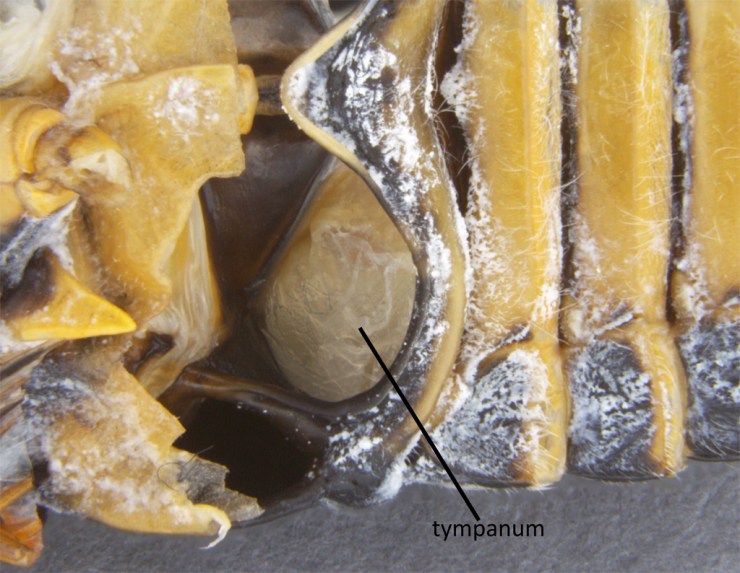
Blowing across a bottle produces sound due to the behaviour of air when it is confined in a container with an open hole. The abdomen of cicadas forms a Helmholtz resonator as well: it is completely hollow, and two openings on the underside, called tympana, act as the top of a bottle and radiate sound in the same way.

Ventral view of a dissected cicada, Tibicen plebejus. The large aperture is the tympanum, which acts as the amplifier for the cicadas' song. The hole of an empty bottle behaves in the same way when you blow air over it.
Ventral (underside) view of a dissected cicada, Lyristes plebejus. The large opening is the tympanum, which acts as the amplifier for the cicada’s song. The hole of an empty bottle behaves in the same way when you blow air over it.

The singing habits and unique anatomy of the cicadas are perhaps best summarized in a quote by 19th-century entomologist Jean Henri Fabre, who, poetically as always, said:

Assuredly one must be passionately devoted to music thus to clear one’s internal organs in order to make room for a musical box!

OFoN_logo_green block_small

Invasive crayfish

A Spotlight Specimens special for Oxford Festival of Nature

By Sancia van der Meij, Research Fellow

The White-Clawed Crayfish (Austropotamobius pallipes) is often assumed to be native in the UK, but was in fact brought across by monks in the Middle Ages from northern France

In the 1970s this was joined by a further seven invasive crayfish species from other parts of the world, but mainly from North America. Some of these species have a very restricted distribution in the UK, such as Procambarus acutus which is only known from a single pond in Windsor.

The most widespread of these is the Signal Crayfish, Pacifastacus leniusculus, which was introduced to Europe in the 1960s and reached the UK by 1975. It is now widespread in waterways around England, Wales and parts of Scotland. There are records of Signal Crayfish from all over Oxfordshire, in the River Thames, River Cherwell, canals and ponds, and they are fished for by many people as sport or food.

The Signal Crayfish is so named because of the blue-white patches on the underside of its claws, next to the finger joint. It is the easiest invasive species to identify given its large size, smooth carapace and signal spots.

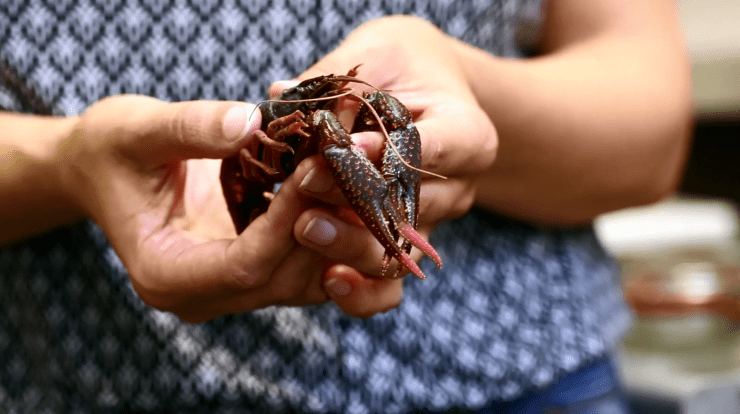
The Red Swamp Crayfish (Procambarus clarkii), from North America, is an invasive species in the UK

There are a number of information sites to help with identification such as the UK Crayfish Hub run by Buglife. The Non-Native species website runs a recording scheme for sightings of all invasive species too. Don’t worry though, the huge Tasmanian Giant Crayfish (Astacopsis gouldi) shown in the video clip has not made it to our waterways!

Whilst increased levels of water pollution and habitat degradation, fragmentation and loss have played their part in the decline of many crayfish populations, several species are also significantly impacted by the introduction and spread of a disease known as ‘crayfish plague’, a fungal disease is carried by some  North American species.

OFoN_logo_green block_small