Diving into deep time

Our current First Animals exhibition is extending its run until 1 September, and to mark the extension our Research Fellow Imran Rahman takes a look at how animal life in the ancient oceans was brought to life in our Cambrian Diver interactive installation.

One of the biggest challenges in developing the First Animals exhibition lay in visualising rare fossil specimens as ‘living’ organisms, transforming them from two-dimensional imprints in the rock into three-dimensional animated computer models.

Many of the specimens on display in First Animals were collected from sites of exceptionally well-preserved fossils called Lagerstätten. These deposits preserve the remains of soft-bodied organisms that are almost never seen in the fossil record; things such as comb jellies and worms, as well as soft tissues such as eyes, gills and muscles. Even so, most of these fossils are flattened and two-dimensional, which makes it very difficult to reconstruct what they looked like in life.

Vetulicola cuneata from the Chengjiang fossil site had a large body with triangular openings on either side and a segmented tail. Its three-dimensional shape is uncertain.

To help exhibition visitors visualise the animals in a living environment we worked closely with Martin Lisec and his team at Mighty Fossils to create a set of detailed computer models of a key set of animals. We have worked with Martin before on the video of a Jurassic sea inhabited by plesiosaurs and other marine animals for our Out of the Deep display. That was very successful, but our idea for First Animals was even more ambitious: to create a unique interactive installation called the Cambrian Diver.

The material focused on the Chengjiang animals from the Cambrian of Yunnan province, China, which provides the most complete record of an early Cambrian marine community, from approximately 518 million years ago. Using fossil evidence of the organisms thought to have lived at the time we selected 12 species that were representative of the diversity of the Chengjiang biota.

The first phase was collecting as many materials as possible to be able to create 3D models. As usual, we started with rough models, where we set basic dimensions, shapes and proportions of body parts. Once approved, we moved to very detailed models for the animations, artworks and textures for less detailed models to be used within the interactive application. – Martin Lisec, Mighty Fossils

Images showing a preliminary 3-D model of the lobopodian Onychodictyon ferox in multiple views, with annotations in yellow highlighting changes suggested by Museum researchers.

To provide two-dimensional templates for Mighty Fossils to work from we scoured the scientific literature for the most recent accurate reconstructions available for each of the species.

The predatory arthropod Amplectobelua symbrachiata is a good example. We drew heavily upon a 2017 paper by Dr Peiyun Cong and colleagues, which included a very detailed reconstruction of the head region. This reconstruction shows that the underside of the head of Amplectobelua consisted of a rod-shaped plate, a mouth made up of two rows of plates, and three pairs of flaps with spiny appendages, all details that are included in our 3D model.
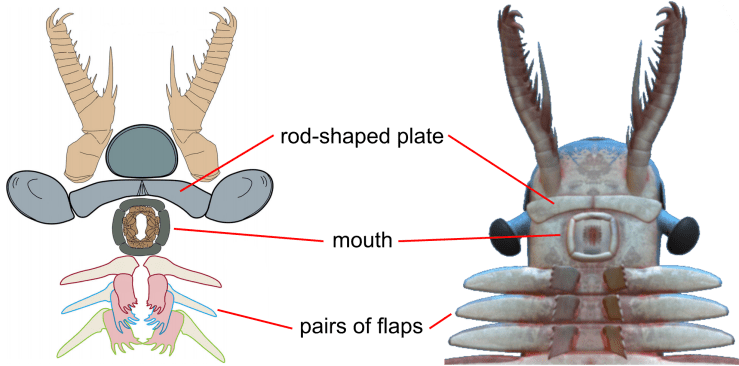
Scientific reconstruction (left) and our 3D model (right) of the arthropod Amplectobelua symbrachiata. Left-hand image modified from Cong et al. (2017).

Colour and texture were another consideration. To inform these we looked at living species that are thought to have similar modes of life today. For Amplectobelua, a free-swimming predator, we examined the colouration of modern marine predators such as sharks. Many sharks have countershading, with a darker upper side of the body and a lighter underside, which acts as camouflage, hiding them from potential prey.

We reconstructed our Amplectobelua model with similar countershading camouflage, with blue and red colouration inspired by the peacock mantis shrimp, a brightly coloured predatory arthropod that lives in the Indian and Pacific oceans.

3-D model of Amplectobelua in angled upper (top) and lower (bottom) views, showing countershading.

The next vital step was establishing how the animals moved and interacted with one another. This is a major challenge because in many cases there are no modern equivalents for these extinct early animals. For Amplectobelua we inferred that the flaps on the sides of the body were used for swimming, with the tail fan helping to stabilize the animal as it moved through the water. This agrees with previous interpretations of swimming in closely related animals such as Anomalocaris.

The models were built and textured by Mighty Fossils using the 3D gaming engine Unity. The video below is an accelerated sequence showing how the elements of the model are layered together.

The finished, animated and annotated Amplectobelua model is shown below, and can be zoomed and rotated. All the models generated by Mighty Fossils for the First Animals exhibition are gathered in a collection on our Sketchfab page.

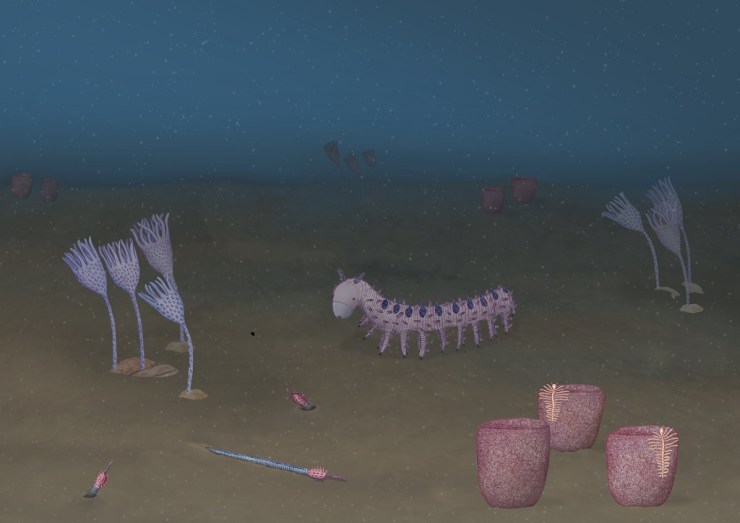
Once animated models of all 12 species were created we placed them in a realistic marine environment. Study of the rocks preserving the Chengjiang fossils suggests these animals lived in a relatively shallow, well-lit sea, perhaps 50 metres deep and characterised by a flat, muddy seafloor. A continuous shower of organic particles is thought to have filled the water column, as in modern oceans.

Reconstruction of the Cambrian seafloor with ‘marine snow’

Based on present-day marine ecosystems, we infer that the number of immobile suspension feeders would have been much greater than the number of predators. As a result, we included multiple individuals of the suspension feeders Cotyledion, Saetaspongia and Xianguangia, which were tightly grouped together, but only a small number of the active predators Amplectobelua and Onychodictyon.

This scene is now populated with animals, including two predators: Amplectobelua (swimming) and Onychodictyon (centre)

The final step involved setting up a camera and user interface to allow visitors to discover the various animals in our interactive environment. For this we worked with creative digital consultancy Fish in a Bottle to identify eight locations, each focused on a different animal.

As the video above shows, users can navigate between locations by touching an icon on the screen, and when the Cambrian Diver sub arrives at a location information about the animal, its mode of life and its closest living relatives is presented on-screen. A physical joystick allows users a 360-degree rotation to look around the scene, and explore the ancient watery world.

This project was significantly bigger than the Out of the Deep work we had done previously with the Museum, mainly because of the complicated approval procedure needed for 20 individual 3D models. Along with three large illustrations, two animations and the interactive application this was a big workload! Fortunately, we managed to finish the whole project on time for the opening of the exhibition. – Martin Lisec

That’s Amore

By Laura Ashby and Megan MacLean, events managers

From cockroaches hissing alluringly to their mate, to smooth newts wafting intoxicating pheromones, and butterflies with eyes in their genitalia, the amorous pursuits of the natural world are enough to make St Valentine blush.

Valentine’s Day may conjure images of Cupid and his arrows, and indeed the romantic cherub of mythology has a brutal counterpart in nature. When the hermaphrodite Garden Snail (Helix aspersa) snuggles up to mate, both partners try to stab each other with love-darts in a mating duel. These darts are coated in chemicals that increase the chances of the dart-receiver’s eggs being fertilised. Love is a dangerous game: sometimes a dart misfires and hits a vital organ – a dart to the heart.

The hermaphrodite Garden Snail (Helix aspersa) fires love-darts as part of its mating ritual

Traditionally given as wedding presents in Japan, the lacy white deep-ocean glass sponge Euplectella, known as Venus’ flower basket, offers an interesting take on “…’til death do us part”. When a young shrimp pair enters the sponge to mate, they become trapped inside as they grow too large to escape. The couple then spend the rest of their lives together, caged in the sponge, whilst their offspring are small enough to leave through the small gaps and seek sponge-mates of their own.

The glass sponge Euplectella spp., also known as Venus’ flower basket

And if you forgot all about Valentine’s Day you will no doubt be panic-buying a bunch of overpriced roses on the way home, but be heartened that humans are not the only creatures that try to attract mates by presenting each other with gifts. The male Bowerbird builds a bower to attract females, decorating it with brightly coloured embellishments including flowers, leaves, stones, and even bits of plastic.

Objects from a Spotter Bowerbird bower, showing an interesting preference for white and green material

Meanwhile, male Empids (dance flies) offer a high-protein ‘nuptial gift’ – a gloopy sac called a spermatophore – for the female to eat during copulation. One theory is that females use the size of the gift as a way of choosing their mates…

Moving on from the natural world to natural historians, in 1835, Frederick William Hope married the wealthy heiress Ellen Meredith. He donated one of the founding collections to the Museum that they subsequently worked on together, the inspiration behind our current HOPE for the Future project. Meredith had recently rejected a marriage proposal from the future Prime Minister Benjamin Disraeli, stating that:

a life as the wife of a politician would have been a very dull one indeed

We at the Museum completely understand that weekends rootling around in dung for beetles with her entomologist husband seemed more appealing than stiff diplomatic receptions at Number 10.

Ellen Meredith and Frederick William Hope married in 1835

Fast forward to the modern day, and romance is in the air at the Museum, as many couples celebrate their marriages here each year. Every wedding has a different flavour, depending on the interests of the bride and groom, but natural history puns are guaranteed during the speeches, and dancing amongst the dinosaurs is a must!

A wedding in the Museum is surely the best start to a marriage

It may seem like a strange idea to tie the knot in a Museum, but perhaps 60-odd years of marriage seems comfortingly short in the context of 4.5 billion years of geological time?

If you are interested in talking with our events team about celebrating your wedding at the Museum of Natural History, contact Laura and Megan at venue@oum.ox.ac.uk / 01865 282780.

HOPE for the Future is supported by the National Lottery Heritage Fund. Find out more and get involved: https://www.oumnh.ox.ac.uk/hope-future

Top image: Gold-fronted Bowerbird, once thought to be extinct, but rediscovered in the Foja Mountains of Indonesia, painted by activist artist Jane Mutiny for the Conservation Optimism film festival at the Museum in 2019.


First Impressions: exploring early life through printmaking

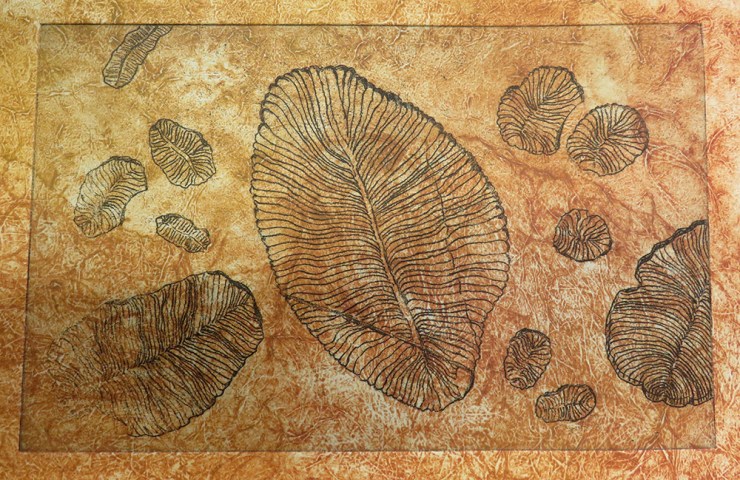
Dickinsonia by Claire Drinkwater

by Rachel Parle, public enagement manager

In each of our special exhibitions, we complement contemporary scientific research with contemporary art. In recent years this has included Elin Thomas’s crocheted petri dishes, Ian Kirkpatrick’s migration and genetics-themed installation, and who could forget the enormous E. coli sculpture by Luke Jerram?!

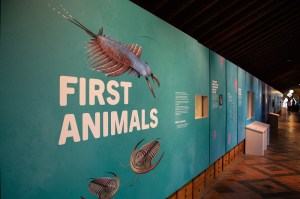
First Animals exhibition is on show until 24 February 2020

For our current exhibition, First Animals, we’ve taken this collaboration to a new level by commissioning original works from a total of 22 artists, all part of Oxford Printmakers Co-operative (OPC) – a group of over a hundred printmakers which has been running for more than 40 years.

First Animals looks at the very earliest evidence of life on Earth, dating back half a billion years. Some of the fossils on display are shallow impressions in the rock – the only direct evidence we have that life existed at that time.

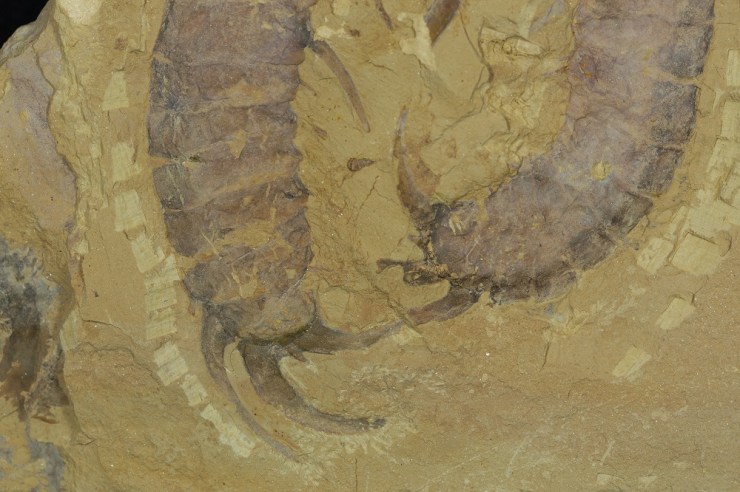
Amplectobelua symbrachiata – one of the incredible Cambrian fossils from the Chengjiang site in China

To kick-start the project we ran a series of workshops for OPC artists to meet the Museum researchers working on the exhibition, and to see the fossils first hand. There were also opportunities to draw directly from these unique fossils, many of which have never been displayed in the UK before.

Discussions between researchers and artists revealed fascinating similarities between these ancient fossils and the process of printmaking. Sally Levell, of Oxford Printmakers Co-operative, explains:

I was completely fascinated by the fossil collection in the Museum, especially the fine specimens from Chengjiang and Newfoundland. They are preserved as mere impressions in the rock, so they are, in essence, nature’s prints.

Each printmaker partnered with a researcher who could answer questions, provide extra info and help the artist decide which specimen or subject to depict in their final print. It’s clear from talking to the printmakers that this direct contact with the experts was invaluable and made the work really meaningful.

Xianguangia by Charlie Davies

We couldn’t have worked without the patient explanations and “show and tell” sessions with the three main researchers – Dr Jack Matthews, Dr Imran Rahman and Dr Duncan Murdock. They were just excellent and their dedication to their work was an inspiration to all of us printmakers.

Sally Levell

Over a period of around seven months, ideas blossomed and printing presses were put into action, with the printmakers exploring the forms, textures and evolution of the fascinating first animals. The final result is First Impressions, an enticing art trail of twenty-five prints dotted around the Museum, both within the First Animals exhibition gallery and nestled within the permanent displays.

Ottoia by Jackie Conway

Such a large group of artists brings a huge variety of techniques and styles, all under the umbrella of printmaking; from a bright, bold screen print in the style of Andy Warhol, to a delicate collagraph created from decayed cabbage leaves! To take part in the art trail yourself, simply grab a trail map when you’re next in the Museum.

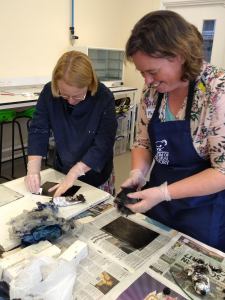
Workshop printers inking up their plates

But our foray into fossils and printmaking didn’t stop there. OPC member Rahima Kenner ran a one-day workshop at the Museum where participants made their own intaglio prints inspired by the First Animals fossils. The group of eight people featured artists and scientists alike, all keen to capture the unique fossils through print techniques.

Designs were scratched onto acrylic plates and inked up, before a professional printing press created striking pieces to take home. Participants also explored techniques such as Chine-Collé, the addition of small pieces of paper to create texture and colour underneath the print.

It was a delight to be able to share with the group our enthusiasm for these discoveries in the medium of making the drypoint prints and to share their enjoyment of learning and using the new techniques. Some lovely work was produced in a single day.

Rahima Kenner

A plate about to go into the press
A finished print, using intaglio and chine-colle

The First Impressions project has been transformative for the Museum team and for the Oxford Printmakers Co-operative. Catriona Brodribb describes its impact on the printmakers :

It’s been a great opportunity to challenge one’s own artistic boundaries in terms of stretching the imagination, and for our members to throw themselves into something new, and enjoy responding to such ancient material in a contemporary way.

The First Animals and First Impressions exhibitions are open until 24 February 2020 and are free to visit.

Abigail Harris - artwork showing reconstruction of Cambrian ocean animal life

Cambrian creation

Abigail Harris - artwork showing reconstruction of Cambrian ocean animal life

by Abigail Harris

Over the past few months our researchers have been working with University of Plymouth illustration student Abigail Harris, who has delved into the weird and wonderful world of some of the earliest animals. Here, Abigail tells us about the process that led to the creation of her Cambrian artwork, inspired by our First Animals exhibition.

I first visited the Museum in April this year when I was given the opportunity to collaborate with scientists as part of a module in my BA in at the University of Plymouth. Things kicked off with a short talk about the Ediacaran and Cambrian geological periods, when Earth’s first animal life started to appear.

I quickly narrowed my interest down to fossils from the Cambrian period which are more complex life forms, more similar to life today. A collection of small fossils from the Chengjiang fossil site in Yunnan province, China was the inspiration for some initial observational drawings.

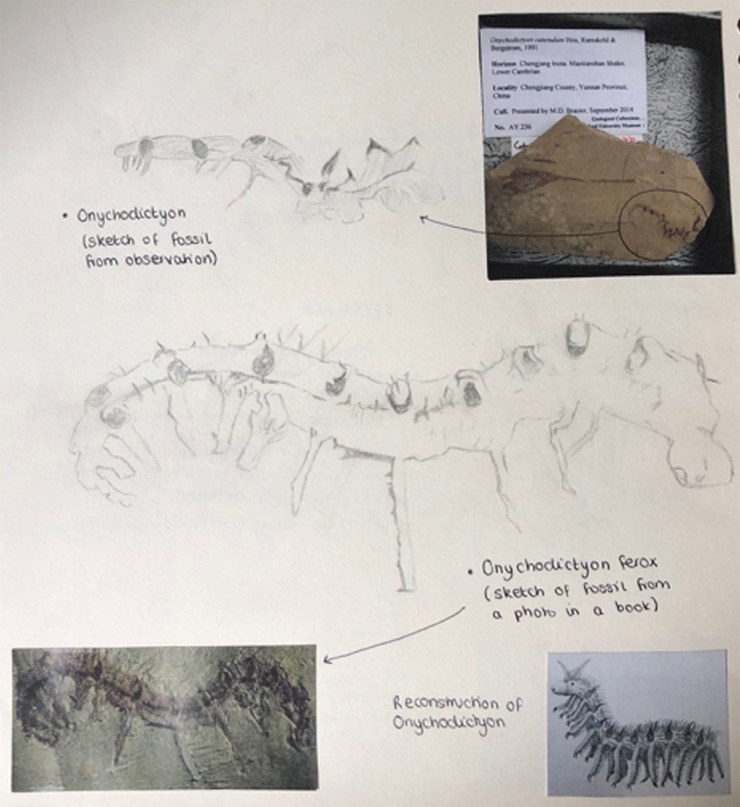
Abigail Harris - sketches for artwork showing reconstruction of Cambrian ocean animal life
A sketchbook page showing initial sketches and observations of Onychodictyon
Final illustration of Cotyledion

After returning to Plymouth University, I began to develop these initial sketches and observations, continuing to research the Chengjiang material and learning more about the characteristics of some of the creatures preserved as fossils.

I wanted to create an under-the-sea ecology reconstruction showing a diversity of life forms, focusing on Onychodictyon, Cotyledion, Cricocosmia, Luolishania, and Paradiagoniella.

A five-step process was used for each reconstruction. Initially, I would sketch the fossil as I saw it, then I would research the characteristics and features of that animal, making a list of things to include in my drawing. A second drawing would then include all of these characteristics, not just what was initially visible in the fossil.

These rough sketches were then sent to the scientists for feedback, helping me to redraw and paint the illustrations with watercolour, before scanning and digitally editing each painting. Lastly, I created a background and added my illustrations.

Initial under under the sea ecology reconstruction.

Although the reconstructions were not completely finished by the time of my project deadline, I returned to the Museum in July and was given a tour of the First Animals exhibition by Deputy Head of Research Imran Rahman, as well as the opportunity to discuss how to improve my artworks for accuracy.

Another round of sketching and painting led to the final piece, shown at the start of this article, complete with an added digital background of the seafloor, and darkened to reflect the murky world of a Cambrian ocean, 50 metres below the surface.

Tests of time: Foraminifera and Radiolarians in science, art and 3D

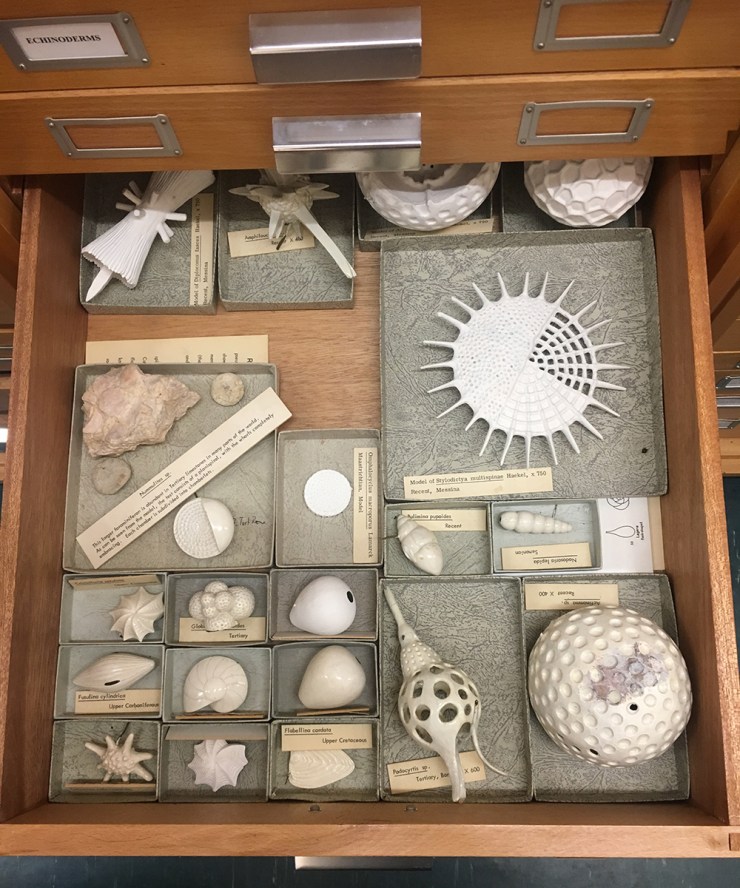
Doctoral researcher Elaine Charwat is exploring the value and meaning of models and casts in the Museum’s collections as part of her PhD. She has recently been studying some fabulous models that help to visualise and understand some of the very, very smallest of specimens…

By Elaine Charwat

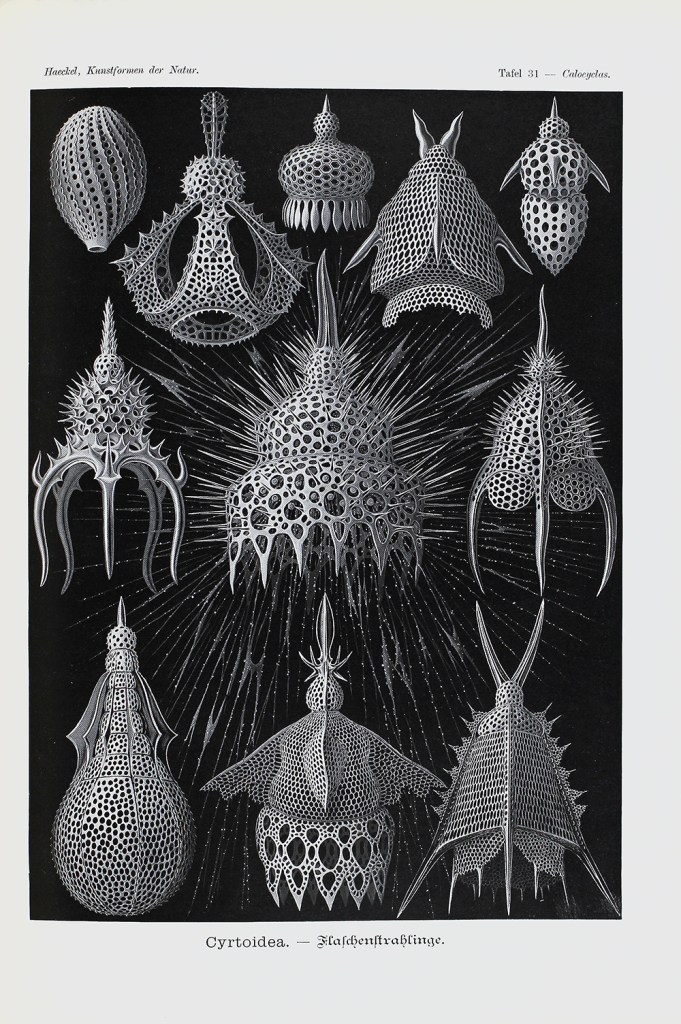
The first time I encountered a Radiolarian was in a book – Ernst Haeckel’s (1834-1919) weird and wonderful Kunstformen der Natur (Art Forms in Nature, 1899-1904). It took comparative morphology – comparing the shapes of organisms – to new giddy heights, scientifically, philosophically and artistically. I felt that giddiness when looking at page after page crammed with crustaceans, orchids, hummingbirds, moths and even bat faces, all exquisitely arranged to celebrate their symmetries, the evolution and kinship of their shapes and forms. It also made visible organisms that are normally all but invisible.

Illustration of Cyrtoidea (table 31) from Kunsterformen der Natur (1899 – 1904) by Ernst Haeckel. By permission of the Linnean Society of London.

Foraminifera and Radiolarians are microscopic sea-dwelling organisms. Species may be found as fossils dating from Cambrian times, ca. 500 million years ago, right up to living specimens today.

To Haeckel, they were living proof of Darwin’s theory of evolution, and for his own belief that morphology was the key to understand the actual processes of evolution, catching it in the act. However, these organisms had two big disadvantages – their unwieldy taxonomy, or the way they are classified, and their minute size: they were difficult to examine and display.

Illustrations of Radiolarians, (table 28). from Die Radiolarien (1862) by Ernst Haeckel. By permission of the Linnean Society of London.

Through his illustrations, Haeckel widely popularized them – triggering a Victorian craze for microscopes and microorganisms, as well as influencing art nouveau art and architecture. But there were limits to what an illustration could communicate. Models stepped in, representing these organisms in ways illustrations could not.

Detail from Haeckel’s Kunstformen der Natur (1899 – 1904)

One defining feature of Radiolarians and Foraminifera is their shells – called “tests”. Variations in shapes of the tests not only indicate that they are different species, but also, excitingly, provide clues about space and time. The tests of Neogloboquadrina pachyderma, for instance, record ocean temperature over geological timescales – their shells coil to the left when water temperatures are relatively cold, and to the right when it is warmer. The potential for research into climate change is obvious. Foraminifera are also important “signature fossils”, helping geologists to determine geological strata.

You really need to see them in glorious 3D to appreciate these tests across geological time, to understand their complex, beautiful shapes. And I felt a similar twang of excitement to my first encounter with them through Haeckel when discovering these extraordinary models here in the Museum as part of my PhD research.

Václav Frič (1839-1916) was a natural history dealer based in Prague. He developed a series of 100 plaster of Paris models of Foraminifera (1861), as well as the stunning papier-maché models of Radiolaria (listed in his catalogue of 1878). He worked closely with Ernst Haeckel.

A selection of Frič’s models in the Museum’s stores

The Frič models oscillate between visible and invisible, illustration and model, art and science, philosophy and theory. They bear witness to a key period in the history of science when they were used to give tangible shape and proof to Charles Darwin’s poignant phrase:  “[…] from so simple a beginning endless forms most beautiful and most wonderful have been, and are being, evolved.”

Through the models we can “grasp” microorganisms that have been around for over 500 million years; organisms that truly have stood the tests of time.

Petri dish to puppetry

Spheres, spirals, rods, corkscrews… bacteria come in strange and beautiful shapes. Our Bacterial World exhibition (19 October 2018 – 28 May 2019) tells the untold story of life on a microscopic scale, and a recent Museum project brought together a research scientist, a group of school students and an artist to explore the patterns, textures and forms of beautiful bacteria. This science and art collaboration led to the creation of three fabulous bacteria-inspired puppets.

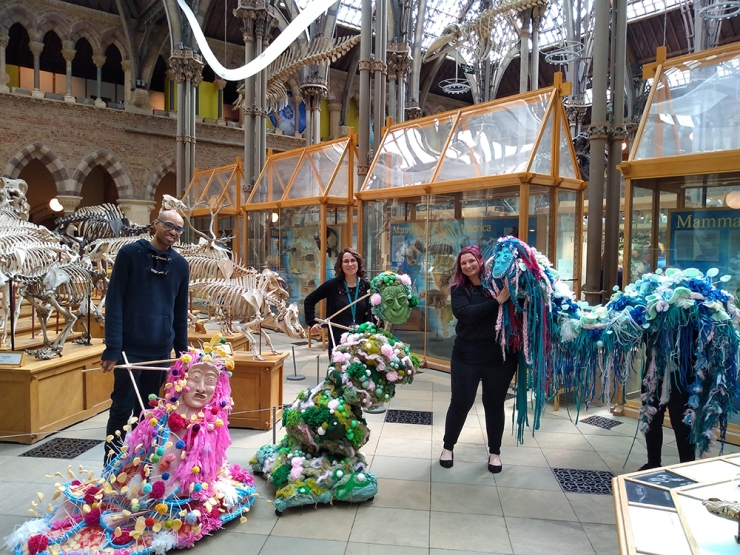
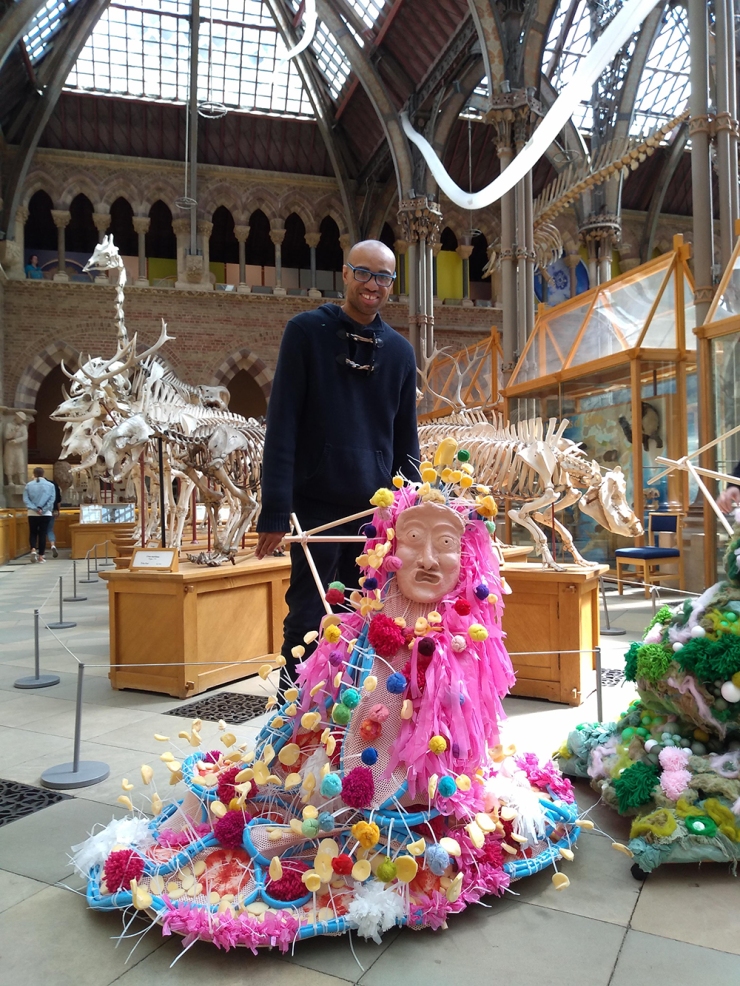
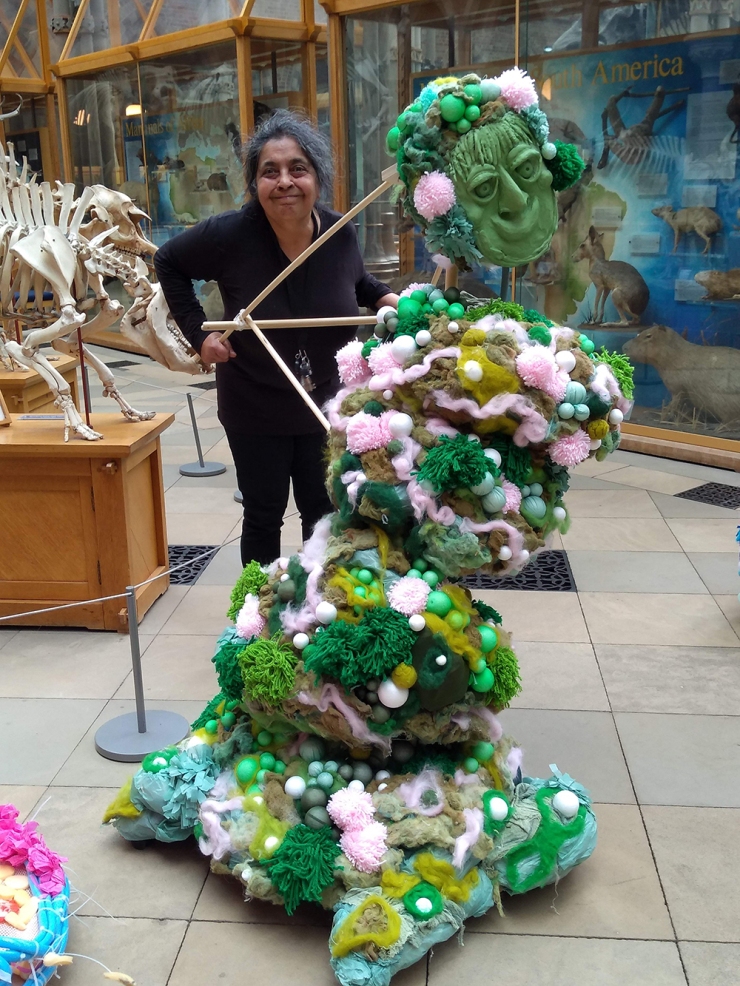
Volunteers and puppets in the museum
The puppets let loose in the Museum. Volunteers Tayo, Chantelle and Humaira (hidden behind the blue puppet!), with Carly from the Museum’s public engagement team.

Our Public Engagement team worked with Iffley Academy, a school for students with special educational needs and disabilities in Oxford. The pupils were from the brilliantly-named ‘Jackson Pollock’ class and they fully embraced the bacteria theme, through museum visits, workshops and classroom activities.

As well as visiting Bacterial World, the students had a workshop with Dr Frances Colles, a microbiology researcher from the University of Oxford, where they learnt about the importance of bacteria in their lives. As well as working with the students to create their own bacteria superheroes, Fran talked about her own work and took part in a Q&A, where the students made the most of quizzing a real, live scientist.

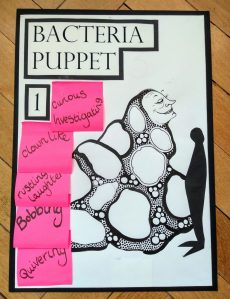
One of the character boards that Georgina created with the students

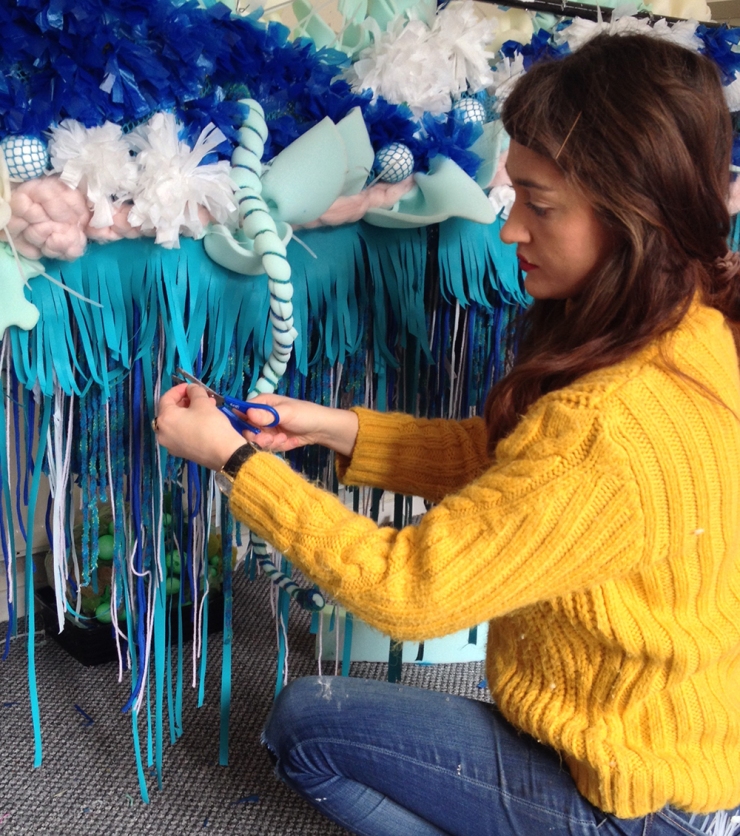
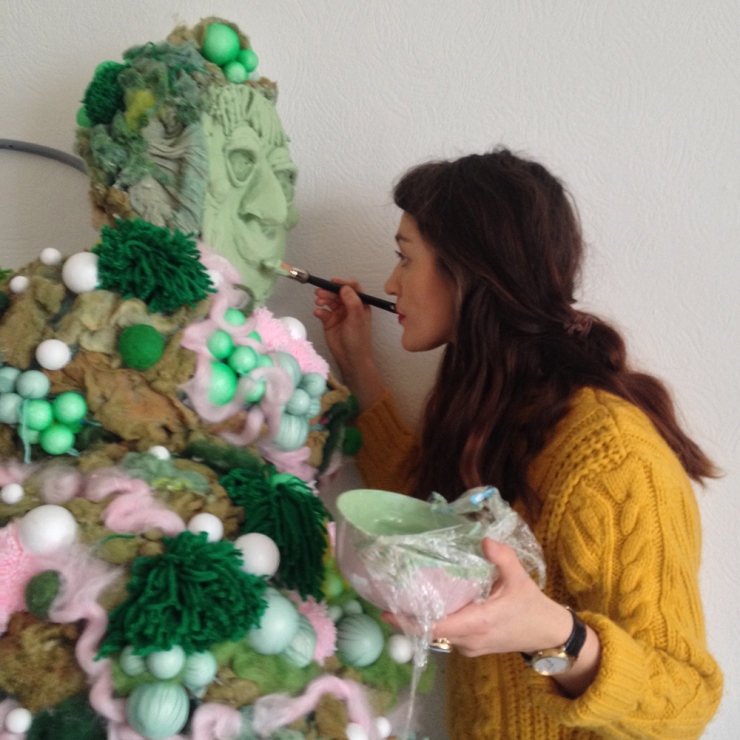
Next, the students spent two days with artist and puppet-maker Georgina Davy, who gave them the chance to experiment with a variety of textiles and techniques, including Japanese shibori dyeing, fringing, plaiting and knotting. The children even created latex faces to ‘personalise’ the bacteria. The pupils worked with Georgina to gather ideas and create mood boards and ‘characters’ for each puppet. She then used these individual pieces to build three giant, bacteria-inspired puppets.

Georgina Davy in her studio, working on the bacteria puppets

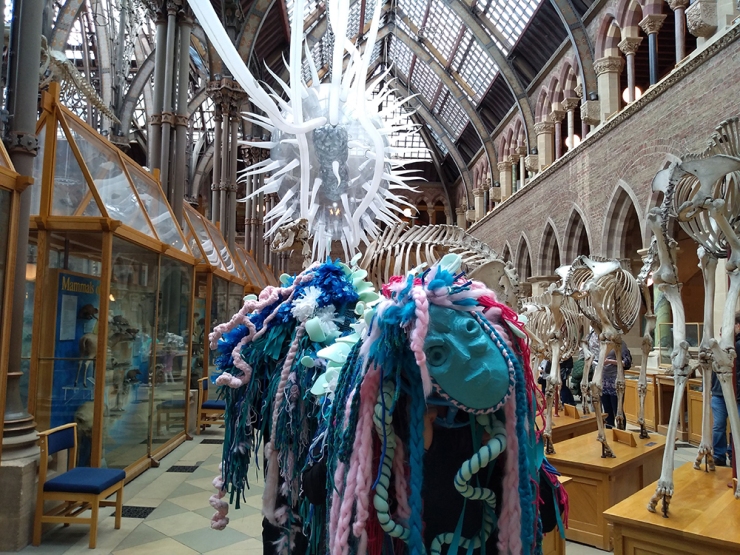
Just like the real bacteria that inspired them, the final puppets all have distinctive appearances and styles of movement. One is tall, green and plodding, another is pink, bobbing and quivering. The long, winding Chinese dragon-style puppet is slinky and searching. An artistic interpretation of bacteria, in motion.

Georgina Davy got a lot out of the collaboration and says:

This project has been the most unusual and marvellous project that a puppet maker could work on. Drawing upon scientific information from museum and academic staff that is enhanced and brought to life by students’ imaginations.

This project is unique in that the physical 3D puppet outcomes come from an almost entirely invisible world. Bacteria operate on an unfathomable microscopic scale. I am still finding it remarkable trying to envision this microscopic galaxy of bacteria taking place around us everyday in riots of colour, shape and movement. We cannot see the surreal bacteria forms that wriggle, bounce and swell around us, but they are there, some even tumbling around in forms like Chinese calligraphy. Their secret world is only unlocked by the microscope.

Once the puppets had been revealed to (and played with by) the students, they were transported to the Museum for the finale of the project – a public performance. On Saturday 11 May, three brilliant volunteers, Humaira, Tayo and Chantelle, showed off the work of Georgina Davy and the Jackson Pollock class to Museum visitors. The puppets twisted, shook and wiggled through the aisles, accompanied by percussion – drums and shakers courtesy of volunteers and visitors joining in with the performance.

If you’d like to see more about the Beautiful Bacteria project, we’ve put together a display in the Museum’s Community Case, where you can see original works by the Iffley Academy students. Until 6 August 2019.

The Beautiful Bacteria project was funded by BBSRC.