Is it real? – Fossils

One of the most common questions asked about our specimens, from visitors of all ages, is ‘Is it real?’. This seemingly simple question is actually many questions in one and hides a complexity of answers. 

In this FAQ mini-series we’ll unpack the ‘Is it real?’ conundrum by looking at different types of natural history specimens in turn. We’ll ask ‘Is it a real animal?’, ‘Is it real biological remains?’, ‘Is it a model?’ and many more reality-check questions.

This time: Fossils, by Duncan Murdock

Whether it’s the toothy grin of a dinosaur towering over you, an oyster shell in the paving stone beneath you, or a trilobite in your hand, fossils put the prehistory into natural history collections. Anyone who has spent a day combing beaches for ammonites, or scrabbling over rocks in a quarry will attest that fossils are ‘real’. It is the thrill of being the only person to have ever set eyes on an ancient creature that drives us fossil hounds back to rainy outcrops and dusty scree slopes. But fossils, unlike taxidermy and recent skeletons, very rarely contain any original material from living animals, so are they really ‘real’?

Megalosaurus
The Museum’s famous Megalosaurus jaw

Fossils are remains or traces of life (animals, plants and even microbes) preserved in the rock record by ‘fossilisation’.

This chemical and physical alteration makes fossils stable over very long timescales, from the most ancient glimpses of the first microbes billions of years ago to sub-fossils of dodos, mammoths and even early humans just a few thousand years old. They can be so tiny they can only be seen with the most high-powered microscopes or so huge they can only be displayed in vast exhibition halls, like our own T. rex. Among this is a spectrum of how much of the ‘real’ animal is preserved, and how much preparation and reconstruction is required to be able to display them in museums.

Trace fossils include footprint trackways like these, made by extinct reptile Chirotherium.

Generally, the more there is of the original material and anatomy, the rarer the fossils are. Among the most common fossils found are ‘trace fossils’: burrows, footprints, traces, nests, stomach contents and even droppings (known as ‘coprolites’). Most ‘body’ fossils also contain nothing of the living creature, rather they are impressions of hard parts like teeth, bones and shells.

This ammonite fossil, Titanites titan, was formed when a mould was filled with a different sediment, which later turned to rock.

When an organism is buried the soft parts quickly decay away. The hard parts decay much more slowly, and can leave space behind, creating a fossil mould. If this later gets filled with different sediment, it forms a cast.

These sediments are buried further still and eventually turned into rocks. Alternatively, the hard parts can be replaced by different minerals that are much more stable over geological time. Essentially bone becomes rock one crystal at a time.
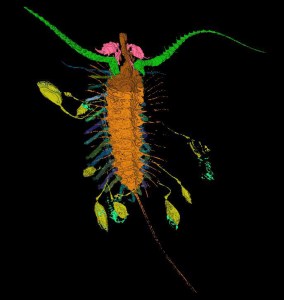
3D reconstruction of 430 million year old fossil, Aquilonifer spinosus. Found in Herefordshire Lagerstätte, which preserves ancient remains with superb detail.

Very rarely the soft parts of an organism get preserved, but in the most exceptional cases skin, muscles, guts, eyes and even brains can be preserved. If buried quickly enough an animal can be compressed completely flat to leave behind a thin film of organic material, or even soft parts themselves can be replaced by minerals, piece-by-piece. These mineralized fossils can be exquisitely preserved in three dimensions, even down to individual cells in some cases. This is about as ‘real’ as most fossils can be, except the few special cases where the remains of an organism are preserved virtually unaltered, entombed in amber, sunk into tar pits or bogs, or frozen in permafrost. The latter push the boundaries of what can really be called a fossil.

Bambiraptor feinbergi

The final step in the process, from the unfortunate demise of a critter to its eventual study or display, involves preparation. In most cases the fossil has to be removed from the surrounding rock with hammers, chisels, dental tools and sometimes acids. This preparation can be quite subjective, a highly skilled preparator has to make judgements about what is or isn’t part of the fossil. The specimen may also need to be glued together or cracks filled in, so not everything you see is always original.

As with modern skeletons, there are often missing parts, so a fully articulated dinosaur skeleton may be a composite of several individuals, or contain replica bones. This is, of course, not a problem as long as it is clear what has been done to the fossil. This is not always the case, and there are examples of deliberately forged fossils, carved into or glued onto real rocks, or forgeries composed of several different fossils to make something ‘new’, like a ‘cut n shut’ car.

So, if you see a fossil that looks too good to be true, then it just might be worth asking, “is it real”?

Next time… Models, casts and replicas
Last time… Skeletons and bones
Is it real? – Taxidermy

One of the most common questions asked about our specimens, from visitors of all ages, is ‘Is it real?’. This seemingly simple question is actually many questions in one and hides a complexity of answers. 

In this FAQ mini-series we’ll unpack the ‘Is it real?’ conundrum by looking at different types of natural history specimens in turn. We’ll ask ‘Is it a real animal?’, ‘Is it real biological remains?’, ‘Is it a model?’ and many more reality-check questions.

First up: Taxidermy, by Mark Carnall

Taxidermy
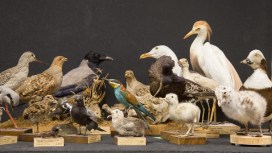
The Museum is well-known for its touchable taxidermy. As of today, we have two large bears, a Black Bear and a Brown Bear, greeting visitors as they enter the main court, as well as taxidermy specimens on our Sensing Evolution touch-tables. For children and adults alike, this close encounter with a taxidermy animal prompts the question – is it real?

Taxidermy, or ‘stuffed’ animals, are specimens that have been specially prepared, preserved and posed to show what the creature may have looked like in life, but real and not real here is tricky. The animal itself is, or was, a real animal – there are no taxidermy unicorns, for example. But the biologically real parts may only be the skin, the skull, and the skeleton inside the paws and feet, depending on the type of animal.

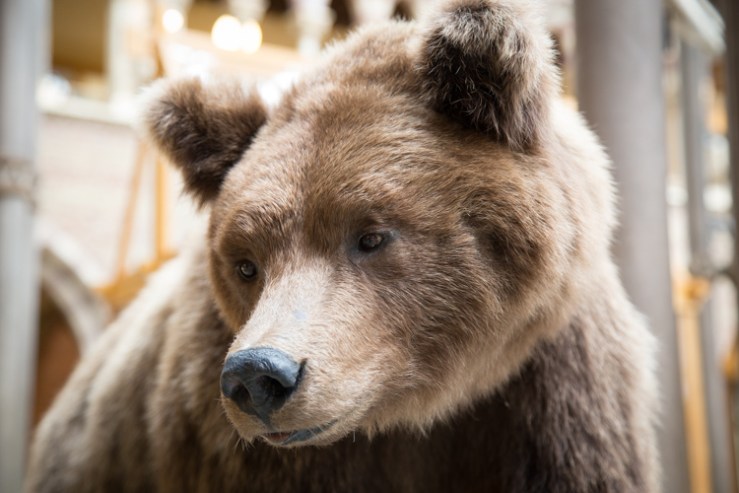
The touchable taxidermy Brown Bear greets visitors to the museum.

Inside taxidermy specimens there may be sculpted statues over which the skin is stretched; for older specimens, a wire and wood framework with paper, wood wool, straw and seeds may be used to fill out the skin. The animal’s squishy parts, which are not easy to preserve –such as eyes, lips and tongues – are normally made of glass or plaster.

Animals that have skins and skeletons that are relatively easy to preserve – including mammals, reptiles, and birds – are generally better suited to taxidermy. Marine mammals such as whales and dolphins, amphibians such as frogs and salamanders, and fish are all less common as taxidermy because their skins are harder to treat and keep stable.

Dogfish and piranha taxidermy which have been painted and varnished in an attempt to make them resemble the living animals. Note the comedic eyes on the shark.

The hard parts of skin, such as crests, wattles and skin patterns in reptiles, are susceptible to discolouring and fading in light, so these areas may be repainted to show what the animals look like in life. This introduces another ‘non-real’ element: paint.

So although there are certainly real parts used in taxidermy, there’s yet another complication in answering the question: the animals are usually posed by a human, so even their posture and appearance could be considered ‘subjective’ and perhaps therefore not quite ‘real’.

In fact, some of our older taxidermy may have been prepared by taxidermists who hadn’t ever even seen a living example of the animal they were working on. This can lead to inaccurate positioning and posing, as in the taxidermy kiwi on display in our main court.

So, is it real? You decide.

Next time… Skeletons and bones


Secrets of an ancient reptile

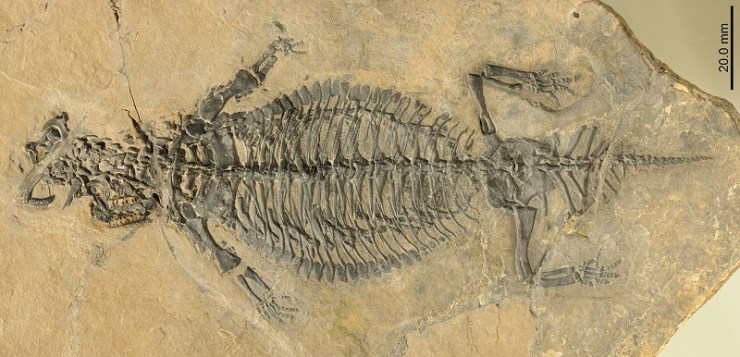
Fossil of Eusaurosphargis dalsassoi PIMUZ A/III 4380 (Credits: Dr. Torsten Scheyer; Palaeontological Institute and Museum, University of Zurich, Switzerland)

Very occasionally, exceptionally well-preserved fossils reveal new clues about poorly understood creatures. Complete, articulated skeletons are rare and, when found, offer rich insight for palaeontologists. One of our research fellows, Dr James Neenan, has been involved with just such a discovery and description, of an armoured reptile from the Middle Triassic named Eusaurosphargis dalsassoi.

A beautifully-preserved fossil found in the Alps in eastern Switzerland has revealed the best look so far at this animal. The findings about its anatomy and probable lifestyle were somewhat unexpected, according to a paper published in Scientific Reports today, led by Dr Torsten Scheyer at the University of Zurich and co-authored by James.

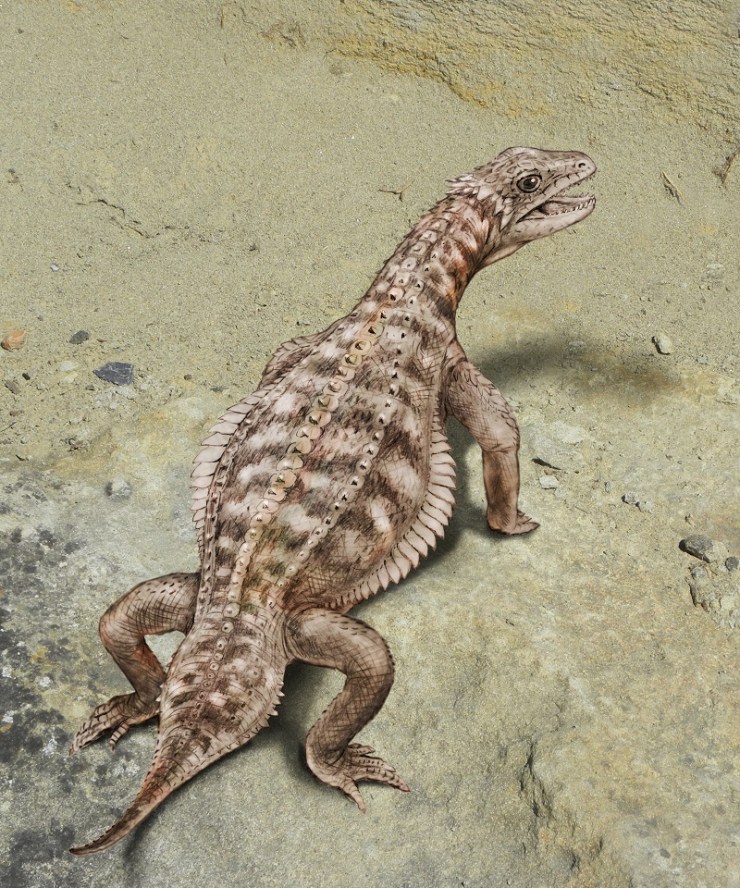
At just 20 cm long, the specimen represents the remains of a juvenile. Yet large portions of its body were covered in armour plates, with a distinctively spiky row around each flank, protecting the animal from predators. Today’s girdled lizards, found in Africa, have independently evolved a very similar appearance even though they are not closely related to Eusaurosphargis.

Life reconstruction of Eusaurosphargis dalsassoi based on new specimen PIMUZ A/III 4380 (Credits: Beat Scheffold; Palaeontological Institute and Museum, University of Zurich, Switzerland).

The new fossil, found in the Prosanto Formation at Ducanfurgga, south of Davos in Switzerland, is not the first material of Eusaurosphargis to be discovered. The species was originally described in 2003 based on a partially complete and totally disarticulated specimen from Italy. This was found alongside fossils of fishes and marine reptiles, leading scientists to believe that Eusaurosphargis was an aquatic animal.

However, the detail preserved in the new specimen shows a skeleton without a streamlined body outline and no modification of the arms, legs or tail for swimming. This suggests that the reptile was in fact most probably adapted to live, at least mostly, on land, even though all of its closest evolutionary relatives lived in the water.

Until this new discovery we thought that Eusaurosphargis was aquatic, so we were astonished to discover that the skeleton actually shows adaptations to life on the land. We think this particular animal must have washed into the sea from somewhere like a beach, where it sank to the sea floor, was buried and finally fossilised. – Dr James Neenan

The findings from the research team are published in Scientific Reports as ‘A new, exceptionally preserved juvenile specimen of Eusaurosphargis dalsassoi (Diapsida) and implications for Mesozoic marine diapsid phylogeny’.

Fossil-finding

By Jack J Matthews, research fellow

On the southern shores of Newfoundland in Canada lie rocks containing the oldest known evidence of large, architecturally-complex life. Deposited within the Ediacaran Period, some 565 million years ago, these deep marine deposits have been the focus of palaeontological research since the first discovery of fossils there in 1967, and the locality – Mistaken Point Ecological Reserve – now sits in the UNESCO World Heritage list.

As part of my research on these rocks, alongside colleagues from Memorial University of Newfoundland, and the University of Cambridge, I created a new geological map of the area, covering 35 km of coastline in and around the Reserve. As well as providing new insights into the rocks themselves, and what environments they were deposited in, this mapping had an unexpected outcome – the discovery of some totally new fossil sites.

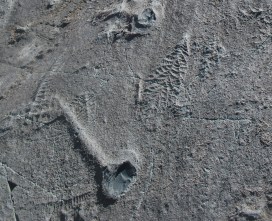
Overview of the Mistaken Point outcrop of the famous ‘E’ Surface

One site in particular, dubbed the ‘E’ surface, is the focus for Ediacaran fossils in Newfoundland. It is an area about the size of three Olympic boxing rings, containing more than 3,000 fossil organisms. Through the mapping we found a number of other outcrops of this same surface, but each shows slightly different types of fossils.

This is a mystery: if all the outcrops are from the same geological surface, why do they show different fossil assemblages?

The clue to the answer came while photographing the fossils and overlying volcanic ash at Mistaken Point, when I heard a loud, deep boom: a freak wave had struck the bottom of the cliff below the outcrop, sending a large splash of salty spray over much of the surface.

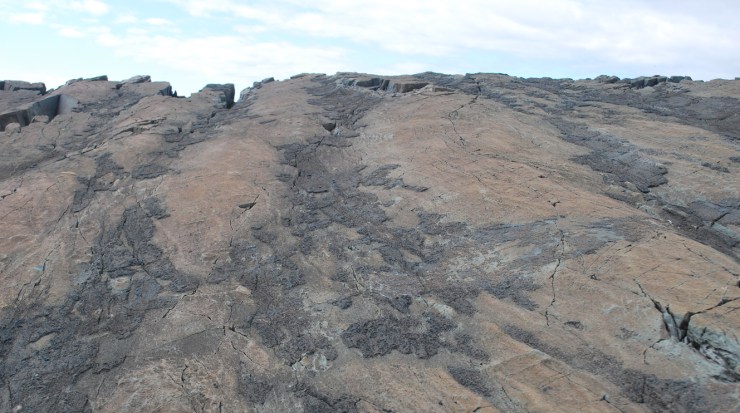
This got me thinking – how are processes such as weathering and erosion affecting the fossil surfaces now? Closer observation revealed those outcrops of ‘E’ with pristine beautiful fossils tended to be further from the sea, have a shallower dip, and the overlying ash tended to fall away in little flakes revealing beautiful, crisp, fossils. Other outcrops with scruffy fossils were usually close to the sea, battered by waves and rocks, steeply dipping, and the overlying ash, and often the fossils below it, would gradually abrade away as they are attacked by the sea.

Looking along the ‘E’ surface showing areas still covered in ash (black) and revealed fossil surface (red and grey)

Palaeontologists often discuss how changes during the fossil preservation of an organism can affect what we discover today, but they rarely discuss how processes occurring after preservation – metamorphism, exhumation, weathering, erosion, and even the time, manner, and conditions in which the fossil is recorded – might all affect how we analyse and interpret the original community of life which became fossilised.

Our new paper, published by the Geological Society of London, talks about these Post-Fossilization Processes, and recommends that when researchers are collecting fossil data they consider how their measurements might have been biased by such factors.

For 50 years now, the coastline of Newfoundland has yielded some of the most important finds in understanding the rise of the early life of the Ediacara, and through that the first evidence of animal life. Discoveries over the past few years show there is still much more to be found, and we’ll just have to hope that the post-fossilization processes fall in our favour to allow for many more significant discoveries.

The ‘birth’ of dinosaurs

by Hilary Ketchum, Earth Collections manager

In April 1842, 175 years ago this year, the dinosaurs were created – in a taxonomic sense at least. In a landmark paper in the Report for the British Association for the Advancement of ScienceRichard Owen, one of the world’s best comparative anatomists, introduced the term ‘Dinosauria’ for the very first time.

Owen coined the term using a combination of the Greek words Deinos, meaning ‘fearfully great’, and Sauros, meaning ‘lizard’, in order to describe a new and distinct group of giant terrestrial reptiles discovered in the fossil record. He based this new grouping – called a clade in taxonomic terms – on just three generaMegalosaurusIguanodon, and Hylaeosaurus.

In the Museum’s collections are some specimens of those three original dinosaurs, collected and described during this exciting early period of palaeontology. These discoveries, amongst others, helped to revolutionise our understanding of extinction, deep time, and the history of life on earth, and paved the way for the theory of evolution by natural selection.

Megalosaurus

The right lower jaw of Megalosaurus bucklandii from the Taynton Limestone Formation, Middle Jurassic, Oxfordshire, UK. OUMNH J.13505.

A nine metre long, 1.4 tonne carnivore that roamed England during the Middle Jurassic, about 167 million years ago, Megalosaurus has the accolade of being the world’s first named dinosaur. It was described by William Buckland, the University of Oxford’s first Reader in Geology, in 1824, and was discovered in a small village called Stonesfield, about 10 miles north of Oxford. The toothy jawbone of Megalosaurus is on display in the Museum.

The sacrum of Megalosaurus. One of the characteristics that made Richard Owen realise dinosaurs were a distinct group was the presence of a sacrum with five fused vertebrae, visible here in the specimen on display at the Museum.

Iguanodon
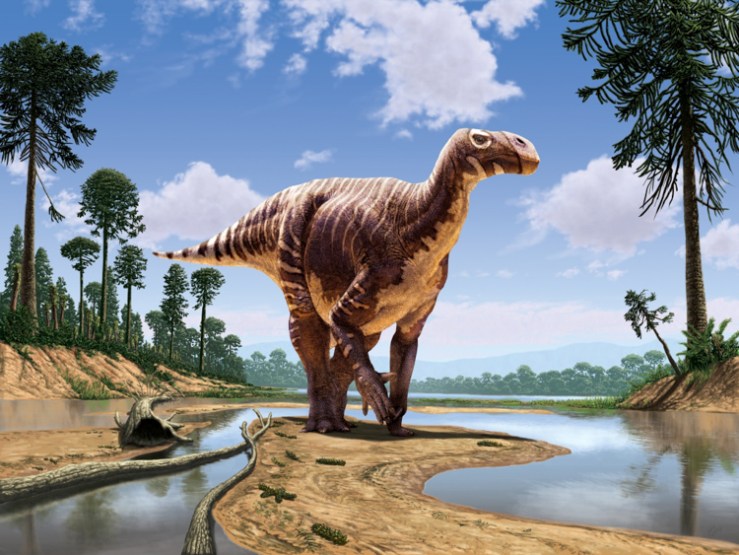
Iguanodon was a plant-eating reptile with a spike on the end of its thumbs, and teeth that look like those of an iguana, only 10 times bigger! Iguanodon lived in the Lower Cretaceous, around 130 million years ago and was named by Gideon Mantell in 1825.

When first discovered, Iguanodon’s spike was thought to go on its nose, like a rhinoceros or a rhinoceros iguana, rather than on its thumb, which is rather unique. In fact, we still don’t know why Iguanodon had such prominent thumb spikes.

Tooth of Iguanodon from the Wealden Group, Lower Cretaceous, Cuckfield, Sussex, UK. Gideon Mantell Collection. OUMNH K.59828.
The Iguanodon’s spike was first thought to go on its nose, rather than on its thumb. A paper label attached to the specimen reads, “Cast of the Horn of the Iguanodon, from Tilgate Forest; in the possession of G. Mantell, Castle Place, Lewes.”

Hylaeosaurus
A squat, armoured, plant-eating dinosaur with long spines on its neck and shoulders. It is the least well known and smallest of the three dinosaurs originally described, but arguably the cutest. Hylaeosaurus was also named by Gideon Mantell, in 1833.

A dorsal spine, probably from the holotype of Hylaeosaurus armatus from the Wealden Group, Lower Cretaceous, Sussex, UK. OUMNH K.59799. Accompanying label in Gideon Mantell’s handwriting.

The exact specimen used by Mantell to describe Hylaeosaurus armatus is in a big block of rock in the Natural History Museum in London. But recently I spotted a specimen in our collections that Mantell had sent to William Buckland in 1834. It has the following label with it, written by Mantell himself:

Extremity of a  dorsal spine of the Hylaeosaurus from my large  block –

Perhaps Mantell just snapped a bit off to send to his friend. Or perhaps more likely, it was one of the broken fragments Mantell said were lying near the main block when it was dug out of the ground.

*

From just three genera included in Dinosauria in 1842, we now have around 1,200 species nominally in the group. The study of dinosaurs has come a long way since those early days; new finds, new technologies, such as micro CT scanning and synchrotron scanning, and new statistical techniques are helping us to better understand these iconic animals and re-evaluate older specimen collections.

The Museum’s dinosaur specimens are exceptionally historically important, but are still used heavily by scientists from across the world for their contemporary research. This is something that I think William Buckland, Gideon Mantell and Richard Owen would be very pleased about.

Cetiosaurus fossil bones on display in the Museum

The one that got away…
Although Owen didn’t know it, other dinosaurs were known in 1842, including Cetiosaurus, the ‘whale lizard’. When Owen named it in 1841, he thought it was a giant marine reptile that ate plesiosaurs and crocodiles. By the following year, he suggested it was actually a crocodile that had webbed feet and used its tail for propulsion through the water.

It wasn’t until 1875, after more substantial remains had been found that Owen recognised Cetiosaurus as a land-living sauropod dinosaur. Interestingly, however, research published last month presented a new hypothesis for dinosaur relationships which, if the previous definition of Dinosauria had been adhered to, would have placed all sauropods outside of the group. So perhaps Owen’s earlier omission wasn’t so wrong after all.

A moving story

img_0737

For the past nine months there has been a lot of moving going on around here. Imagine moving house endlessly for weeks on end, but where your house is full of bones, insects, fossils, rocks, and weird and wonderful taxidermy. And the location of everything has to be precisely recorded. The museum move project was a bit like that.

Project assistant Hannah Allum explains…

The museums are migrating, we declared in May 2016. And so they have. The first major stage of the stores project has been completed. After we had created inventories for the largely unknown collections held in two offsite stores, the next stage was to pack them safely and transport them to a new home nearer the museum, a job which demanded almost 70 individual van trips! We now have over 15,000 specimens sitting in vastly improved storage conditions in a new facility.

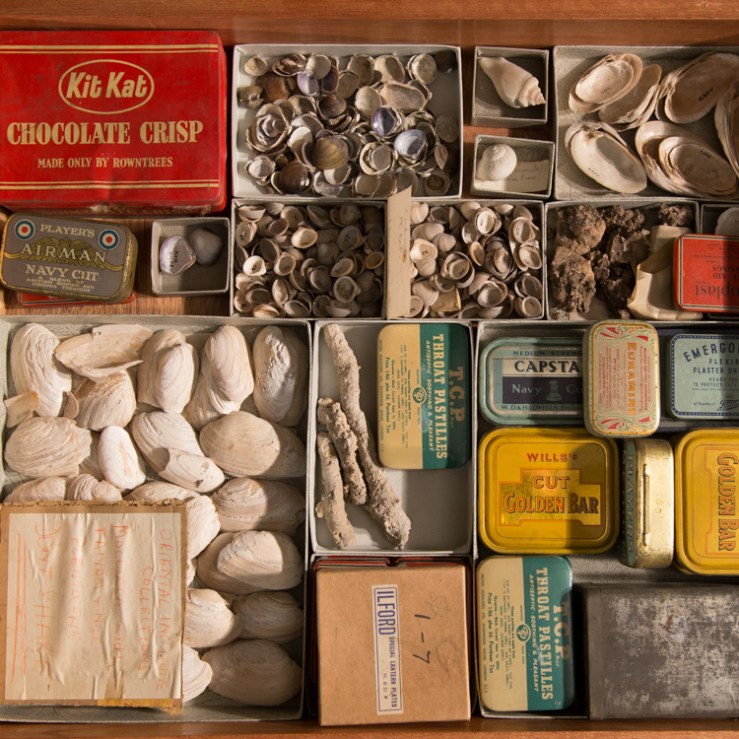
A miscellany of boxes for a collection of shells

Let’s revel in some numbers. All in all there were over 1,000 boxes of archive material, mostly reprints of earth sciences and entomological research papers; over 1,300 specimens of mammal osteology (bones); and more than 1,000 boxes and 650 drawers of petrological and palaeontological material (rocks and fossils).

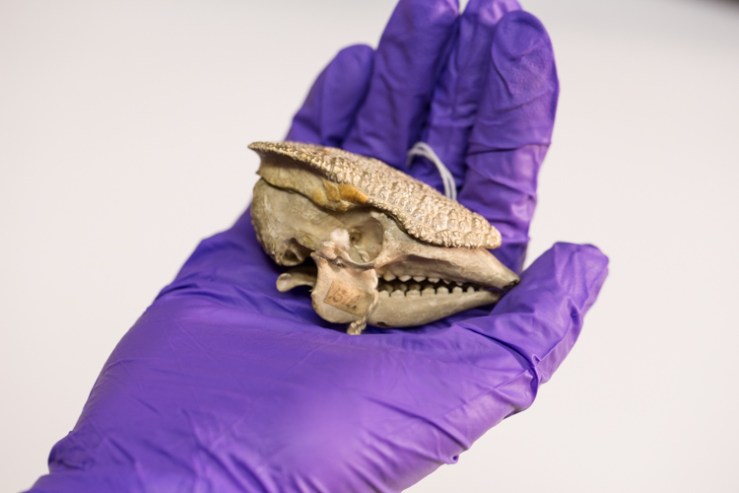
Some of the more memorable specimens include old tobacco tins and chocolate boxes filled with fossils and shells; a beautifully illustrated copy of the ‘Report on the Deep-Sea Keratosa’ from the HMS Challenger by German naturalist Ernst Haeckel; and the skull of a Brazilian Three-banded Armadillo (Tolypeutes tricinctus), complete with armour-plated scute carapace.

img_0756
The skull and carapace of a Brazilian Three-banded Armadillo (Tolypeutes tricinctus)

There were also a few objects that have moved on to more unusual homes. A 4.5 m long cast of Attenborosaurus conybeari (yep, named after Sir David) was too large to fit in our new store and so made its way to another facility along with a cornucopia of old museum furniture. A set of dinosaur footprint casts, identical to those on the Museum’s lawn, have been gifted to the Botanical Gardens for use at the Harcourt Arboretum in Oxford.

And last but not least, a model of a Utahraptor received a whopping 200 applications from prospective owners in our bid to find it a suitable home. After a difficult shortlisting process it was offered to the John Radcliffe Children’s Hospital and following a quarantine period should soon be on display in their West Wing.

Footprint casts, attributed to Megalosaurus, queuing for a lift to Harcourt Arboretum. Credit: Hannah Allum
Casts of footprints by made Megalosaurus, queuing for a lift to Harcourt Arboretum. Image: Hannah Allum

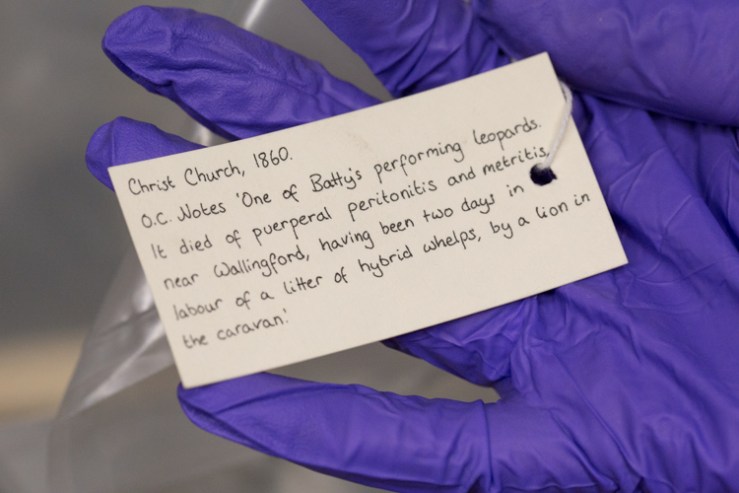
Fittingly, the final specimen I placed on the shelf in the new store was the very same one that had been part of my interview for this job: The skeleton of a female leopard with a sad story. It apparently belonged to William Batty’s circus and died of birthing complications whilst in labour to a litter of lion-leopard hybrids before ending up in the Museum’s collections in 1860.

img_0760
The sad story of a performing leopard

Though the moving part of this project is now complete there is still plenty of work to do. We are now updating and improving a lot of the documentation held in our databases, and conservation work is ongoing. The new store will also become a shared space – the first joint collections store for the University Museums, complete by April 2018.

To see more, follow the hashtag #storiesfromthestores on Twitter @morethanadodo and see what the team at Pitt Rivers Museum are up to by following @Pitt_Stores.