Happy Birthday Darwin!

Onthophagus australis

By Darren Mann, Head of Life Collections

A birthday, on 12 February, and an ‘inordinate fondness for beetles’ are possibly the only things Charles Darwin and I have in common. In his autobiographical notes (1887) Darwin says that at the age of ten he made the decision to collect, but not kill insects; at the same age I was given, by my junior school teacher, four Madagascan hissing cockroaches (the large male I called Burt). So Darwin and I began a lifelong fascination with natural history at a similarly early age, though with very different results.

Much is written about Darwin and his scientific accomplishments, but did you know he was also an avid beetle collector? The quote below is testament to his enduring enthrallment with beetles.

“I feel like an old war-horse at the sound of the trumpet when I read about capturing of rare beetles… It really almost makes me long to begin collecting again”
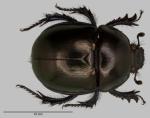
Trypocopris vernalis
Trypocopris vernalis, collected by Darren Mann, North Wales, 1986

Darwin was also a close correspondent of Reverend F.W. Hope, the founder of the entomological collections at the Museum, and the two often set out on insect-collecting expeditions together. These trips regularly resulted in the capture of rare or unusual species, and an occasional publication.

In 1831, Darwin embarked on his famous voyage around the world as naturalist on the HMS Beagle. He returned to England, in 1836, with around 4,000 insects, some of which were donated to his good friend Hope. Hope scientifically described a few of Darwin’s new species of beetles and named them in Darwin’s honour. Examples include the ground beetle Carabus darwinii and the stag beetle Dorcus darwinii.
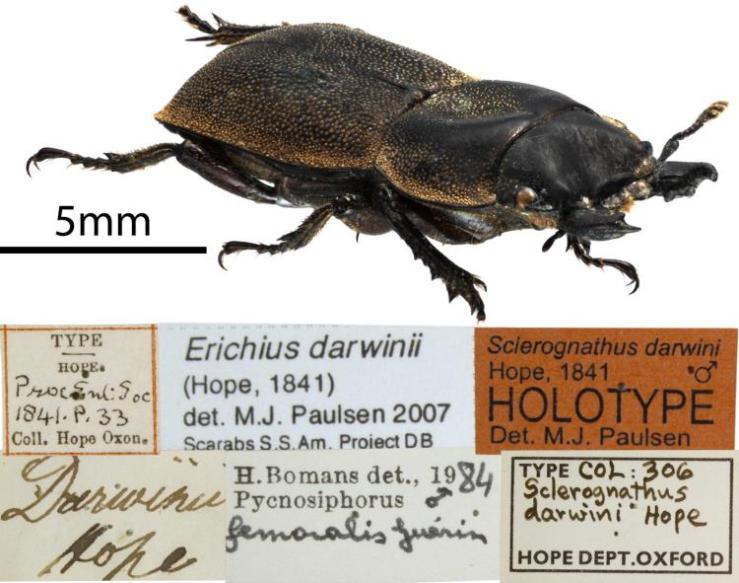
Dorcus darwinii Hope, 1841 “The above insect I have lately received from Chili. It is named in honour of Charles Darwin, Esq., who has greatly contributed to our acquaintance with the Entomology of Valparaiso, Chili, and other parts of the South American continent.” Hope, F.W. 1843. On some nondescript Lamellicorn Beetles Transactions of the Royal Entomological Society of London 3(4): 279–283.
Dorcus darwinii (Hope, 1841)
“The above insect I have lately received from Chili. It is named in honour of Charles Darwin, Esq., who has greatly contributed to our acquaintance with the Entomology of Valparaiso, Chili, and other parts of the South American continent.” Hope, F.W. 1843.

During the Beagle voyage Darwin became the first collector of Tasmanian beetles. Onthophagus australis, collected by Darwin in Hobart Town in Tasmania in 1836, is shown in the photo at the top of this post. Whilst in Hobart Town he was also surprised to find

“Four species of Onthophagus, two of Aphodius, and one of a third genus, very abundant under the dung of cows; yet these latter animals [cows] had then been introduced only thirty-three years. Previously to that time, the Kangaroo and other small animals were the only quadrupeds; and their dung is of a very different quality to that of their successors introduced by man.”

This observation, possibly made on his birthday (and what a great way to spend the day) points to research questions that are ongoing today: the effects of habitat change from forest to pasture, and the impact that introduced farm animals have on native dung beetle populations.

In his 1871 publication, The Descent of Man, Darwin returned to dung beetles, writing about their sexual dimorphism, or differences in appearance between males and females, and arguing that there must be a contest between males and females which drives rapid evolutionary divergence amongst populations. There is now considerable scientific evidence to support these views on sexual selection, some based on dung beetle research.
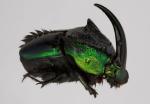
Phanaeus vindex
Phanaeus quadridens from the New World

So we come full circle. I work in the building where, in 1860, there was the first public meeting on Darwin’s then newly-published book, The Origin of the Species, an event now often referred to as the Huxley–Wilberforce debate, or Great Debate. My hobby and research interest focus on dung beetles and their ecology, including the effects of habitat change and loss of dung beetle diversity. And within sight of my office are those dung beetles Darwin wrote of from Hobart Town…

I am fortunate to be part of the curatorial team that looks after Hope’s collection, including those specimens given to Hope by Darwin. We have put a few of these on public display for the first time as part of our ‘Presenting…’ series of temporary exhibitions and to celebrate Darwin’s (and my) birthday I will give an informal short talk in the Museum on Thursday 12 February at 2.30pm, focusing on Darwin material from the collections.

http://darwin-online.org.uk/

Presenting… Darwin’s Insects

IMG_4273

A new year, a nice new display case. You may already be familiar with the Presenting… series that we’ve been running since March 2013; it started as a way to showcase treasures from the Museum’s collection during our closure year. Something changing and engaging to see as you passed through our darkened museum into the Pitt Rivers. Since re-opening early in 2014, we’ve celebrated significant natural history anniversaries, shared some of the staff’s favourite objects and put on joint displays with other departments in Oxford University. Now, for 2015, Presenting…  is getting a make-over.

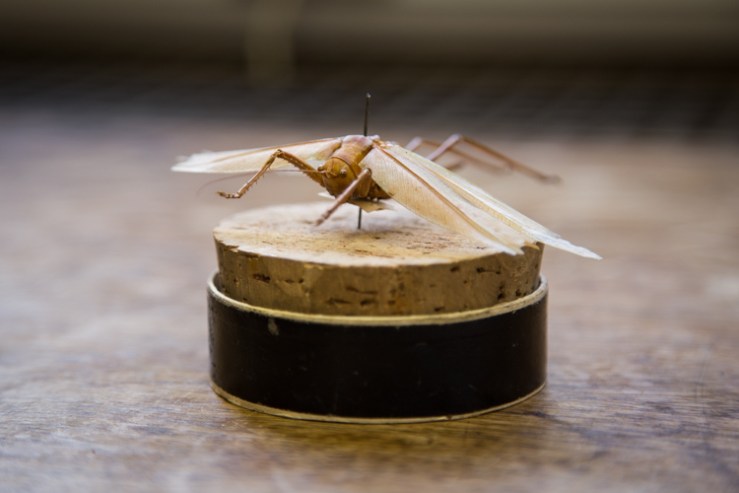
Bush cricket, family Tettigoniidae
IMG_4268
Amoret from Life collections installs a letter from Darwin to Hope

Today we’ve installed a brand new Presenting…  display, in a posh new case. With humidity control and UV protection, this standard-leading unit gives us the opportunity to showcase some of the really special and fragile specimens from the collections. We’re launching tomorrow with a display of insects collected by none other than Charles Darwin.

As well as showing off some specimens collected by the great man in Australia and Tasmania, Darwin’s Insects will tell the story of his close friendship with Frederick William Hope (1797–1862), founder of the Hope Department of Entomology in this Museum. Hope was one of the most eminent entomologists of his time and when Darwin collected insects he often turned to Hope to help identify them.

Preparing specimens in the Life collections

Darwin’s journey on HMS Beagle began in 1831 and towards the end of the trip he travelled around parts of Australia and Tasmania observing and collecting many species, including the insects you can see on display. They’re displayed in pill boxes similar to the type Darwin would have used to collect the specimens originally, and you can see Darwin’s handwriting on the tiny labels.

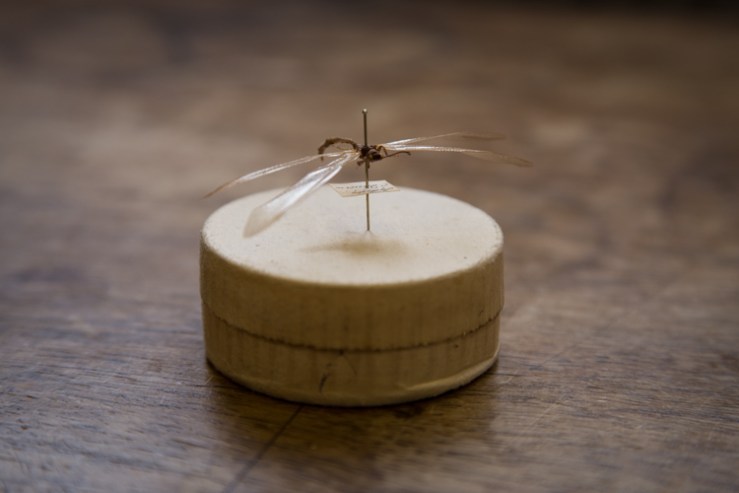
Ant lion, family Myrmeleontidae

Alongside the pinned insects, you can see one of Darwin’s letters to Hope, sent in 1837. He mentions insects that he collected between January and April 1836, which include the specimens on display. He is asking for Hope’s assistance, because so many of these insects are unknown to science. Hope was always keen to help identify new species and in another correspondence, from 1834, he promised to give Darwin “all assistance in my power” with this task.

The insects and letter will be on display from tomorrow (10 January) until 8 March. Pop in and take a look!

Rachel Parle, Interpretation and Education Officer

Presenting… pine cones great and small

IMG_4248

The Museum’s architecture is adorned with plants. Stone ferns carved by the O’Shea brothers unfurl from the capitals and wrought iron palm fronds embellish the roof. But we actually have very few botanical specimens on display in the Museum itself. The Oxford University Herbaria, by contrast, have around 1 million plant specimens in their collection and, established in 1621, they boast the oldest herbarium in the United Kingdom.

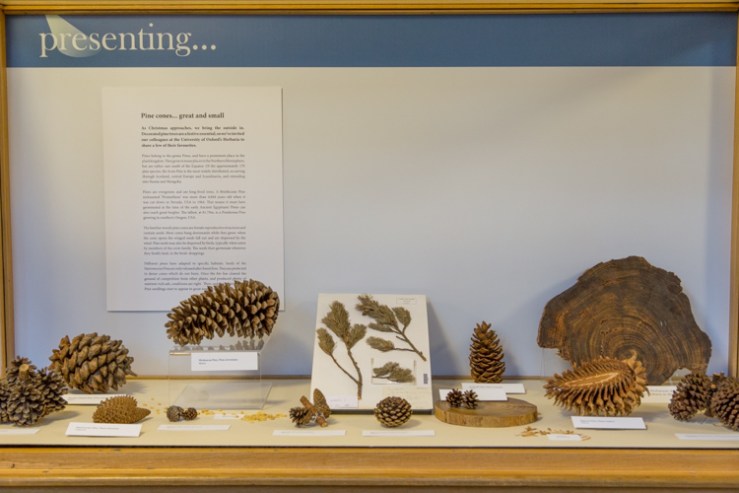
As Christmas approaches, we bring the outside in, with decorated pine trees a festive essential. This seemed like the perfect opportunity to invite our colleagues at the Herbaria to share a few of their favourites, by installing a display in our Presenting… case. James Ritchie, Herbarium apprentice, revealed the story behind these fabulous pine cones.

IMG_4249Pines belong to the genus Pinus, and have a prominent place in the Plant Kingdom. They grow in many places in the northern hemisphere, but are quite rare south of the Equator. Of the approximately 170 pine species, the Scots Pine is the most widely distributed; occurring through Scotland, central Europe and Scandinavia, and extending into Russia and Mongolia.
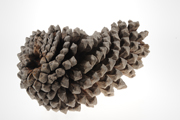
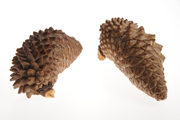
Michoacan Pine cone
Michoacan Pine cone

Pines are evergreens and are long-lived trees. A Bristlecone Pine nicknamed ‘Prometheus’, was more than 4,844 years old when it was cut down in Nevada, USA in 1964 . That means it must have germinated at the time of the early Ancient Egyptians!

Pines can also reach great heights. The tallest, at 81.79 m, is a Ponderosa Pine growing in southern Oregon, USA.

The familiar woody pine cones are female reproductive structures and contain seeds. Most cones hang downwards while they grow; when the cone opens the winged seeds fall out and are dispersed by the wind. Pine seeds may also be dispersed by birds, typically when eaten by members of the crow family. The seeds germinate wherever they finally land, in the birds’ droppings.

Narrowcone pine cone

Different pines have adapted to specific habitats. Seeds of the Narrowcone Pine are only released after forest fires. They are protected in dense cones which do not burn. Once the fire has cleared the ground of competition from other plants, and produced plenty of nutrient-rich ash, conditions are right for the Narrowcone Pine seedlings to flourish.

You can see the pine cones on display in the Museum until early in the New Year. Next in the Presenting... series will be a special selection of insects collected by none other than Charles Darwin – on show from 10th January.

Rachel Parle, Interpretation and Education Officer

Crab in the lab

After_small

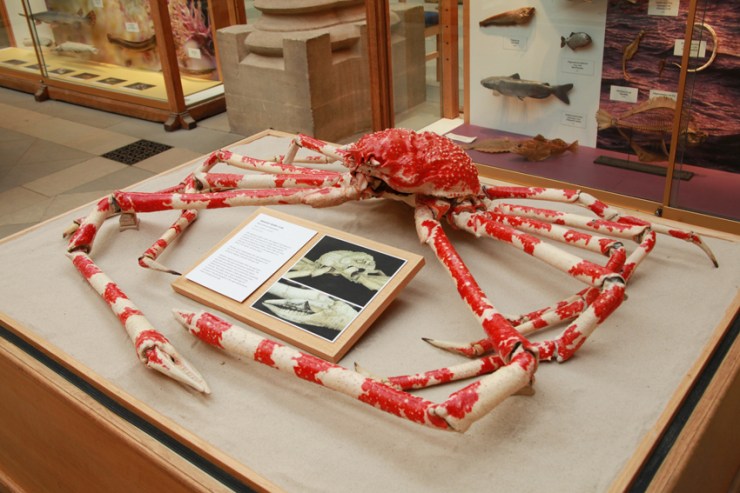
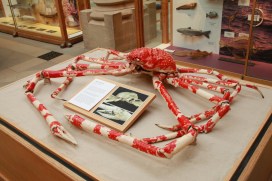
One of the most loved specimens in the Museum is the enormous Japanese Spider Crab. It’s been on display for over 100 years, so it’s unsurprisingly shown serious signs of deterioration. In July, staff in our Life collections decided that the crab should come off display and undergo conservation treatment. Bethany Palumbo, Conservator in Life Collections, took charge of this famous specimen.

The spider crab looking washed out after 100 years on display

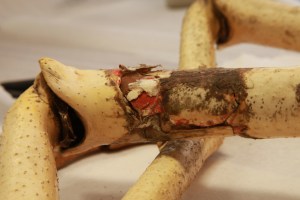
The most obvious damage was the loss of colour – the natural carotenoid pigments had completely faded due to decades of continuous light exposure under the glass roof. However, once it was taken into the laboratory for a closer look, Bethany soon realised that there were actually many areas that were fake, composed of old materials such as acidic cardboard, newspaper and even carved wood.

Some of the old filler material in a leg

These restoration efforts were causing more harm than good, deteriorating and damaging the natural shell material. The whole specimen was loosely held together with animal glue, PVA adhesive and, in some areas, tough wire which was cutting through the shell.

The first step for our conservator was to check the Museum database for information about the specimen, such as when it was donated and by whom. But unfortunately the specimen has no record, nor is it accessioned into the Museum’s collection. Although frustrating, this was important information. As it had no scientific data, Bethany could give this specimen more extensive conservation treatment, without compromising its scientific or historic integrity.

Bethany decided that treatment would consist of cleaning, the removal and replacement of old, deteriorating fill material and the restoration of colour to the shell, making the specimen true to life. These treatments, with the exception of the cleaning element, would be completely reversible.

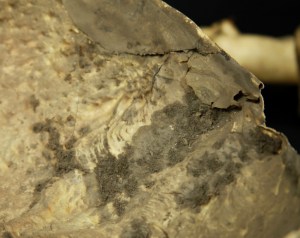
Dirt build-up on the underside of the shell

Work began by taking the specimen apart to clean and treat each section. Sections were gently vacuumed and a moist cloth used to wipe away 100 years of embedded grime. Bethany removed old fill material, softening it with water vapour to allow it to be easily peeled away.

Newly filled and coloured leg

The next task was to create replacements for the missing sections. Bethany used a combination of acid-free tissue and closed-cell polythene foam. Intricate areas like the claws proved more challenging. Replacements were sculpted free-hand from Plasticine, moulded in silicone and finally cast in Jesomite composite plaster. They now look pretty close to the real thing and are a big improvement on the old wood and paper versions.

Replacement parts made from Jesomite plaster

Before it was ready to go out on display Bethany replaced the faded colour. Japanese Spider Crabs are bright red and white in life, but ours had become washed out beige.

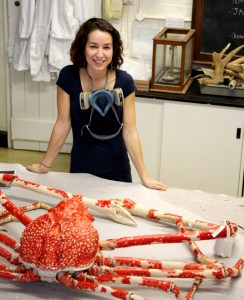
Conservator Bethany with the finished Spider Crab

Photographs of Spider Crabs were used as a reference for the colours, and Bethany also spoke to crustacean experts in the Museum to make sure it was accurate. She used an airbrush and acrylic inks, selected for their high UV resistance. The shell was coated with a barrier layer to allow the ink to be removed in the future, if needed.

Airbrushing the specimen was the most time consuming element, as it required multiple layers and various brushing techniques to make the crab look true to life. Once completed, Bethany gave the crab a final protective coating, providing good water resistance, ready for the next time it needs a good clean!

Rachel Parle, Interpretation and Education Officer

On the wing

Jones 2

Since the 1920s the Museum has had in its care an original, unpublished manuscript containing over 1,500 beautifully detailed and colourful paintings of butterflies and moths. Known as Jones’ Icones, this one-of-a-kind work was created in the late 18th century by amateur Lepidopterist and retired London wine merchant, William Jones.

The paintings depict over 760 butterflies and moths from the collections of some of the most eminent naturalists in London at that time, including the founder of the Linnean Society, Sir James E. Smith and entomologist Dru Drury, as well as Jones’s own specimens.

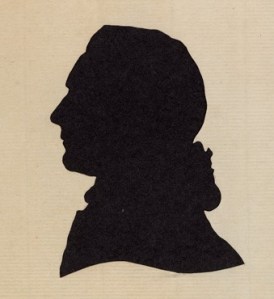
A silhouette of William Jones

In addition to being a beautiful work of art, Jones’ Icones is also an extraordinarily important document in the history of entomology and insect collecting in Britain. At the time Jones was making these paintings, many of the specimens he was depicting were being brought to Europe and described for the first time, most notably from Australia and the Oceanic region. Jones meticulously recorded these specimens through his paintings, and his work remains the only record of many of these important collections, a large number long-since destroyed, lost, or divided among private collectors.

The Icones was also consulted by a student of Linnaeus, Johann Christian Fabricius – the man credited as the first to describe over 10,000 insects. It is believed that Fabricius named over 200 species from the images in the Icones, citing Jones’ work in his publication Entomologica Systematica in 1791.

Large Copper from Jones Collection at the Museum
Large Copper butterflies (Lycaena dispar) from Jones Collection at the Museum

In spite of this manuscript’s huge importance to the history of entomology in Britain, it has never been made available beyond the reading room of the Museum’s archive. So now, after almost a century of failed or abandoned attempts, Jones’ Icones is available for all to see!

A plate from the Jones' Icones
A plate from the Jones’ Icones

As part of an HLF funded project, Flying Icons, which has been running since April 2013, all six volumes of Jones’s Icones have been digitised and made available online. A website at www.jonesicones.com has also been developed in order to promote this amazing manuscript and the related collection here at the Museum.

This website also serves another very important function: to solicit help from keen amateurs and experts worldwide to help identify all the species represented in Jones’ Icones. Identification is the first step in tracking down extant specimens of some of Jones’ paintings. It may even change our understanding of the history of the science of entomology. Can you help? If you think so, request an account and we’ll set you to task!

If you’d like to read more about Jones’ Icones – and see some large scale prints – then head to the current exhibition in the cafe area of the Museum.

Kate Santry – Head of Archives and Library

Jones

Every breath you take

IMG_3738

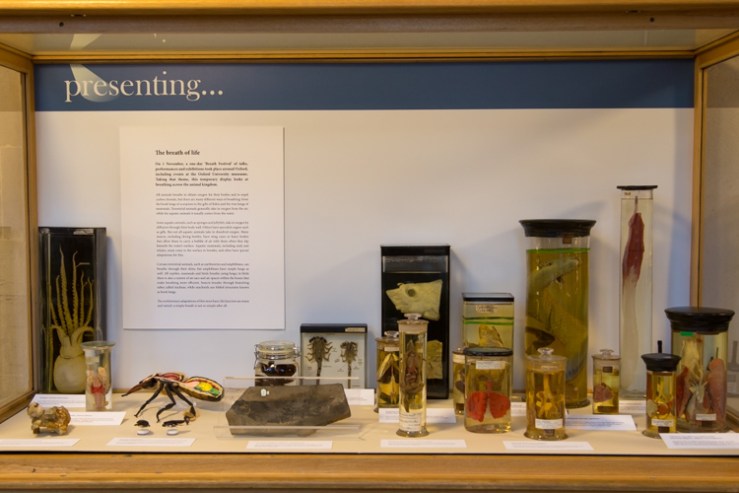
Tomorrow afternoon the Museum will host talks, tours and a dance performance as part of the Breath Festival, a unique series of events coordinated by the Oxford University Hospitals Artlink programme. To coincide with the festival we have put together a special display in our changing Presenting… case, all about breath and breathing across the animal kingdom.

There’s something of the Halloween macabre about the display too, with its pink-coloured lungs and eviscerated bodies suspended in spirit. Here’s a taster of the display, but to see the full selection head down to the Museum either for the Breath Festival tomorrow, Saturday 1 November, or at any time during the rest of the month.

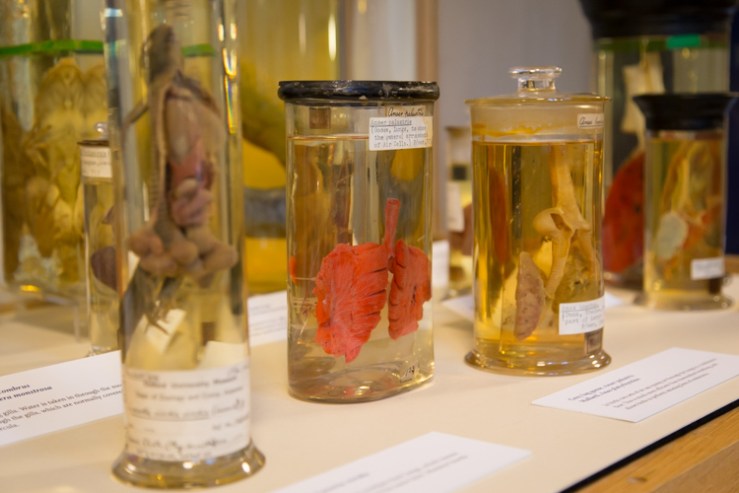
Lungs of a lizard, goose and duck.
Lungs of a lizard, goose and duck

The breath of life
All animals breathe to obtain oxygen for their bodies and to expel carbon dioxide, but there are many different ways of breathing: from the book lungs of scorpions to the gills of fishes and the true lungs of mammals. Terrestrial animals generally take in oxygen from the air, while for aquatic animals it usually comes from the water.

Crocodile and alligator lungs

Some aquatic animals, such as sponges and jellyfish, take in oxygen by diffusion through their body wall. Others have specialist organs such as gills. But not all aquatic animals take in dissolved oxygen. Many insects, including diving beetles, have wing cases or hairy bodies that allow them to carry a bubble of air with them when they dip beneath the water’s surface. Aquatic mammals, including seals and whales, must come to the surface to breathe, and often have special adaptations for this.

Certain terrestrial animals, such as earthworms and amphibians, can breathe through their skins, but amphibians have simple lungs as well. All reptiles, mammals and birds breathe using lungs; in birds there is also a system of air sacs and air spaces within the bones that make breathing more efficient. Insects breathe through branching tubes called tracheae, while arachnids use folded structures known as book lungs.

The evolutionary adaptations of this most basic life function are many and varied: a simple breath is not so simple after all.

Visitors pick out their favourite specimen

Scott Billings – Public engagement officer