Viva Volunteers!

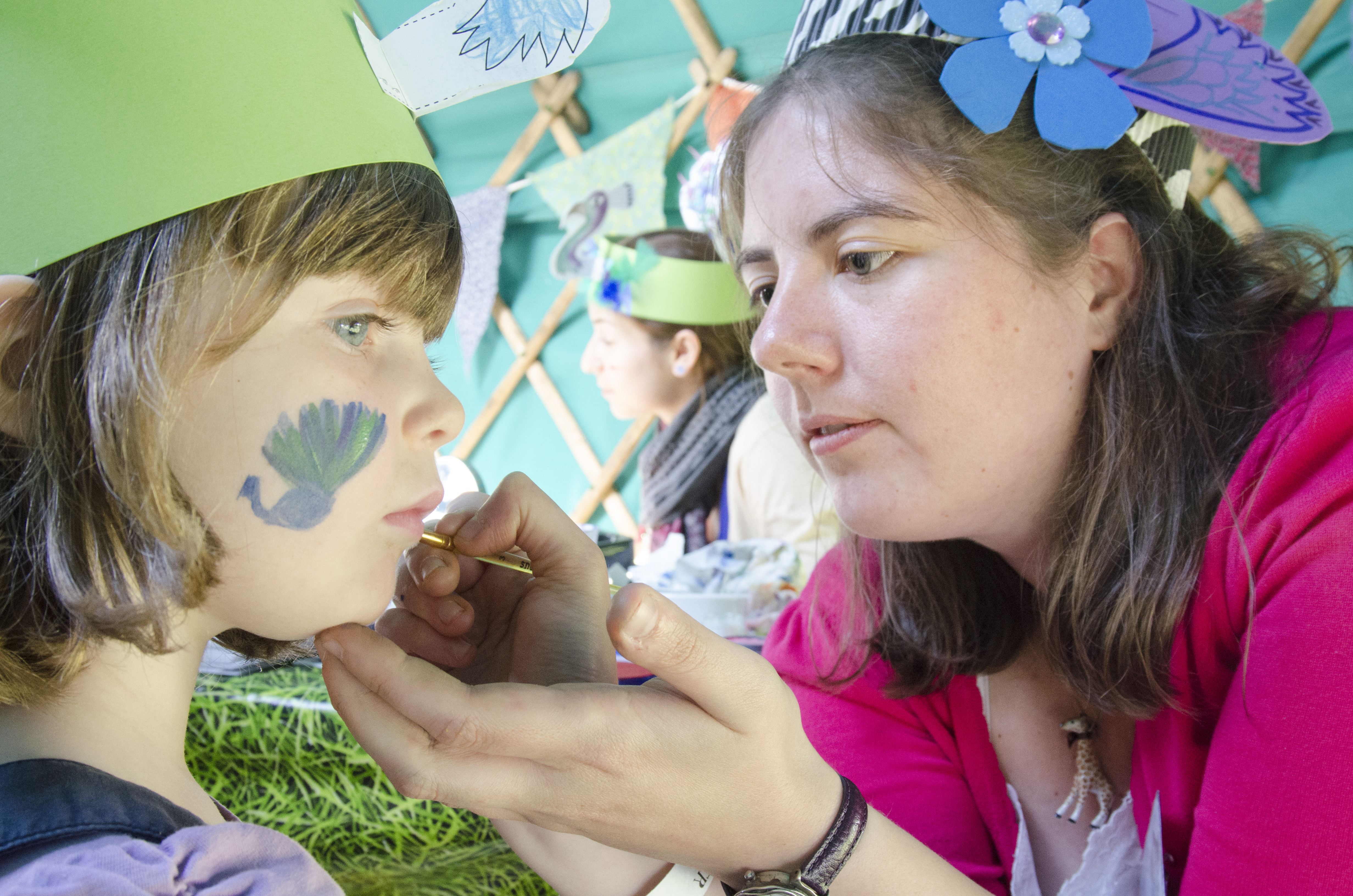
Alice facepaintingThey sort, they scan, they stick, they smile: who are they? Our team of brilliant Collections and Public Engagement Volunteers of course! This week has been the 30th anniversary of Volunteers’ Week, so we wanted to put the spotlight on them…

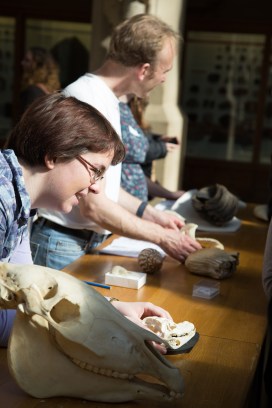
The majority of our volunteers help with public events, particularly those for our family audience. In 2014 alone, our awesome team of volunteers have given the Museum over 1500 hours of their time to help with public engagement events. This includes painting children’s faces, like the wonderful Alice Wilby (above), leading tours of the Museum’s architecture and running a pub quiz at one of our late night events. IMG_1322
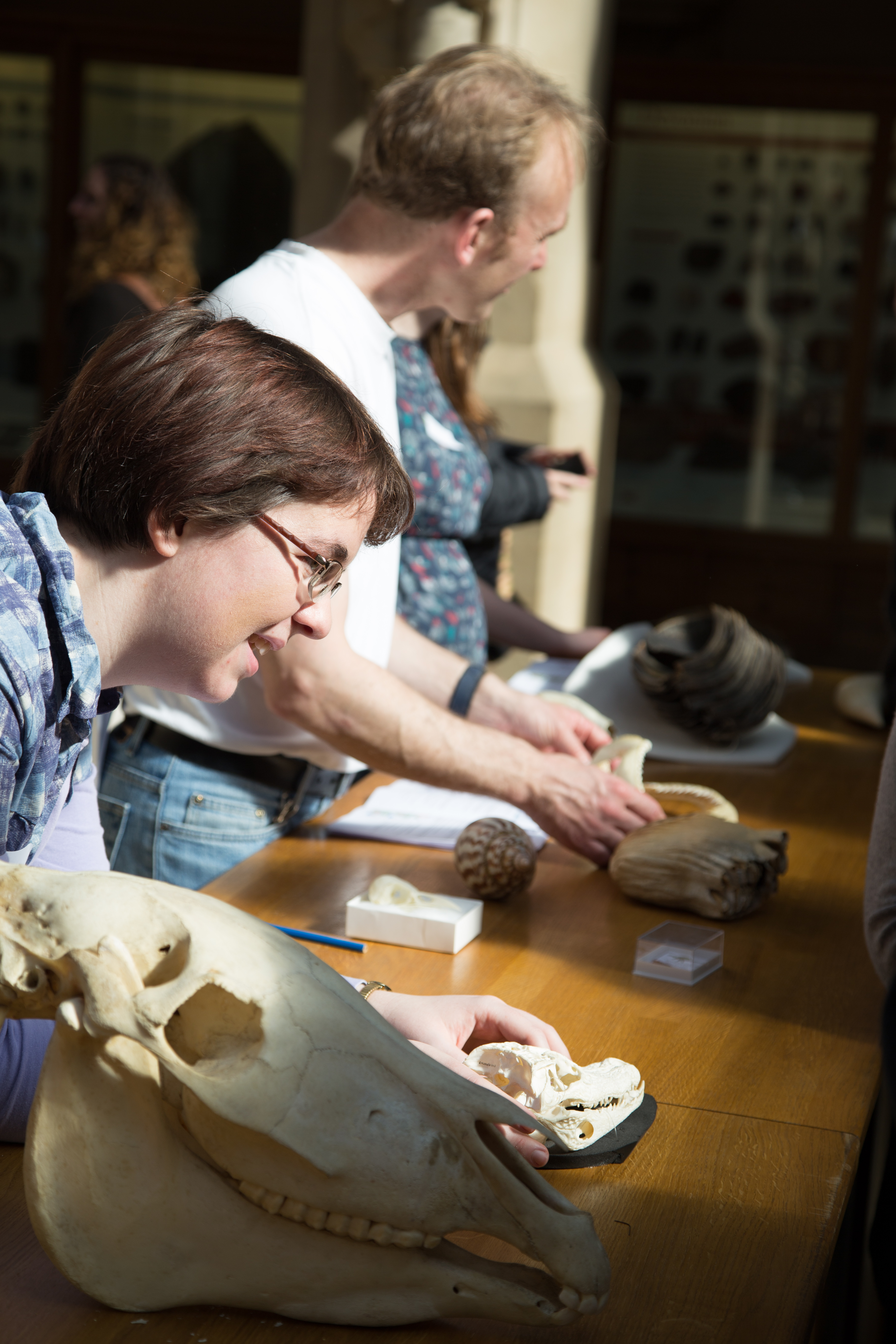
On top of that, we have a team working away behind the scenes supporting our collections staff. Here’s just a sample of the projects they’ve been working on this week…
Laura Cotton in the Earth Collections.

– 5 volunteers identifying butterflies from painted images in our Archival Collections.
– 1 volunteer working in the Life Collections sorting and cataloguing bones.
– 4 volunteers tucked away in the Earth Collections cleaning ancient horse fossils or sorting Jurassic fish teeth.

Simone Dogherty is the Museum’s Education Assistant and co-ordinator of Science Saturdays – a weekly family event aimed at older children and led entirely by volunteer scientists. So why does she think volunteers are so valuable?

We’re very lucky here to have such a large quantity and high quality of volunteers. They help us with a huge range of activities and with the increase in visitor numbers that the Museum has been experiencing since re-opening in February, I just don’t know how we’d cope without them.
For Science Saturdays we use volunteers with a specific expertise. This gives children access to enthusiastic and inspiring individuals that they can look up to. And, in return, the volunteers gain valuable science communication skills.

Fancy joining our merry band of volunteers? Whether you’re into making masks or dusting off molluscs, we need you! You can simply sign up to help out on our Volunteers website.

But what’s in it for you? Aside from the glow of knowing you’ve simply helped us do more, you can develop your confidence when working with the public, learn a new skill or get up close with the treasures stashed away behind the scenes. But that’s forgetting the most important part – you’d be joining a fantastic team of people who, like you, think this museum is a pretty exciting place to be!

Rachel Parle, Interpretation and Education Officer
Lost & Found

Lost & Found

One of the tasks of a University museum – and indeed all museums – is to communicate often complex and detailed academic knowledge to a non-specialist audience. There are lots of creative ways for us to go about this, from capturing children’s interest in nature and natural history through well-structured schools and family sessions, to the careful interpretation of specimens and subjects in exhibition displays. Another route is to collaborate with artists who can respond to and present the collections in a different manner.

We’ve been running a collaboration like this in our Life Collections since 2011, working with local artist Jane King. Jane has more recently teamed up with another Oxford-based artist, Neil Mabbs, and together they have formed Pale Blue Dot, a not-for-profit arts-science partnership that aims to raise public awareness about environmental and social concerns through exhibitions, publications and events.

IMG_1599
Jane picks out a great yellow bumblebee (Bombus distinguendus)

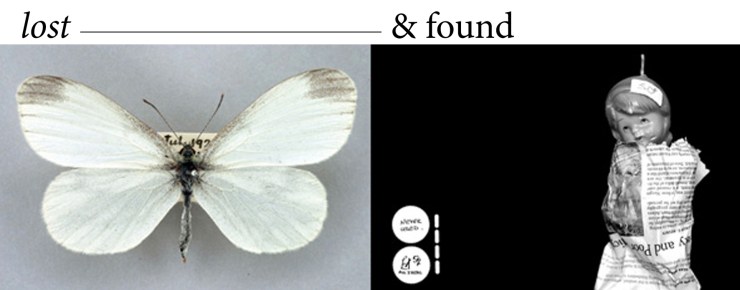
The first of these events is a multimedia installation called Lost & Found, running at the North Wall Arts Centre in Oxford from 28 May – 13 June. For this project Jane and Neil have worked with head of Life Collections Darren Mann and Amoret Spooner in the Museum, along with Professor Dave Goulson at the University of Sussex.

The Lost & Found exhibition asks whether consumerism is causing the extinction of millions of the planet’s species and the ecosystem services they provide. It uses a variety of material, including mixed media prints, photography, film and projection, 3D display, live planting, textiles, and artists’ books.

Artwork is supported by ‘Evidence Tables’ containing specimens from the Museum’s collections, as well as the results of the latest scientific research in the area. It is part of an effort by Pale Blue Dot to communicate complex scientific messages to a wider public audience.

Amoret explains the idea behind the project:

It focuses on the pollinators and decomposers that provide humans with some of the most tangible benefits in terms of ecosystem services.

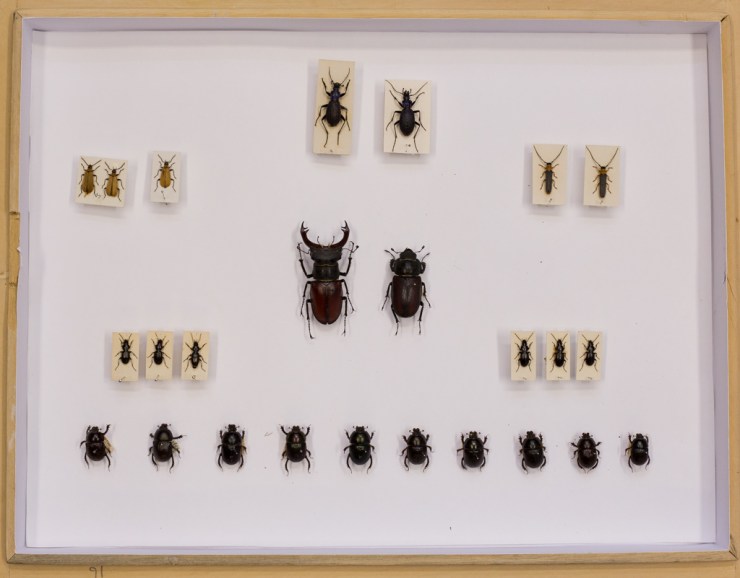
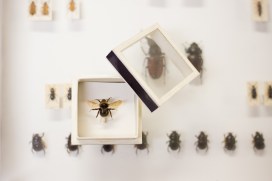
The pollinators are a group of almost 500 species of UK bees, hoverflies, butterflies and moths. Specimens from the collection are being displayed in cases to represent many of the species, as well as being utilised as source material for the artwork.

Pale Blue Dot’s Lost & Found aims to raise awareness of some of the research carried out by scientists here at the Museum that visitors wouldn’t normally hear about.

Jane and Amoret researching bee specimens

Darren’s photographs of dung beetles and his research papers on the role of dung beetles in the environment are featured. Dung beetles’ daily task of dung recycling helps increase crop yields by speeding up the release of nutrients into the soil, as well as reducing the spread of farm animal parasites and infections caused by biting insects. One of the pieces made by Jane is an artist’s book – Beetle Book – which highlights this vital ecosystem service that beetles provide to humans.

Many of our beetle, bee, moth and butterfly specimens will be on display in the Lost & Found exhibition at the North Wall, so head over there from 28 May to check it all out.

IMG_1615

Poo, pooters and pitfall traps

018

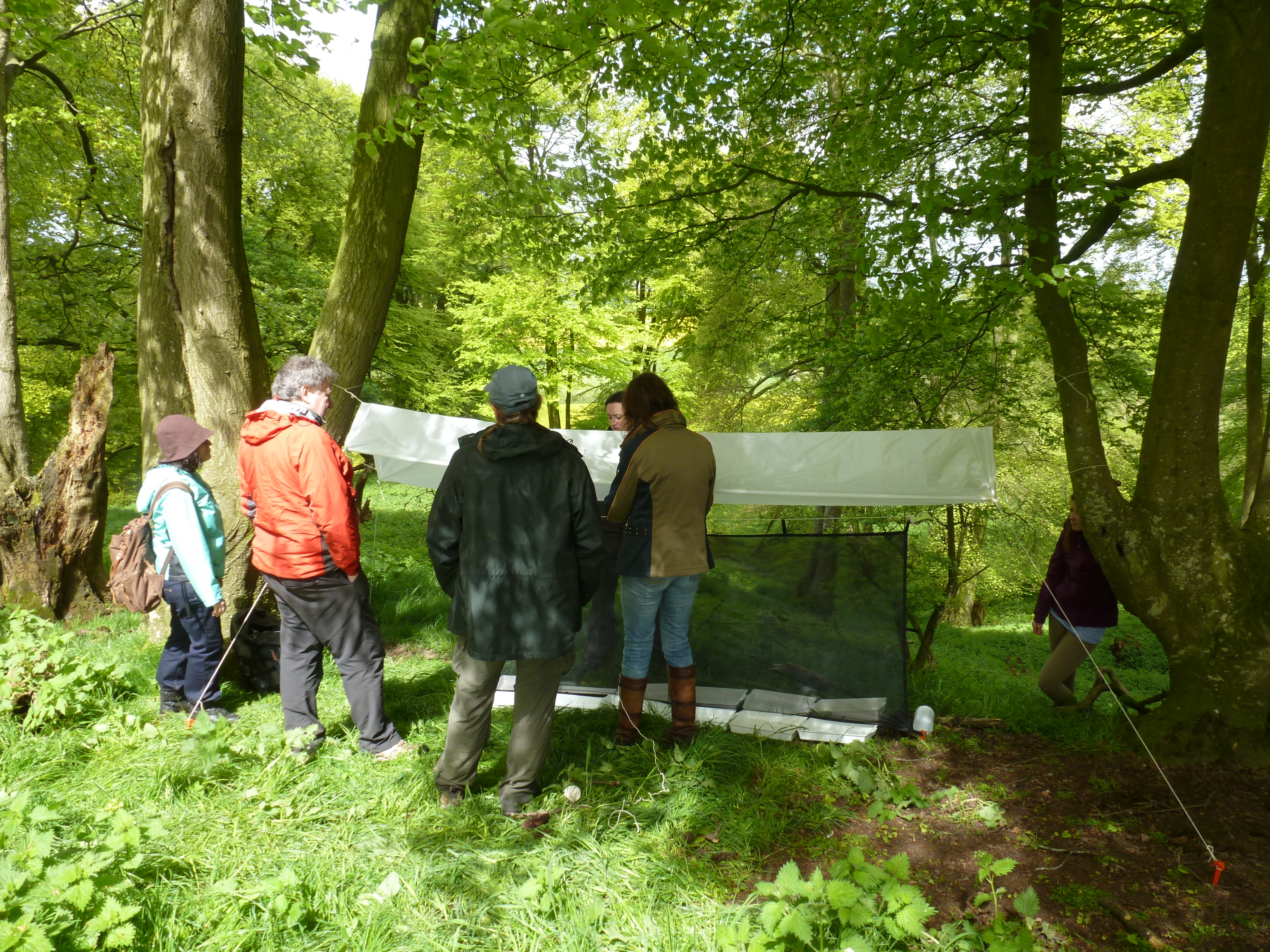
On a sunny Wednesday morning, the entomologists in the Life Collections and the Museum Director, Professor Paul Smith, left the safety of the Museum and headed out into the great outdoors. The aim of the day was to study the huge variety of insect life that’s found in the area, and to do a bit of team bonding along the way.

Zoë and Darren putting up a malaise trap

This new territory was a beautiful farm in Ashbury, in the Vale of the White Horse, which belongs to our friend and fellow insect lover, Sally-Ann Spence. If you’ve ever taken part in live bug handling at the Museum, you may know Sally-Ann as the energetic face behind Minibeast Mayhem.

Molly and I were very proud of our attempt at a baited pitfall trap

The day had been carefully planned out and consisted of putting up insect traps in the morning, leaving the afternoon free to play… in poo!

Head of Life Darren Mann taught us all how to put up a flight interception trap (FIT), a malaise trap and a dung-baited pitfall trap. Darren beautifully summed-up the purpose of the different traps, “The first two catch insects that are flying, and the dung trap catches ones that are attracted to poo.” We used sheep poo, in case you were wondering.

After washing our hands and enjoying a lovely lunch, it was time to head back out to a different part of the farm. More poo was involved. We spent a reasonable amount of time (way too long for some of you) playing in horse and cow poo looking for dung beetles – Darren’s favourites.

Clipboard, pooter and a cow pat!
Clipboard, pooter and a cow pat

Then came a short but heavy downpour of rain, followed by a chance to beat trees to coax out more insects, use pooters and swish nets around in a fancy manner. Darren talked us all through it, but essentially it was a ‘hit and hope’ method that resulted in plenty of us getting stung by nettles – all part of the great outdoors experience.

Pooters, in case you are wondering, are a vital piece of kit used to suck insects into a tube (pictured above on the clipboard) via plastic tubing – don’t worry there’s no chance of sucking one up by mistake as a little snack!

Having a good look at the goodies we found in the pond

Once everyone had collected their insects, we headed back to the farm house to have a go at pond dipping, where we saw tadpoles, dragonfly larvae and water bugs. Sally-Ann had prepared a delicious supper and we all went home happy and full.

Amo Spooner and Molly Carter, Life Collections

Saint Helena shrimps

Gnathophylleptum

Over the last few months, a number of parcels containing marine decapod crustaceans – yep, ten-footed sea beasts – have arrived at the Museum from the small island of Saint Helena in the South-central Atlantic. Saint Helena is perhaps best known as the place of exile and death of Napoleon Bonaparte, but far less well known are the marine fauna of the island, especially the decapod crustaceans.

The specimens that have been arriving for our Invertebrate Collections were collected by Dr Judith Brown of the Environment and Natural Resources Directorate in Saint Helena and Professor Peter Wirtz of Universidade do Algarve, Portugal. Until now only 36 species were known from the island, and the majority of these were collected between 1958 and 1964; only a single additional species has been recorded since, a specimen collected in 1977, but only reported on in 2007!

The present collection is being studied in collaboration with Dr Paul Clark at the Natural History Museum in London and has so far yielded upwards of ten additional species found on the island, as well as four completely new species. 

Alpheus cedrici
Alpheus cedrici – a snapping shrimp

The snapping shrimp Alpheus cedrici, pictured right, is one of the new records for the island. The species was previously only known from two specimens collected in 2008 from Ascension Island, 1,300 km further north, during this Museum’s Ascension expedition; it was formally described in 2012.

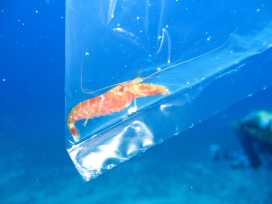
Gnathophylleptum tellei, pictured at the top of the post, is not a new record for St Helena but it is a very rare species of shrimp, currently only known from three specimens in museum collections worldwide (and now one of them is here!). The species was only sighted for the first time in 2001 in Gran Canaria and is otherwise only known from Saint Helena.

The four new species will now be described in the scientific literature, after which a new check-list of the decapod fauna of Saint Helena will be produced. It’s also clear that there’s plenty more to learn about the decapod crustaceans of the island so plans for a more focused collecting trip are now underway.

Photographs: P. Wirtz

Sammy De Grave – Life Collections


Havoc in the hive

IMG_3657

One of the most popular spots in the Museum is the live beehive tucked away upstairs. Even when the Museum seems quiet, you’ll find plenty of visitors huddled around the glass, watching the honey bees coming, going, dancing and buzzing. But if you head up to the hive today, you will notice that there’s a lot less buzzing than usual… some of the bees have abandoned us!

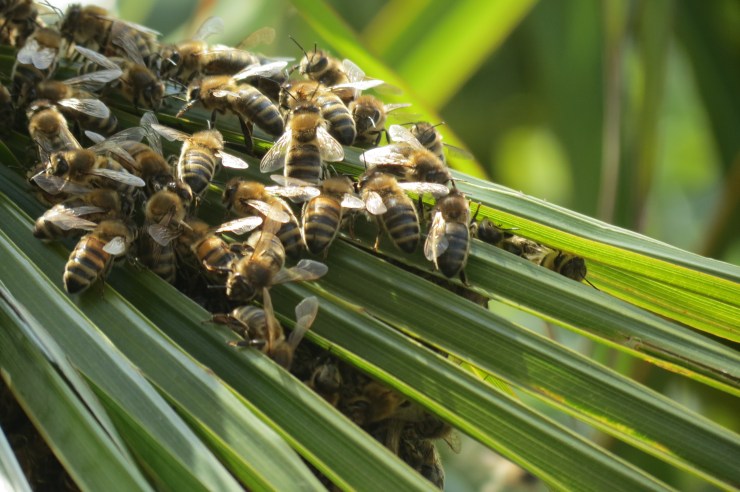
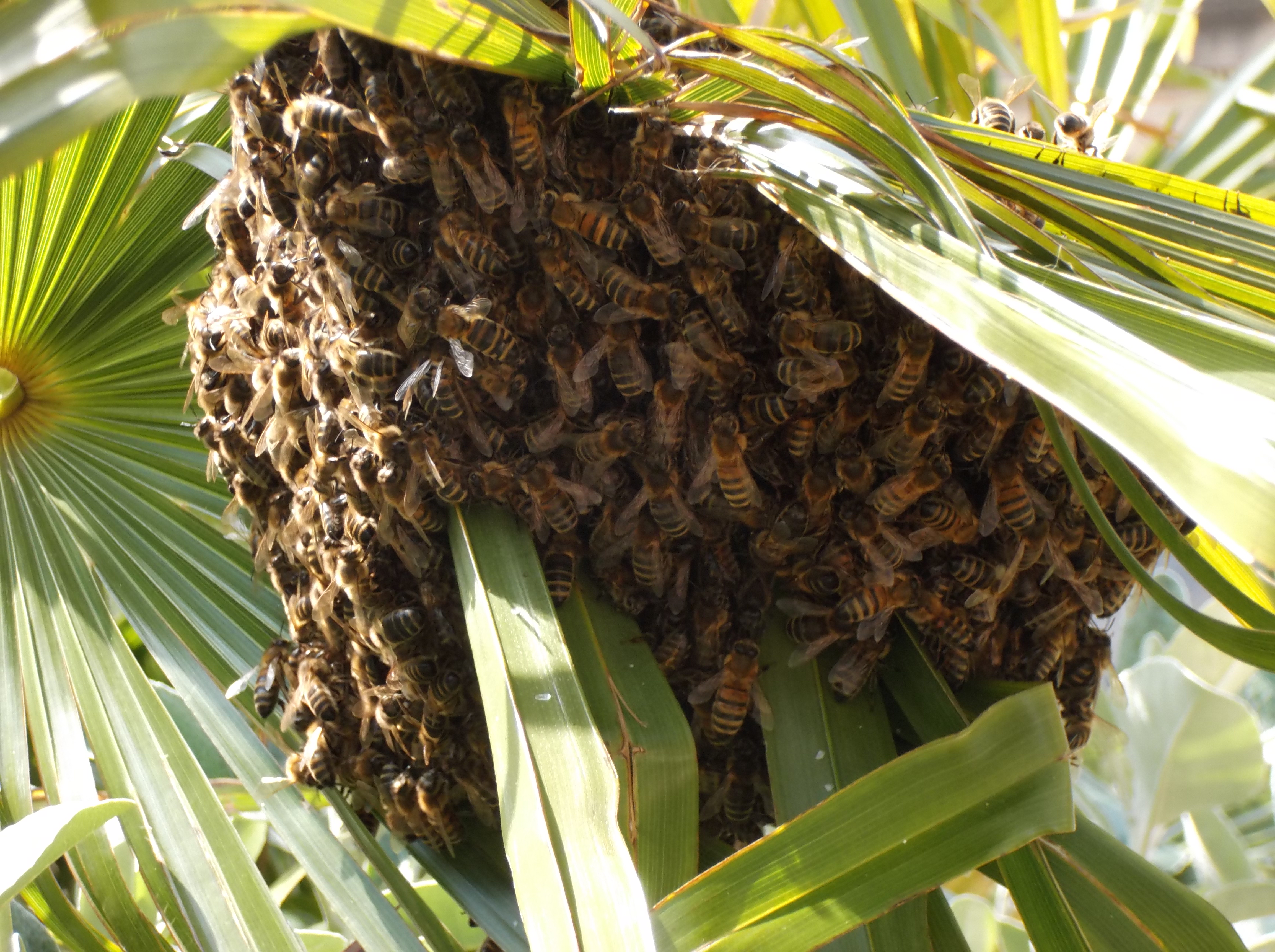
The swarm of bees gathered on a palm leaf

Last week I was sitting at my desk in the education office when Zoë Simmons from our Life Collections popped her head round the door and calmly announced, “The bees are swarming”. I must admit that I had a brief vision of angry bees chasing visitors through the Museum, or swirling cartoon-like across the lawn! But the swarm was actually a large throbbing bundle of fairly calm honey bees clustered on one of the plants outside. But why did hundreds of bees suddenly decide to leave their cosy hive and break out into the unknown?

Zoë, who’s been involved in caring for the beehive for several years explains what happened:

After a difficult beginning to the year, the observation beehive was left without a queen bee in residence. This may sound disastrous, but bees are both resourceful and well organised, and the worker bees left in the hive immediately started to feed up a number of the youngest larvae on royal jelly, to create themselves a new queen. There are three large queen cells to be spotted in the hive at the moment and we believe that one of the young queens must have emerged on the morning of the swarm. The first thing she would have done is assess the hive; it appears that it wasn’t to her majesty’s liking, as the next thing she then did was leave, taking about half of the workers bees (mostly the older ones) with her.

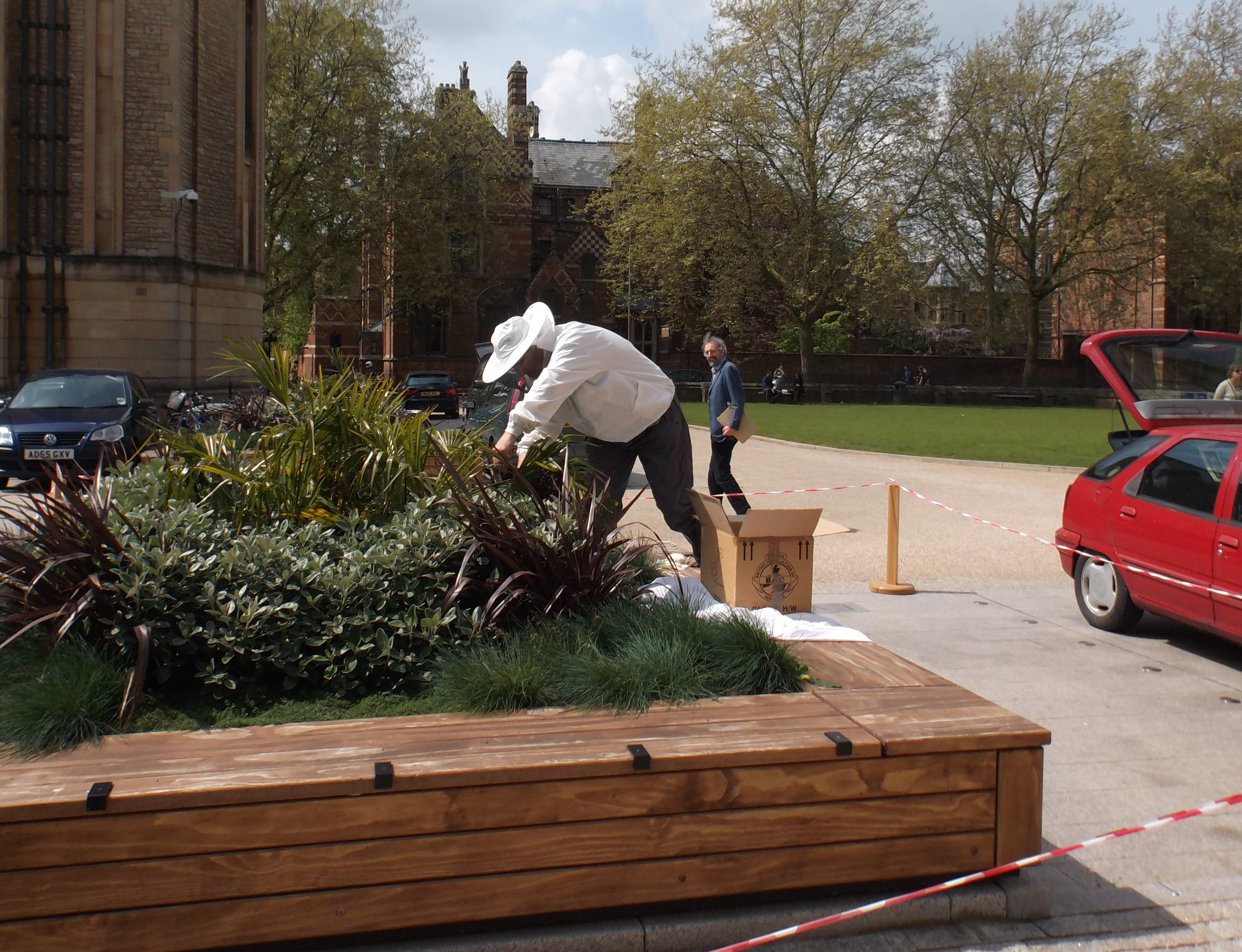
The bee-keeper gathering up the swarm

The area around the swarm was fenced off, but it attracted a lot of attention as people passed by on their way in and out of the Museum. Zoë Simmons and the Life collections team decided the swarm needed a new home:

Staff at the Museum were able to get in touch with a local bee-keeper, who rushed to the Museum to collect the swarm up. The bees have now been gathered up and taken to live in a custom built hive somewhere on the edge of Port Meadow, where we hope that they will thrive and bee happy.

Rachel Parle, Interpretation and Education Officer
Baleen at the Ball

nicolacrompton's avatarOnce in a Whale

The whales suspended for all to see The whale aisle once more open to the public

It is with much happiness (and a lot of satisfaction) we can announce that the ‘Once in a Whale’ project has been shortlisted for a Museums and Heritage Award for Excellence 2014, in the ‘Restoration or Conservation’ category. The glitzy ceremony is to be held at 8 Northumberland Avenue in London on May 14th 2014. We will be competing with some other amazing projects, including the Staffordshire Hoard Conservation Outreach Programme and the Mary Rose Trust. We are extremely grateful for the opportunity and feel that even to be shortlisted is a huge accomplishment for our little project. With thanks to the Museums and Heritage show, details of which can be found here: http://www.museumsandheritage.com/

Project Conservators: Nicola Crompton, Gemma Aboe and Bethany Palumbo Project Conservators: Nicola Crompton, Gemma Aboe and Bethany Palumbo

We’d also like to thank the Arts Council England for the Preservation of Industrial and Scientific Material…

View original post 27 more words