The ancient mariner

Helen J. Bullard is a PhD candidate at the University of Wisconsin–Madison whose research aims to tell the historical and cultural stories of the horseshoe crab. After visiting the museum, and reading the story of our Natural History After-School Club member’s horseshoe crab fossil find, Helen offered to write a guest post for the blog about these amazing, ancient mariners…

You’re reading this, so I’m guessing you like museums. But have you ever heard of living fossils? Animals such as sharks and crocodiles are often referred to as ‘living fossils’ because they appear pretty unchanged from their ancient fossilized relatives. Of course, by definition, you can’t be both alive and a fossil. But fossils allow us to become primary eyewitnesses to ancient life; we can literally see what life used to look like, how cool is that? They can also dole out some pretty valuable advice, if we just choose to listen.

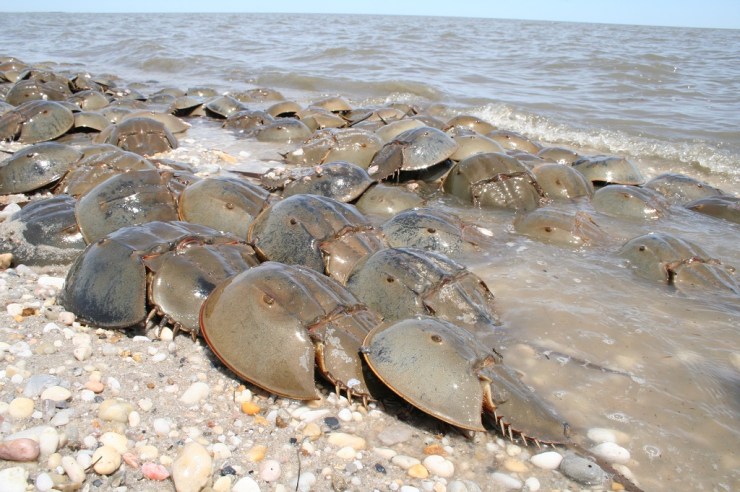
This summer during a visit to England, I spent some time at the Museum studying another so-called living fossil, the horseshoe ‘crab’. The horseshoe crab is not actually a crab, but is instead more closely related to spiders, scorpions and ticks. In fact, they are the closest living relatives of the extinct trilobites. But unlike their famous trilobite cousins, horseshoe crabs have survived all five of Earth’s major mass extinction events. Today, as a direct result of their ability to survive, the four remaining species of horseshoe crab play a vital role in global medical safety.
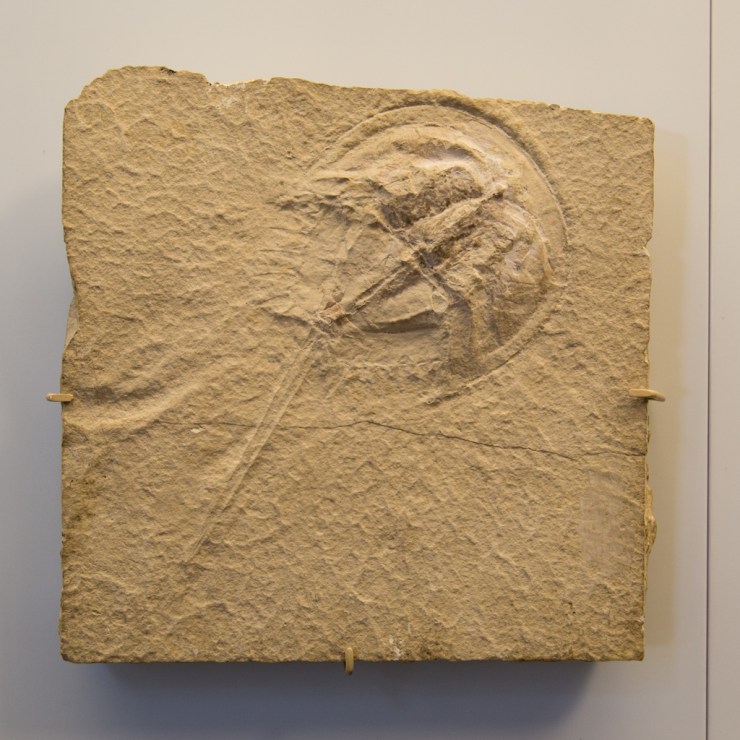
The Museum’s fossil specimen of Mesolimulus walchi, from the Upper Jurassic (163-145 million years ago), Solnhofen Germany, shows how little the form of the horseshoe crab has changed since

Not only do living horseshoe crabs look very similar to their early relations, they are also able to survive surprisingly severe injuries that often leave them missing body parts. Being able to see, through fossil evidence, how little their form has changed over time has helped to uncover the answer to this secret superpower. It lies in a very special life-saving trick that the crabs have kept for millions of years: a coagulating blood protein.
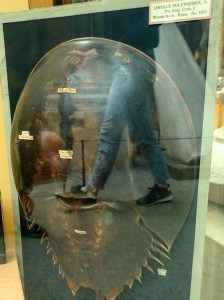
Horseshoe crabs on display in the Museum may provide food for thought for visitors

The blood of the horseshoe crab is able to clot quickly if bacteria are introduced, preventing infection, and saving the crab’s life. Since this discovery in the 1970s, this life-saving protein has been extracted from horseshoe crab blood and used in human medicine to test the safety of vaccines, medical laboratories, intravenous drugs, implants, and much, much more. The chances are that you owe a great deal of gratitude to the horseshoe crab.

But after all that surviving, horseshoe crabs, like many species, are now struggling for survival. They are losing their spawning grounds because of coastal development, industry, housing, marinas and coastal defense structures; they are collected and killed by the millions for bait, and bloodlet in their hundreds of thousands for medical use every year. It is likely that horseshoe crabs will not survive much longer.

But don’t despair. Museums are critical because they hold collections that can unlock knowledge about environmental change, and we can use that knowledge to protect life. Of course, horseshoe crabs are not alone in telling their stories through the fossils they leave – natural history museums are full of stories in stone, bones, pollen, and other traces. If you want to learn about and protect biodiversity, visit your local museum, or support organisations like Oxford’s Environmental Change Institute.

And to help the ancient horseshoe crab itself, join in with the efforts of the Ecological Research and Development Group – the crabs have saved us, so let’s return the favour.


Amber time capsules

New Museum Research Fellow Dr. Ricardo Pérez-de la Fuente talks about his fascinating work with a special collection at the Museum of Comparative Zoology, Harvard University, and what he’ll be getting up to at the Museum of Natural History. 

Amber, fossilised resin, has fascinated humanity since prehistoric times due to its mesmerising colour, shine, and fragrance when burned. From a scientific viewpoint however, what makes amber unique is the ability that the resin has to capture small portions of the ecosystem and the organisms living within almost instantaneously, in an unaltered way, preserving them for tens of millions of years. This has an unmatched fidelity among the fossiliferous materials.

Fibla_carpenteri_holotype_RPF_President_and_Fellows_of_Harvard_College
Holotype of Fibla carpenteri Engel, 1995, a snake-fly. Credit: President and Fellows of Harvard College.

During a four-year postdoctoral fellowship at the Museum of Comparative Zoology (MCZ) at Harvard University, I had the chance to curate, identify and digitise one of the premier fossil insect collections worldwide. It holds about 50,000–60,000 specimens, including around 10,000 amber inclusions. One of the unexpected outcomes of my time there was helping to rediscover a forgotten loan of about 400 Baltic amber samples that had been brought to the MCZ from the University of Königsberg during the 1930’s.  This loan ended up sparing the specimens from being destroyed during the bombardment of the city of Königsberg (renamed Kaliningrad thereafter) in World War Two. The full-story as showcased by the Harvard Gazette can be found here.

Lagynodes_electriphilus_holotype_RPF_President_and_Fellows_of_Harvard_College
Holotype of Lagynodes electriphilus Brues, 1940, a megaspilid wasp. Credit: President and Fellows of Harvard College.

As a researcher specialising in fossil arthropods, one of the most remarkable challenges for me during the digitisation project at the MCZ was to overcome the thrill to learn more about the specimens that we were imaging. In what way were they different from their modern relatives? Were they perhaps new to science? What information were they providing from the ecosystem in which they lived? At present, I can fully embrace these questions and many more thanks to becoming a Museum Research Fellow at the Museum of Natural History.

Hypoponera_atavia_cotype_RPF_President_and_Fellows_of_Harvard_College
Cotype of Hypoponera atavia (Mayr, 1868), an ant. Credit: President and Fellows of Harvard College.

My research at the museum focuses on studying interactions between organisms in deep time and their behaviours, particularly in Cretaceous amber, such as plant-insect pollination relationships around 100 million years ago. During that time, a major shift was taking place in terrestrial ecosystems due to the diversification of angiosperms (flowering plants), which ended up replacing gymnosperms (non-flowering plants) as the dominant flora. There was also the appearance of key groups of organisms from the ecological perspective — ants and bees in the case of insects, for instance.

It is a well-accepted fact that preservation in amber is biased towards small organisms because the larger ones tend to escape the sticky resin more easily. But how easy it is for one to get lost in amber when examining its secrets and trying to unravel its mysteries! Becoming forever trapped within.

Some of the most remarkable Baltic amber specimens (about 40 million years old) returned to the Königsberg collection from the MCZ. Pictures: RPF. Credit: President and Fellows of Harvard College.

Is it real? – Fossils

One of the most common questions asked about our specimens, from visitors of all ages, is ‘Is it real?’. This seemingly simple question is actually many questions in one and hides a complexity of answers. 

In this FAQ mini-series we’ll unpack the ‘Is it real?’ conundrum by looking at different types of natural history specimens in turn. We’ll ask ‘Is it a real animal?’, ‘Is it real biological remains?’, ‘Is it a model?’ and many more reality-check questions.

This time: Fossils, by Duncan Murdock

Whether it’s the toothy grin of a dinosaur towering over you, an oyster shell in the paving stone beneath you, or a trilobite in your hand, fossils put the prehistory into natural history collections. Anyone who has spent a day combing beaches for ammonites, or scrabbling over rocks in a quarry will attest that fossils are ‘real’. It is the thrill of being the only person to have ever set eyes on an ancient creature that drives us fossil hounds back to rainy outcrops and dusty scree slopes. But fossils, unlike taxidermy and recent skeletons, very rarely contain any original material from living animals, so are they really ‘real’?

Megalosaurus
The Museum’s famous Megalosaurus jaw

Fossils are remains or traces of life (animals, plants and even microbes) preserved in the rock record by ‘fossilisation’.

This chemical and physical alteration makes fossils stable over very long timescales, from the most ancient glimpses of the first microbes billions of years ago to sub-fossils of dodos, mammoths and even early humans just a few thousand years old. They can be so tiny they can only be seen with the most high-powered microscopes or so huge they can only be displayed in vast exhibition halls, like our own T. rex. Among this is a spectrum of how much of the ‘real’ animal is preserved, and how much preparation and reconstruction is required to be able to display them in museums.

Trace fossils include footprint trackways like these, made by extinct reptile Chirotherium.

Generally, the more there is of the original material and anatomy, the rarer the fossils are. Among the most common fossils found are ‘trace fossils’: burrows, footprints, traces, nests, stomach contents and even droppings (known as ‘coprolites’). Most ‘body’ fossils also contain nothing of the living creature, rather they are impressions of hard parts like teeth, bones and shells.

This ammonite fossil, Titanites titan, was formed when a mould was filled with a different sediment, which later turned to rock.

When an organism is buried the soft parts quickly decay away. The hard parts decay much more slowly, and can leave space behind, creating a fossil mould. If this later gets filled with different sediment, it forms a cast.

These sediments are buried further still and eventually turned into rocks. Alternatively, the hard parts can be replaced by different minerals that are much more stable over geological time. Essentially bone becomes rock one crystal at a time.

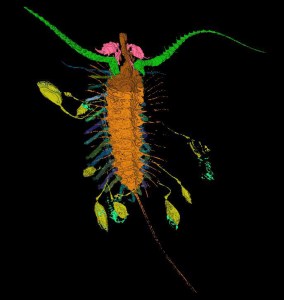
3D reconstruction of 430 million year old fossil, Aquilonifer spinosus. Found in Herefordshire Lagerstätte, which preserves ancient remains with superb detail.

Very rarely the soft parts of an organism get preserved, but in the most exceptional cases skin, muscles, guts, eyes and even brains can be preserved. If buried quickly enough an animal can be compressed completely flat to leave behind a thin film of organic material, or even soft parts themselves can be replaced by minerals, piece-by-piece. These mineralized fossils can be exquisitely preserved in three dimensions, even down to individual cells in some cases. This is about as ‘real’ as most fossils can be, except the few special cases where the remains of an organism are preserved virtually unaltered, entombed in amber, sunk into tar pits or bogs, or frozen in permafrost. The latter push the boundaries of what can really be called a fossil.

Bambiraptor feinbergi

The final step in the process, from the unfortunate demise of a critter to its eventual study or display, involves preparation. In most cases the fossil has to be removed from the surrounding rock with hammers, chisels, dental tools and sometimes acids. This preparation can be quite subjective, a highly skilled preparator has to make judgements about what is or isn’t part of the fossil. The specimen may also need to be glued together or cracks filled in, so not everything you see is always original.

As with modern skeletons, there are often missing parts, so a fully articulated dinosaur skeleton may be a composite of several individuals, or contain replica bones. This is, of course, not a problem as long as it is clear what has been done to the fossil. This is not always the case, and there are examples of deliberately forged fossils, carved into or glued onto real rocks, or forgeries composed of several different fossils to make something ‘new’, like a ‘cut n shut’ car.

So, if you see a fossil that looks too good to be true, then it just might be worth asking, “is it real”?

Next time… Models, casts and replicas
Last time… Skeletons and bones

Crayfish of the world united

by Sammy De Grave, head of research

How many species of crayfish can you name? Not many, or perhaps none? Well today, for the first time, a list of all the species of crayfish in the world has been published, thanks to a collaborative effort between Professor Keith Crandall at George Washington University and Dr Sammy De Grave, head of research here at the Museum.

The new list draws together much recent work and gives biologists access to a single, comprehensive summary of all the recognised species of crayfish for the first time. The new classifications group crayfish into 669 species, 38 genera, and five families, with two superfamilies corresponding to the Northern and Southern hemispheres.

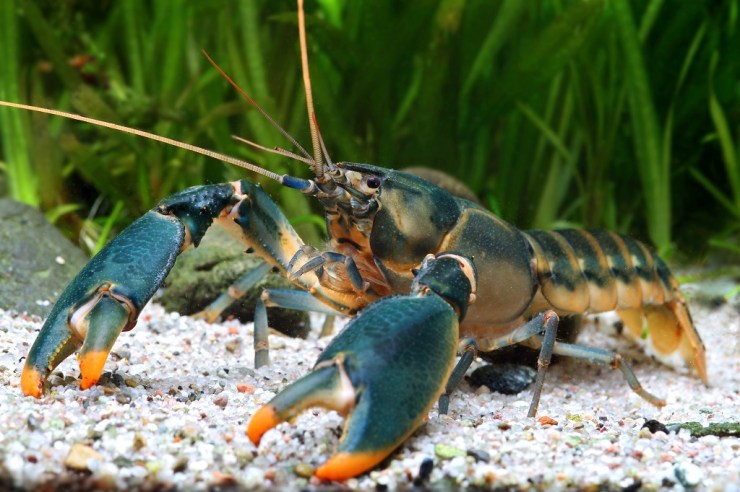
Fallicambarus devastator. Image: Chris Lukhaup

On the occasion of this taxonomic triumph it seems like a good opportunity to take a look at some interesting crayfish from around the world.

Outside biological taxonomy, crayfish are much better known as a source of food. They are eaten worldwide, but especially in the southern US, Australia, and Europe, where the Red Swamp Crayfish (Procambarus clarkii) is most commonly on the menu. As a result, the Red Swamp Crayfish has been introduced into several countries and has out-competed the local species.

Several other species are also known as invaders. The Signal Crayfish (Pacifastacus leniusculus), native to North America, is now very abundant in Europe, and is out-competing the native Noble Crayfish (Astacus astacus).

The Noble Crayfish (Astacus astacus), above, is native to Europe, but is being out-competed by the introduced Signal Crayfish (Pacifastacus leniusculus). Image: Chris Lukhaup

Another remarkable crayfish is the Marmorkrebs, a species which still has no official taxonomic name. It was first noticed in the aquarium trade in Germany in the 1990s, but no natural populations are known. But the really interesting thing about this species is that all known individuals are female: it is parthenogenetic, which means the females reproduce from eggs without fertilisation – no males involved!

The Marmorkrebs crayfish has no official taxonomic name and is parthenogenetic – all individuals are female, genetically identical and reproduce without males. Image: Chris Lukhaup

Unfortunately, Marmorkrebs has escaped from aquaria in several countries, and is outcompeting local species due to its fast reproduction. Of most concern is its occurrence in Madagascar, where it competes for food and space with the endemic Astacoides crayfish, a much larger but slower-growing species.

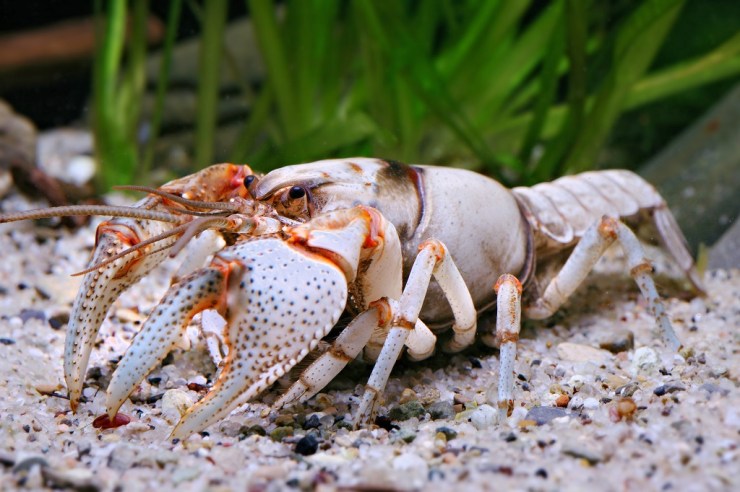
Astacopsis madagascariensi, above, is being out-competed in Madagascar by the Marmorkrebs, which has escaped from several aquaria. Image: Chris Lukhaup

The Tasmanian Giant Crayfish (Astacopsis gouldi) is considered to be the largest freshwater invertebrate on the globe. Although its size has declined in recent years due to over fishing, historical specimens weighed up to 6kg and could reach 80-90 cm in length.

The completion of the new world crayfish list allows for further refinements to the conservation status of the animals too. Current Red List assessments show that 32 per cent of crayfish are already thought to be threatened with extinction, a similar number to freshwater shrimps and crabs.

It is really exciting to finally have a single source for the world’s freshwater crayfish taxonomy. Such a resource will impact a wide variety of fields that rely on crayfishes as study organisms. We hope it will also advance conservation efforts of these keystone species of highly endangered freshwater ecosystems.
– Professor Keith Crandall, George Washington University

The paper, An updated classification of the freshwater crayfishes (Decapoda: Astacidea) of the world, with a complete species list, is published today in the Journal of Crustacean Biology.

Going, going… not gone?

by Darren Mann, head of Life Collections

Extinct or not extinct; that is a question raised by a report into the status of the beetles of Great Britain, published last year by Natural England. It may sound easy to determine whether a species is extinct or not, but tiny insects can be very hard to spot, despite the best efforts of many people.

The results of the report were alarming: using the International Union for Conservation of Nature criteria, just over half of our dung beetles are in decline, five have gone regionally extinct, and a further four were classified as Critically Endangered (Possibly Extinct) in Great Britain.

Prompted by this assessment, targeted surveys were made at known historic sites for some of our rarest and possibly extinct species. Over the past two years we have already made some exceptional discoveries, including new sites and new county records for several rare dung beetles.


My favourite finds from recent field exploits are the discovery of two new populations in Gloucestershire for the Critically Endangered Aphodius quadrimaculatus, and the rediscovery of Heptaulacus testudinarius in the New Forest, Hampshire after 35 years with no records. But sadly we have failed to find four of our target species at their last known sites.

Finally, after ten years of repeated site visits, we did finally find one of our rarest species, the Ainsdale dung beetle Amoecius brevis. This small beetle, just 3.5-4.5 mm long, was first found in Britain in 1859. It’s restricted to the Ainsdale and Birkdale sand dunes of Lancashire, where there were several records from the early 20th century, one record in 1962, and four records from the 1990s.

A specimen of Amoecius brevis from the Museum, collected in 1903

The last known record was of a single specimen caught in 1996. The lack of recordings for the past 20 years, despite a large number of surveys, led us to proclaim it Critically Endangered and ‘Possibly Extinct’ in the Natural England report.

Unlike many of our other dung beetles, which prefer fresh dung, Amoecius brevis breeds in older dung of large herbivores, such as cattle and horses, and rather unusually, in the UK it is also found breeding in rabbit latrines.

So it was in pursuit of rabbit latrines that we spent five days walking up and down sand dunes, covering an area of about 5km2. We then used a fine mesh sieve and tray to search through the dung and sand beneath. When our first beetle appeared it took a few minutes for the euphoria to fade, and then to our delight a further three were found in the next handful of sand and rabbit dung, along with a few more a little way down the coast.

In one sense, proclaiming a small, inconspicuous and evidently hard to find beetle as ‘Possibly Extinct’ is premature, but without that designation who would bother to go and look? Would wildlife conservationists give it any attention?

Since the Natural England Status Review was published, surveys have been commissioned for four rare dung beetles; in the case of the Ainsdale dung beetle at least, this has proven very successful.

I hope that the rediscovery of this very rare beetle will highlight the importance of invertebrate conservation as a whole. In the meantime, our data will feed in to conservation management plans for the Ainsdale site, safegaurding this little beetle’s future.


Secrets of an ancient reptile

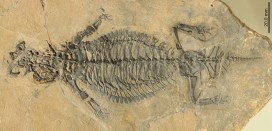
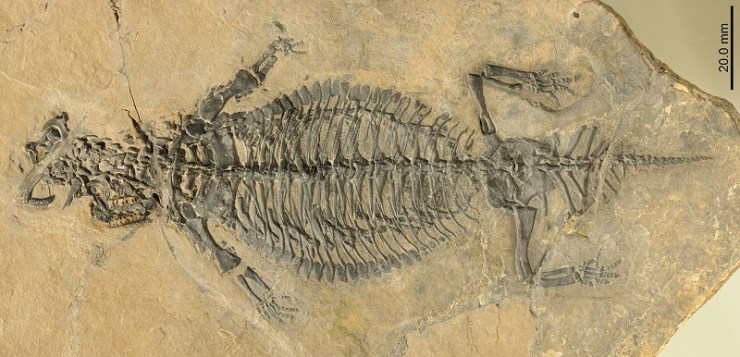
Fossil of Eusaurosphargis dalsassoi PIMUZ A/III 4380 (Credits: Dr. Torsten Scheyer; Palaeontological Institute and Museum, University of Zurich, Switzerland)

Very occasionally, exceptionally well-preserved fossils reveal new clues about poorly understood creatures. Complete, articulated skeletons are rare and, when found, offer rich insight for palaeontologists. One of our research fellows, Dr James Neenan, has been involved with just such a discovery and description, of an armoured reptile from the Middle Triassic named Eusaurosphargis dalsassoi.

A beautifully-preserved fossil found in the Alps in eastern Switzerland has revealed the best look so far at this animal. The findings about its anatomy and probable lifestyle were somewhat unexpected, according to a paper published in Scientific Reports today, led by Dr Torsten Scheyer at the University of Zurich and co-authored by James.

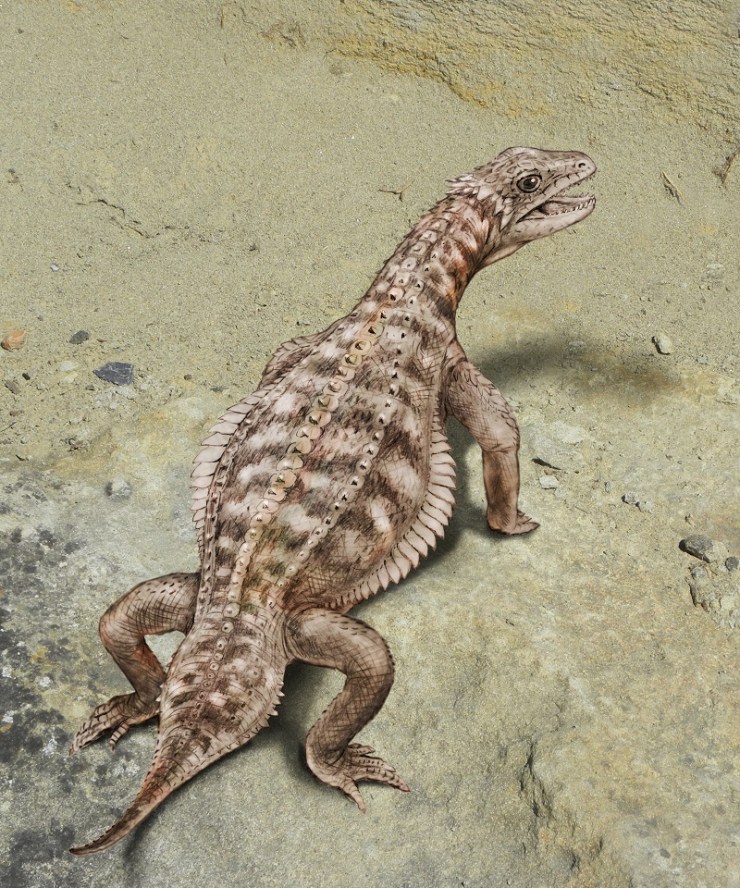
At just 20 cm long, the specimen represents the remains of a juvenile. Yet large portions of its body were covered in armour plates, with a distinctively spiky row around each flank, protecting the animal from predators. Today’s girdled lizards, found in Africa, have independently evolved a very similar appearance even though they are not closely related to Eusaurosphargis.

Life reconstruction of Eusaurosphargis dalsassoi based on new specimen PIMUZ A/III 4380 (Credits: Beat Scheffold; Palaeontological Institute and Museum, University of Zurich, Switzerland).

The new fossil, found in the Prosanto Formation at Ducanfurgga, south of Davos in Switzerland, is not the first material of Eusaurosphargis to be discovered. The species was originally described in 2003 based on a partially complete and totally disarticulated specimen from Italy. This was found alongside fossils of fishes and marine reptiles, leading scientists to believe that Eusaurosphargis was an aquatic animal.

However, the detail preserved in the new specimen shows a skeleton without a streamlined body outline and no modification of the arms, legs or tail for swimming. This suggests that the reptile was in fact most probably adapted to live, at least mostly, on land, even though all of its closest evolutionary relatives lived in the water.

Until this new discovery we thought that Eusaurosphargis was aquatic, so we were astonished to discover that the skeleton actually shows adaptations to life on the land. We think this particular animal must have washed into the sea from somewhere like a beach, where it sank to the sea floor, was buried and finally fossilised. – Dr James Neenan

The findings from the research team are published in Scientific Reports as ‘A new, exceptionally preserved juvenile specimen of Eusaurosphargis dalsassoi (Diapsida) and implications for Mesozoic marine diapsid phylogeny’.