Have you created a ‘vision of nature’ that you could share with us? During 2016, the Museum has seen some wonderful work inspired by nature and the natural environment, as part of our Visions of Nature year. To take the idea further we’d like to showcase work by our visitors and online readers too.
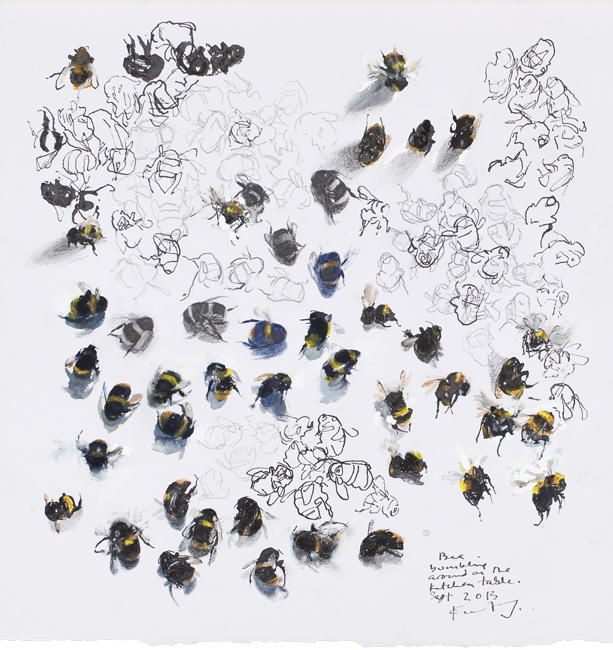
Visions of Nature kicked off with Kurt Jackson’s Bees (and the odd wasp) in my Bonnet exhibition, a celebration of the diversity of bees through Jackson’s textured paintings, mixed media sculptures and beautiful ceramics. This was followed in May by Microsculpture, a showcase of photographer Levon Biss’ extraordinary portraits of insects from our collections.
And later this autumn our three poets in residence will round off the year with a poetic vision of nature, inspired by their time here.
Splendid-necked Dung Beetle (Helictopleurus splendidicollis) from the Microsculpture exhibition by Levon Biss
The Museum’s court is often alive with visitors engaging artistically with the collections, sketchpad or camera in hand. The Visions of Nature year is the perfect opportunity to share your work with us. Whether it’s paintings, photographs, sculptures, drawings, or textiles, we would love to see what has inspired you, either in the Museum or out there in the natural world.
To show us your vision of nature, whether old or new, just Tweet or Instagram a photo of your work using #visionsofnature and tag @morethanadodo too so that we’ll definitely see it. Alternatively, you can email your photos to communications@oum.ox.ac.uk.
Then we’ll choose a rolling selection of submissions to exhibit throughout the rest of the year on the Visions of Nature website. If your image is selected we’ll get in touch to make sure you are happy for us to do this.
Today we are excited to be opening our new special exhibition, Microsculpture: The Insect Photography of Levon Biss. You may well have already heard about Microsculpture, and have perhaps watched the video showing how Levon Biss made these incredible portraits of insects from the Museum’s collection.
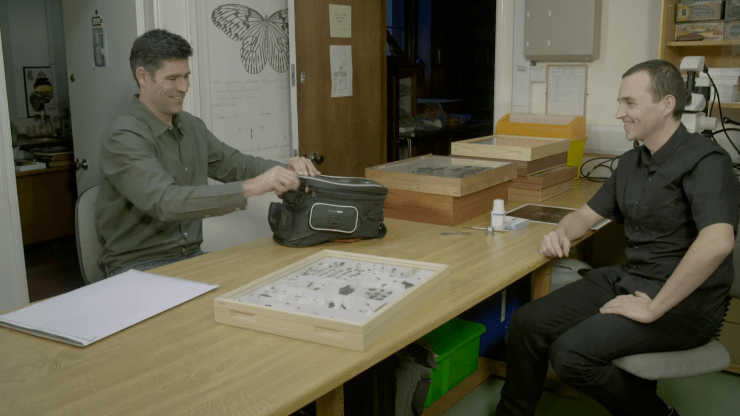
As we open the show in the Museum’s main court we wanted to give a little more insight into the process that Dr James Hogan, an entomologist in our Life Collections, went through to select and describe the specimens for the project. So I put a few questions to James to explain the making of Microsculpture from his point of view.
James Hogan (right) selecting specimens with Levon Biss
There are 23 specimens on show in the exhibition: how did you choose these particular ones? We wanted a wide variety of specimens that would all show some interesting surface detail. Some were also chosen for their spectacular colours, interesting shapes or strange appearance.
Splendid-necked Dung Beetle (Helictopleurus splendidicollis) from Madagascar. Length: 10 mm
But perhaps 95 per cent of the specimens we initially considered were rejected because we had some pretty strict criteria; very hairy specimens, which includes most bees, were out as the image processing was too difficult; the specimens had to be intact, so no broken antennae or legs.
Probably the biggest problem was finding specimens which were clean enough. Because Levon’s technique reveals so much detail, any dirt on the specimen is glaringly obvious. And the whole idea was to look at the surface structures, which are obviously very small and easily obscured by any dirt.
How did you prepare them for their close-ups? All the specimens needed a bit of preparation work before being ready for Levon’s photography. First they needed to be remounted on the end of long pins to allow more clearance space for the lighting setup. Some of the specimens are very small and fragile and this is the stage where damage is most likely to occur.
After remounting, all the insects needed at least some degree of cleaning under the microscope. For this I used a range of fine paintbrushes; we also make our own tools from micro-pins bent into different points and hooks. Again, I had to be careful to not damage the specimens – easily done by over-enthusiastic cleaning!
Where do the specimens come from? The specimens in the exhibition are from the Museum’s very large insect collection, stored behind the scenes in many different rooms. The insects in the show are from all over the world, from a back garden in England to a remote island near Antarctica. Some were collected over 150 years ago while others were collected very recently by Museum staff.
Of particular historical significance is the Tricolored Jewel Beetle (Belionota sumptuosa) which was collected by the Victorian naturalist and explorer Alfred Russel Wallace, co-publisher of the theory of evolution with Charles Darwin in 1858.
Tricolored Jewel Beetle (Belionota sumptuosa), collected by Alfred Russel Wallace in Seram Island, Indonesia. Length: 25 mm
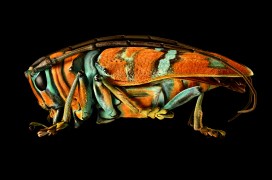
How big are the actual specimens in comparison with the photos? The actual specimens are mostly pretty small, ranging from 6 mm to about 30 mm. Some of the larger printed photographs will be about a thousand times larger than the specimen!
Orchid Cuckoo Bee (Exaerete frontalis) from Brazil. Length: 26 mm
What do you hope people will get out of the pictures in the exhibition? To me insects are beautiful creatures and Levon has done an outstanding job of revealing this. I hope the photographs will spark people’s interest in insects and inspire more people to study them.
The photographs certainly pose some interesting questions, and reveal that there is so much we don’t know, particularly about the functions of all their strange and varied adaptations.
Is it valuable to showcase specimens from the collections in this way? One of the most exciting parts of this exhibition for me was the opportunity to show part of the Museum’s collection which visitors don’t normally see.
The collection is used all the time by scientists, artists and educators, but unfortunately most of it is unsuitable for display because the specimens are so small. Levon’s ultra-high resolution photography has in a way solved this problem, allowing us to showcase some of these spectacular, but tiny and fragile creatures in all their beauty.
Since the launch of our Kurt Jackson exhibition in March, the Museum has gone a bit bee mad. We’ve had themed events for all different audiences; expert beekeepers sharing their top tips with adults, right through to little ones trying on beekeeping outfits and building a giant beehive. There’s even more coming soon, including a talk by Kurt, the artist himself, on 12th May.
Now the buzz has spread to the Presenting… case, our changing display that shows off real treasures from the collection. The Jackson exhibition focuses on some of the 270 British bees, but this smaller display gives a different perspective, exploring the amazing variety of bees found around the world.
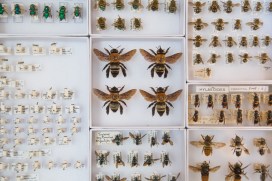
A selection of specimens from the Museum’s collection, which shows how varied bees can be.
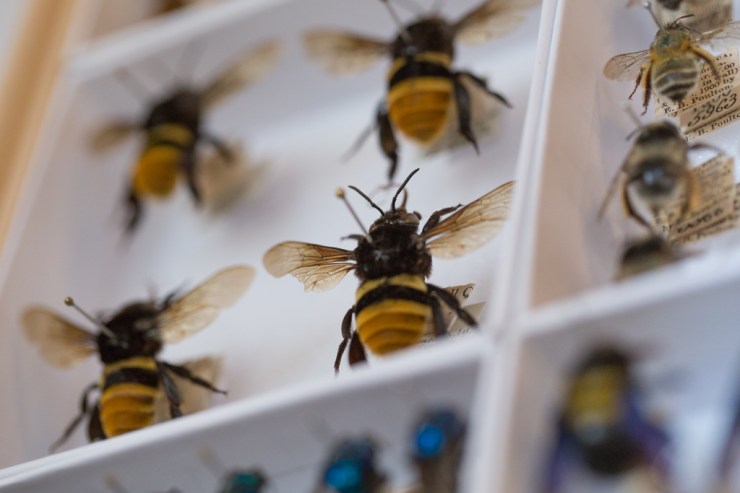
Bees are one of the major groups of insects, numbering about 20,000 described species. Only a very small proportion of bees are the familiar honeybees or bumblebees that we think of first – most species are actually solitary bees. Bees exist in a great diversity of shapes, sizes and colours. In particular the smaller species do not look like bees at all and are often mistaken for small wasps or flies.
Many bees are specialised as pollinators and have evolved together with flowering plants for over 100 million years. In return for pollination services, plants provide nectar, pollen and other substances to bees.
Although most are specialist pollinators, about 10 per cent of bee species are parasites of other bees, taking advantage of the nectar and pollen collected by their host to feed their own young. These parasitic bees can be quite strange in appearance – not needing to collect pollen they have typically lost most of their hair and appear more like wasps.
The Museum has one of the most important bee collections in the world, containing specimens collected over 200 years ago and from many different countries. The star bee specimen, and one of the Museum’s greatest treasures, has to to be Wallace’s Giant Bee (Megachile pluto). This is the first time it has been on open display to the public.
Wallace’s Giant Bee (Megachile pluto) alongside a honeybee (Apis mellifera)
It was captured by the Victorian explorer and naturalist Alfred Russel Wallace in 1859. Only found on the Indonesian island of Bacan and its two neighbouring islands, this giant was believed to be extinct until it was re-discovered in 1981. The massively enlarged mandibles of the female are used for collecting tree resin and excavating tunnels in termite nests. To give an impression of scale, Wallace’s Giant Bee is shown here next to a familiarhoneybee (Apis mellifera).
You have just a couple of weeks left to appreciate the wonderful diversity of bees, before it closes on 16th May.
Juliet and Pete painting wooden panels ready to hang Kurt’s work
In just 24 hours, our brand new exhibition will be open to the public. Bees (and the odd wasp) in my bonnethas been over a year in the making, but it’s all finally falling into place and an unexpected calm has set in.
The exhibition is an arts/science collaboration, with vibrant artwork by Kurt Jackson alongside bee specimens from the Museum’s collection and the latest scientific research on threats to British bee populations. Pop in and see it between 18 March and 29 September.
But let’s lift the gallery barrier and take a peek at some of the hard work that goes into putting an exhibition like this together.
One of Kurt Jackson’s paintings is unwrapped
Back in November 2014, we first met with Kurt Jackson to discuss a new direction in his work. Famous for dramatic, dynamic landscape paintings, he had recently become particularly fascinated by bees.
He thought the Museum would be the perfect place to exhibit his new paintings and sculptures and, of course, we agreed.
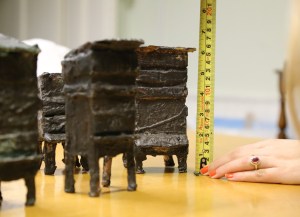
Measuring ‘Hives’ bronze sculptures
Fast forward 15 months and these works arrived at the Museum, couriered all the way from Kurt’s home and studio in Cornwall. We then spent several days unpacking, measuring, examining and photographing each of the pieces.
When the Museum takes on loan items, we need to fill in object condition reports so we can be sure how they come into the building… and how they leave at the end of the show! With 57 pieces to work through, it was a painstaking process, but we all relished the opportunity to get up close to the beautiful artworks. Holding them in our hands and visualising them on display was a special experience.
Examining the back of one of the largest paintings in the exhibition, “Vespa”.
While Kurt was painting, drawing and sculpting to create these works, we were also working hard preparing the exhibition space to show them off. Pete Johnson and Adam Fisk, from the Museum’s workshop, created large wooden panels to hang paintings, installed all sorts of intriguing 3D works and suspended fabric banners, to name but a few challenges. They’ve done a great job in creating a contemporary art gallery space in a Victorian museum.
One specimen for each of the 270 British bee species
Bees are fascinating for artists and scientists alike. The scientific specimens and text panels interspersed among the artworks draw attention to the amazing diversity of British bees (almost 270 species in total) and explore the causes of population decline.
This was put together by James Hogan, in our Life Collections, but included further expert advice from Professor Dave Goulson of the University of Sussex and Professor Charles Godfray of Oxford University, to ensure all of the research was accurate and right up to date.
As we tick off the last tasks on our to do list, I can’t wait to see the exhibition buzzing with visitors from tomorrow morning.
Rachel Parle, Interpretation and Education Officer
As mentioned in a blog post a little while ago, we’ve launched Visions of Nature, a special programme of exhibitions, talks and workshops by artists and writers whose varied work celebrates the natural environment. Things will come and go throughout 2016 but one thread will weave throughout the season – our Poets in Residence.
We welcome three poets, who will work alongside staff in our collections and out in the Museum itself to gain inspiration for their writing: John Barnie, Steven Matthews, and Kelley Swain.
But as the poets begin exploring the possibilities of their residency, we’ve asked them each to introduce themselves. The final ‘hello’ comes from Steven Matthews.
**
As a poet, I am particularly drawn by the interconnections we have with place, landscape, the shifting tides and weather, and their encapsulation in literature and art across history. My book Skying (Waterloo Press, 2012), for instance, comes back repeatedly to the work, and working practice, of the painter John Constable, who is a presiding spirit in the North Essex-Suffolk countryside near where I grew up.
‘Skying’ is Constable’s own word for the exhilaration of artistic creation – yet an acknowledgement also that creation of any kind is about ‘conquering difficulties’. I take it that those difficulties are to do with the medium, partly; the struggle with, in his case, the rendition of complex light and shadow, cloud-movements, perspectives across flat vistas of landscape, with oil paint as an awkward medium for capturing a moment in time.
For the poet, those difficulties are similarly with the medium – the struggle with words and form to capture the shifting moods inspired by landscape and family, the struggle to write directly and deeply about our relationships to the world when that world itself has become sensationally pixel-thin.
It is therefore a particular and a humbling thrill to be a poet-in-residence for what I see as the indoor-outdoor world of the ‘Visions of Nature’ project at the Oxford University Museum of Natural History. The building itself, with its iron-arched interior courtyard roof, gives the impression of an exposed nature caught beneath changeable skies.
My first experiences of the collections have been of their overwhelming abundance and of their daunting history, from insects captured by Charles Darwin on his Beagle voyage, to a new find of an immense sea-dinosaur, a plesiosaur, which we were privileged to see being cleaned. I have seen thousands of beautiful butterflies, hundreds of miraculously-coloured marble slabs, eerie animals in spirit jars.
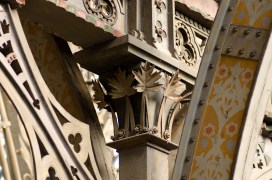
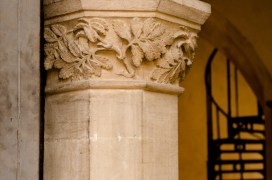
The Museum building’s natural forms are a source of inspiration for Steven.
What strikes me so far most strongly, though, are the shapes and forms all around the museum. And the juxtapositions of these shapes, which force their own rhythms. The Gothic arches against the angled diamonds of the glass in the courtyard roof; the straight lines of the lovely old display cases against the whirls and whorls of ammonites and stone carvings of plants on columns.
I’m looking forward to the difficult task of trying to capture something of those juxtapositions, and of those exciting shapes and stories, in the architecture of new poems.
As part of our Visions of Nature programme, we will be joined by three poets in residence: John Barnie, Steven Matthews, and Kelley Swain. They will work alongside staff in our collections and out in the Museum itself to gain inspiration for their writing.
As the poets begin exploring the possibilities of their residency, we’ve asked them each to introduce themselves. Here we meet Kelley Swain, a poet, writer and editor, particularly in art-science crossover genres.
**
My first collection of poetry grew out of spending my final year of university in the zoology and biology laboratories – even though I was completing a degree in English. Darwin’s Microscope was published by Flambard Press in 2009, two years after I graduated, and I was fortunate to take part in many ‘Darwin 200’ celebrations, events and readings.
This led me to fashion a niche as a ‘science poet’, and I spent four years volunteering as Poet-in-Residence at Cambridge University’s Whipple Museum of the History of Science, running public engagement events for the Cambridge Festival of Ideas and Cambridge Science Festival each year. Being affiliated with the Whipple also contributed to my first novel, Double the Stars (Cinnamon Press, 2014) about the Georgian astronomer Caroline Herschel.
For my next book, I immersed myself in the science of human anatomy, writing a verse drama, Opera di Cera, about the famous, life-sized anatomical wax Venus in the Florentine Museum of Physics and Natural History. The Museum opened in 1775, and the Venus, along with hundreds of other anatomical waxworks, are still in situ today, used as training tools for medical students, and serving as marvellous examples of artistic sculpture and the history of medicine. Opera di Cera won the Templar Poetry Prize in 2013, and was published in full by Valley Press in 2014. A long-term aim is for it to become a real opera, and I’ve met a marvellous composer who is keen to make this happen.
It was particularly significant to be invited as one of the Poets-in-Residence for Visions of Nature. I feel no more at home than in a Museum of Natural History, and after my time at Cambridge, it felt very special to be invited to get to know Oxford University better. The unique smells of the Museum’s Spirit Stores and specimen cabinets are – perhaps oddly – incredibly comforting and familiar, whispering of care, of travel, and of old knowledge patiently waiting to be unwrapped.
A good natural history museum is a microcosm of the world itself, and like Darwin preparing to set sail on the Beagle, I’m excited about the year ahead – what treasures will I find in the ship of this Museum of Natural History, and who will I meet along the way? I’m especially interested in botany, geology, cetaceans and cephalopods, but open to inspiration from any perspective. Let’s set sail!


 Have you created a ‘vision of nature’ that you could share with us? During 2016, the Museum has seen some wonderful work inspired by nature and the natural environment, as part of our Visions of Nature year. To take the idea further we’d like to showcase work by our visitors and online readers too.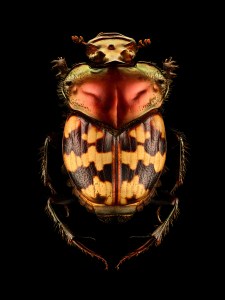




 Although most are specialist pollinators, about 10 per cent of bee species are parasites of other bees, taking advantage of the nectar and pollen collected by their host to feed their own young. These parasitic bees can be quite strange in appearance – not needing to collect pollen they have typically lost most of their hair and appear more like wasps.





 As a poet, I am particularly drawn by the interconnections we have with place, landscape, the shifting tides and weather, and their encapsulation in literature and art across history. My book
 This led me to fashion a niche as a ‘science poet’, and I spent four years volunteering as Poet-in-Residence at Cambridge University’s Whipple Museum of the History of Science, running public engagement events for the Cambridge Festival of Ideas and Cambridge Science Festival each year. Being affiliated with the Whipple also contributed to my first novel, Double the Stars (Cinnamon Press, 2014) about the Georgian astronomer Caroline Herschel.
 More Than A Dodo