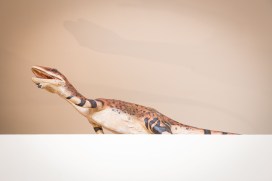
Last summer we ran an unusual competition: finding a new residence for our four metre-long model of Utahraptor ostrommaysorum. It had been hibernating in one of our off-site stores for a while, but following a reorganisation of collections we needed to find a new place for it to live. The competition to rehome the dinosaur was fierce, with 200 venues across the world vying to become the Utahraptor‘s new keeper…
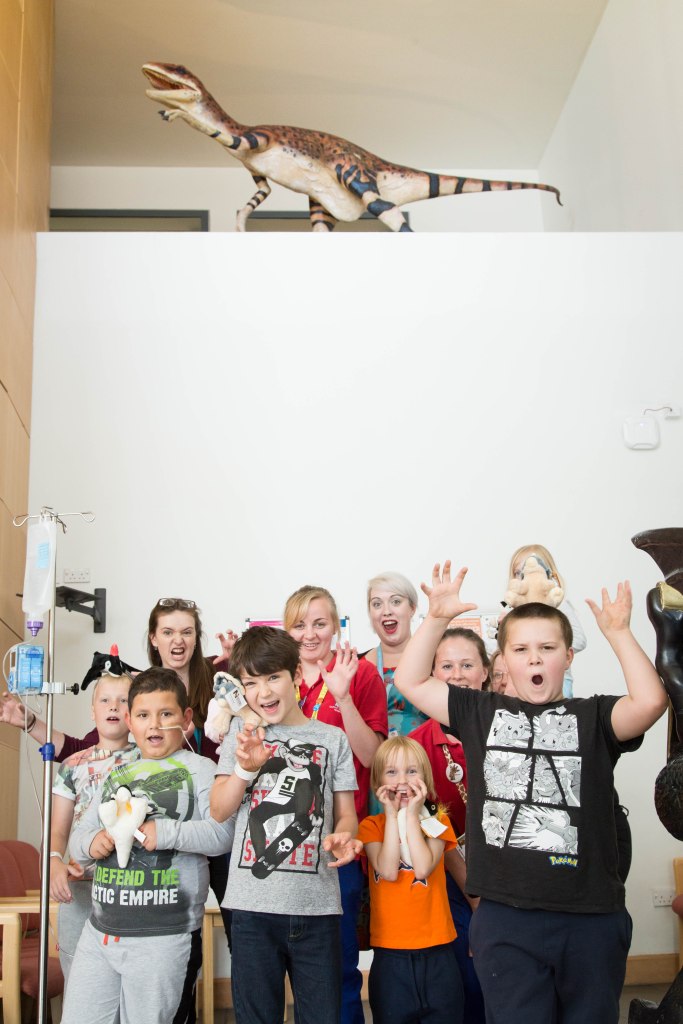
It’s taken some time, thanks to logistics and admin, but one year later we are really delighted to reveal that the Utahraptor has now been installed at the Children’s Hospital at the John Radcliffe Hospital in Oxford.
The bid to take in the Cretaceous creature came from Sarah Fletcher, who now works at the Churchill Hospital in Oxford. Sarah nominated the Children’s Hospital so that the dinosaur could amaze and inspire the young patients.
The idea of having a model Utahraptor in the hospital seemed like a lot of fun. Having been through the Children’s Hospital with my family, I knew that it would make such a difference to everyone who walks through those doors. But I never thought in a million years that we would win it – I am thrilled!
– Sarah Fletcher
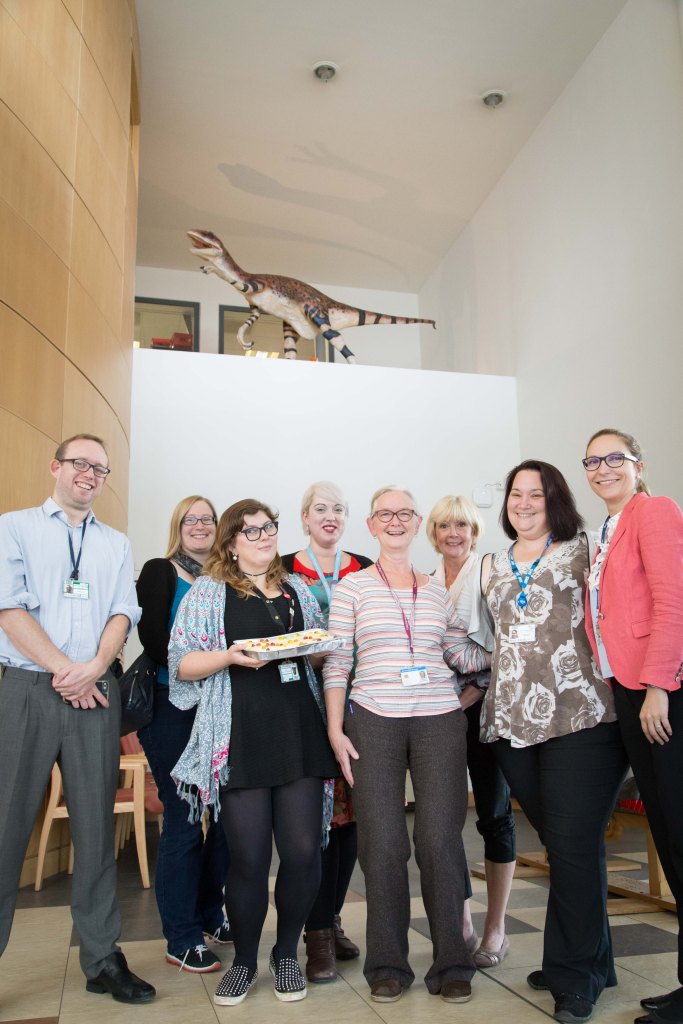
The Children’s Hospital team celebrate the arrival of their new ‘pet’
The model has been installed in the main entrance of the hospital, complete with new shadow-casting lighting, thanks to support from Oxford Radcliffe Hospitals Charitable Funds.
The team are now looking to develop new arts projects for young patients, themed around the dinosaur, including an all-important naming competition. We all hope it will bring pleasure to patients, provide a welcome distraction, and make their hospital visit a little more fun.
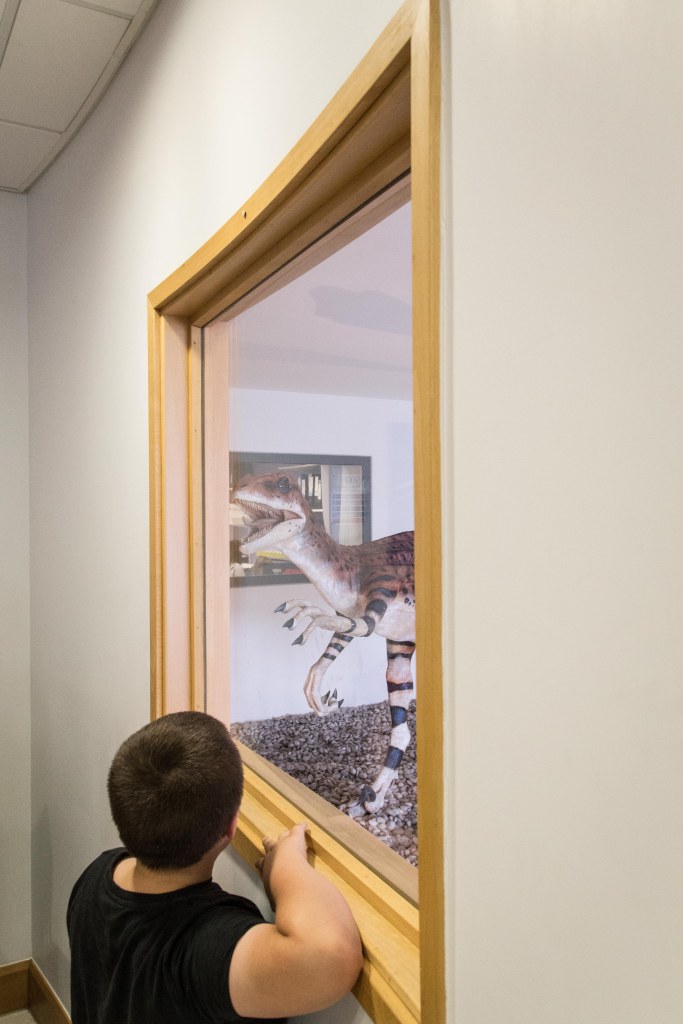
Patients, staff and visitors can peer at the dino on the way to the wards
One of the most common questions asked about our specimens, from visitors of all ages, is ‘Is it real?’. This seemingly simple question is actually many questions in one and hides a complexity of answers.
In this FAQ mini-series we’ll unpack the ‘Is it real?’ conundrum by looking at different types of natural history specimens in turn. We’ll ask ‘Is it a real animal?’, ‘Is it real biological remains?’, ‘Is it a model?’ and many more reality-check questions.
Whether it’s the toothy grin of a dinosaur towering over you, an oyster shell in the paving stone beneath you, or a trilobite in your hand, fossils put the prehistory into natural history collections. Anyone who has spent a day combing beaches for ammonites, or scrabbling over rocks in a quarry will attest that fossils are ‘real’. It is the thrill of being the only person to have ever set eyes on an ancient creature that drives us fossil hounds back to rainy outcrops and dusty scree slopes. But fossils, unlike taxidermy and recent skeletons, very rarely contain any original material from living animals, so are they really ‘real’?
The Museum’s famous Megalosaurus jaw
Fossils are remains or traces of life (animals, plants and even microbes) preserved in the rock record by ‘fossilisation’.
This chemical and physical alteration makes fossils stable over very long timescales, from the most ancient glimpses of the first microbes billions of years ago to sub-fossils of dodos, mammoths and even early humans just a few thousand years old. They can be so tiny they can only be seen with the most high-powered microscopes or so huge they can only be displayed in vast exhibition halls, like our own T. rex. Among this is a spectrum of how much of the ‘real’ animal is preserved, and how much preparation and reconstruction is required to be able to display them in museums.
Trace fossils include footprint trackways like these, made by extinct reptile Chirotherium.
Generally, the more there is of the original material and anatomy, the rarer the fossils are. Among the most common fossils found are ‘trace fossils’: burrows, footprints, traces, nests, stomach contents and even droppings (known as ‘coprolites’). Most ‘body’ fossils also contain nothing of the living creature, rather they are impressions of hard parts like teeth, bones and shells.
This ammonite fossil, Titanites titan, was formed when a mould was filled with a different sediment, which later turned to rock.
When an organism is buried the soft parts quickly decay away. The hard parts decay much more slowly, and can leave space behind, creating a fossil mould. If this later gets filled with different sediment, it forms a cast.
These sediments are buried further still and eventually turned into rocks. Alternatively, the hard parts can be replaced by different minerals that are much more stable over geological time. Essentially bone becomes rock one crystal at a time.
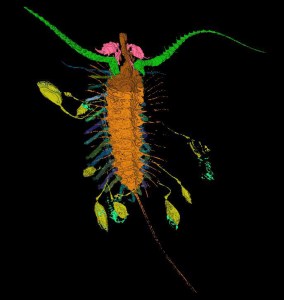
3D reconstruction of 430 million year old fossil, Aquilonifer spinosus. Found in Herefordshire Lagerstätte, which preserves ancient remains with superb detail.
Very rarely the soft parts of an organism get preserved, but in the most exceptional cases skin, muscles, guts, eyes and even brains can be preserved. If buried quickly enough an animal can be compressed completely flat to leave behind a thin film of organic material, or even soft parts themselves can be replaced by minerals, piece-by-piece. These mineralized fossils can be exquisitely preserved in three dimensions, even down to individual cells in some cases. This is about as ‘real’ as most fossils can be, except the few special cases where the remains of an organism are preserved virtually unaltered, entombed in amber, sunk into tar pits or bogs, or frozen in permafrost. The latter push the boundaries of what can really be called a fossil.
Bambiraptor feinbergi
The final step in the process, from the unfortunate demise of a critter to its eventual study or display, involves preparation. In most cases the fossil has to be removed from the surrounding rock with hammers, chisels, dental tools and sometimes acids. This preparation can be quite subjective, a highly skilled preparator has to make judgements about what is or isn’t part of the fossil. The specimen may also need to be glued together or cracks filled in, so not everything you see is always original.
As with modern skeletons, there are often missing parts, so a fully articulated dinosaur skeleton may be a composite of several individuals, or contain replica bones. This is, of course, not a problem as long as it is clear what has been done to the fossil. This is not always the case, and there are examples of deliberately forged fossils, carved into or glued onto real rocks, or forgeries composed of several different fossils to make something ‘new’, like a ‘cut n shut’ car.
So, if you see a fossil that looks too good to be true, then it just might be worth asking, “is it real”?
At this year’s Oxford Festival of Nature I ran a spotlight session on cephalopods, the group of molluscs that includes squids, octopuses, cuttlefish, nautiluses and ammonites. While many visitors recognised the distinctive shells of nautiluses, they often weren’t too sure about the animals that made them.
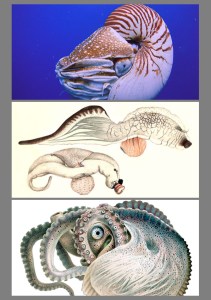
Top: Chambered nautilus (Image: Manuae) Middle: Glassy nautilus (Image: Johan Jacob Tesch) Bottom: Paper nautilus, or argonaut (Image: Comingio Merculiano)
This is not surprising because, confusingly, there are three different animals often referred to as ‘nautiluses’ and which all create strikingly similar shells or shell-like structures. This is deeply mysterious because there is no direct biological relationship between either the animals or the structures they make…
To helpful clarify just what’s going, here’s a quick guide to glassy nautiluses, chambered nautiluses and paper nautiluses, and the beautiful spiral structures they create.
Glassy nautilus
Shell of a ‘glassy nautilus’ Carinaria lamarckii.
The glassy nautilus is the outsider of the ‘nautiluses’. It is actually a free-swimming gastropod – the group of molluscs that includes snails, slugs and limpets. The glassy nautilus creates extremely fragile transparent, glass-like shells, but unlike many other shelled gastropods, it can’t retract into its shell, which only covers a small portion of the body.
These fragile shells are understandably quite rare and are said to be worth their weight in gold; unfortunately that wouldn’t be very much as they are extremely light.
Chambered nautilus
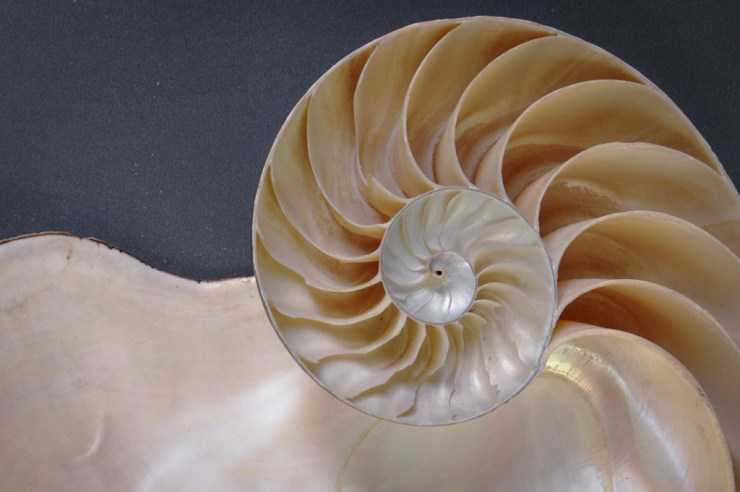
Bisected young Nautilus shell showing the internal chambers. The small tubes along the middle of the chamber walls are where a structure called the siphuncle runs; this moves fluid and gas in the chambers.
Perhaps the most familiar of the three creatures here are the chambered nautilus, cephalopods belonging to a very old group that first appeared nearly 500 million years ago. Despite being known and collected for a long time – examples of polished Nautilus shells mounted in gold and silver from the 16th century can be seen at the Ashmolean Museum – the living animals weren’t actually scientifically described until the 19th century.
‘Chambered’ refers to the internal walls of the shell which form chambers as the animals grow. The living nautilus occupies the most recently grown and largest chamber. A structure called a siphuncle runs throughout the chambers, adjusting the gas and fluid in each to aid in buoyancy.
A nautilus shell cut in half, or sectioned, is often used as a symbol to demonstrate the mathematical beauty of nature, and you’ll see it in logos worldwide. Unfortunately, as with most biology, these chambers aren’t formed with mathematical regularity; growth rates are affected by environment and diet.
It was thought that measuring the chambers in fossil nautiloids, if they were laid down regularly, could tell us how far the moon has been from Earth in the past. Disappointingly, this is not the case.
Argonauta, or paper nautilus
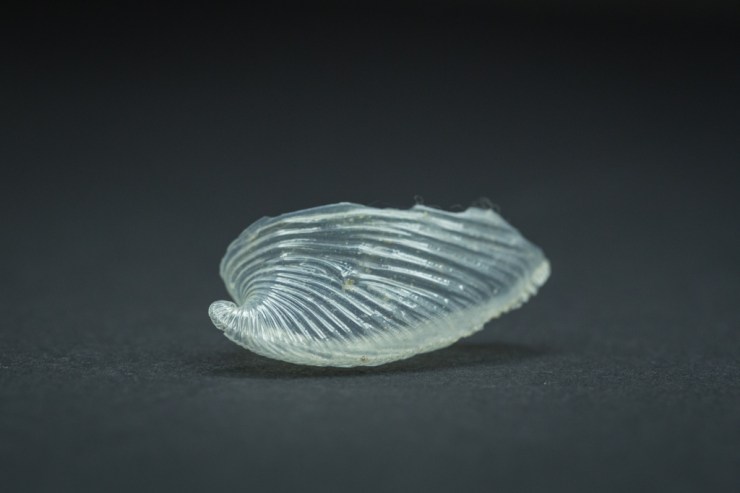
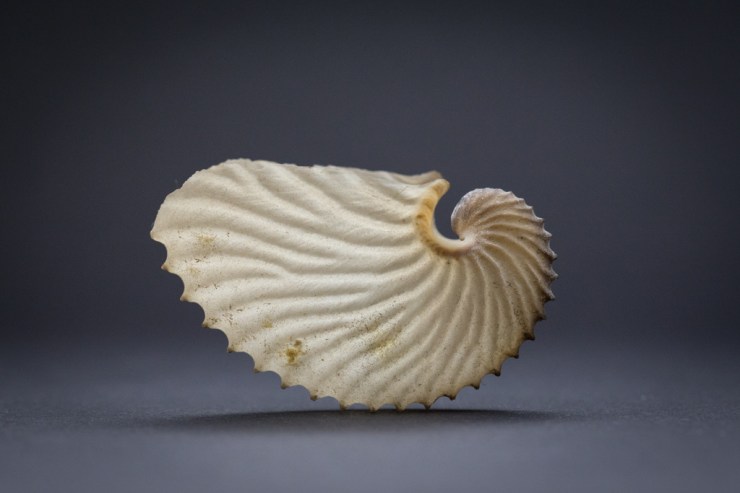
The fragile ‘paper nautilus’: the egg case and brooding chamber of an argonaut, Argonauta.
The last of our ‘nautiluses’ is the argonaut, or paper nautilus, which is a type of octopus. The structure it creates looks superficially similar to the shells of the chambered nautilus and glassy nautilus, and not surprisingly it was thought to be a paper thin shell with some affinity to the chambered nautiluses. In fact, paper nautiluses ‘shells’ are not true shells at all, but are structures secreted by female argonauts as a brood chamber for eggs.
Preparation showing series of argonaut egg cases of varying sizes.
Argonaut shells are arguably better known than the animals that make them. But unlike other kinds of mollusc shells, which can be reliably used to delineate different species, argonaut shells take a diverse array of forms across individuals thought to be of the same species. Female argonauts can also repair and replace these cases, adding to variation in their forms.
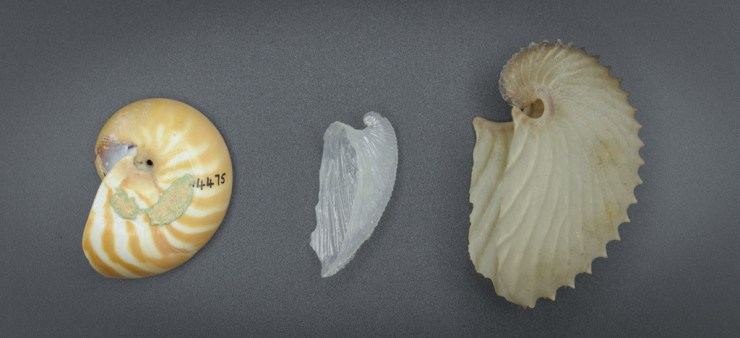
A strange similarity What’s striking about chambered nautilus and argonaut shells is their superficial similarity, despite the animals being in two distantly-related cephalopod groups. Both argonauts and nautiloids use their shells to remain buoyant in the water column but there are a myriad of different biological solutions to solving this problem, so why so similar?
The three different kinds of ‘nautilus shells’ from left to right chambered nautilus Nautilus, glassy nautilus Carinaria and paper nautilus Argonauta.
It’s tempting, though not scientific, to suppose that argonauts are somehow tapping into their deep evolutionary history of chambered shelled relatives; however, superficial resemblance aside, the shells of argonauts are chemically, mechanically, structurally and physiologically completely different to those of the chambered nautilus.
So how and when did argonauts evolve this egg case-making behaviour? Fossil examples provide little evidence of how it happened and don’t reveal whether case-making is the ancestral state that has subsequently been lost in related free-swimming cephalopods that brood their young differently.
So the strange similarity between these three structures – the shell of the chambered nautilus, that of the glassy nautilus (not a nautilus really, but a gastropod), and the egg case of the argonaut – remains a beautiful and intriguing mystery.
This bizarre creature, somewhere between fish and early four-legged land animals, is called Tiktaalik. The more scientists learn about this 375 million year-old beast, now long extinct, the more it intrigues them. Recent discoveries suggest its strong pelvis and hind limbs allowed it to move effectively through water, but also to clamber on the river bed and possibly onto mud flats.
Education Officers here at the Museum often use Tiktaalik as an example of how animals moved out of water and onto land and how that relates to the history of life on Earth. Until now, this has been a bit of a challenge: our education activities all focus on using specimens, but only a few fossilized bones remain from this ancient animal. Enter Robyn Hill, model maker! Here she explains how she tackled the task of bringing Tiktaalik to life:
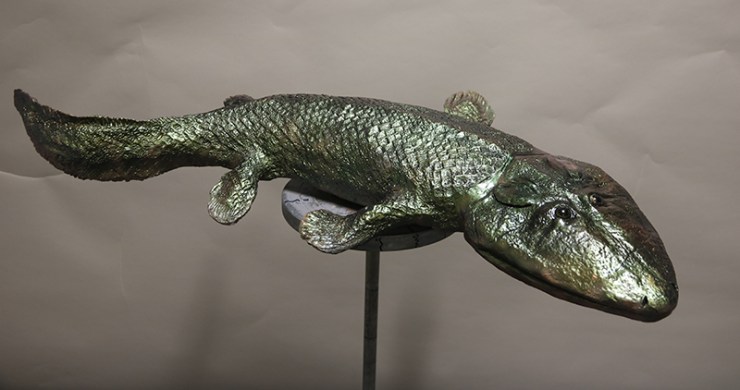
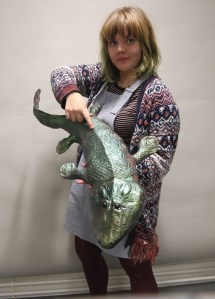
Robyn brandishes her Tiktaalik model
For the last 3 years I have been studying model-making at Arts University Bournemouth. For a final year project we were required to find a client and create a model in 7 weeks. One of my fellow students put me in contact with Chris Jarvis, an Education Officer at the Museum of Natural History, who gave me the project. He’s been very supportive and incredibly enthusiastic about the collaboration. The whole experience has been a boost in confidence as this was the first model of this type and scale I had made.
The model will be used as a tool to illustrate the story of the Tiktaalik during schools workshops. The Tiktaalik is important in the evolutionary timeline as it is the cross over between historic fish, such as the Coelacanth, and the first four-legged animals, the tetrapods.
Robyn used clay to flesh out an armature she made from steel, aluminium wire and chicken wire.
I decided to make the model out of fibreglass as it would withstand more wear and tear, such as being stroked by school children, and it is light enough to be carried by a single person when holding up and demonstrating.
The head was probably the easiest part to model, because I could use the direct evidence from fossil remains. Then it was a case of imagining where the muscles and flesh would lie over the skull. I used written explanations of the creature alongside illustrations to help me create the final look.
To make this mould, Robyn applied silicon to the clay sculpture, followed by a fibreglass jacket to add support. She then filled them with fibreglass for the final model.
When posing Tiktaalik I looked into how much the body would realistically curve. I referred to the fossil remains and animations of how it would have moved, alongside images of preserved footprints. Tiktaalik was one of the first animals with a neck, which is something I hope I illustrated in my design.
Once it was released from the mould, Robyn sanded and filled the model, then sprayed it with colour.
The Coelacanth is a living relative of Tiktaalik and has a similar type of scales, so I used images of this animal to help my research. I also looked at fish which live in similar conditions. I was experimental with the paint, as no one is certain what colour its scales would have been. I used changing pigments over a detailing layer of airbrushed cellulose paint.
On the final model, you may see a few scars: some of these I made on purpose, some made by mistake, but I believe it gives the creature more character, because it was a predator and would have had to fight for its place!
One of the most common questions asked about our specimens, from visitors of all ages, is ‘Is it real?’. This seemingly simple question is actually many questions in one and hides a complexity of answers.
In this FAQ mini-series we’ll unpack the ‘Is it real?’ conundrum by looking at different types of natural history specimens in turn. We’ll ask ‘Is it a real animal?’, ‘Is it real biological remains?’, ‘Is it a model?’ and many more reality-check questions.
Them bones, them bones… They are all over the place in most museums of natural history: suspended above you, parading around you, or towering menacingly over you in the case of the attention-grabbing Tyrannosaurus rex. When it comes to skeletons you might think the ‘Is it real?’ question is pretty easy to answer; the bones are there, tangibly real, right?
The articulated skeleton of a Barn Owl
Bones are only found in fish, amphibians, reptiles, birds, and mammals. Other animals possess hard parts which can confusingly be named using similar language, such as the cuttlebone of cuttlefish, or the ‘skeletons’ of corals. These hard parts may resemble bone but are formed in different ways to true bone like the ones we possess.
Unlike taxidermy, discussed in the previous instalment, on the face of it bones are less easy to manipulate and so less likely to be subjectively represented. But individual bones did not exist individually in life, and articulated skeletons, where bones have been attached together, have been manually reassembled to illustrate the shape of the whole animal. The accuracy of an articulated skeleton can depend on a number of things, including the skill and knowledge of the person doing the assembly, the completeness of the bone material, and even the preparation of the bones themselves.
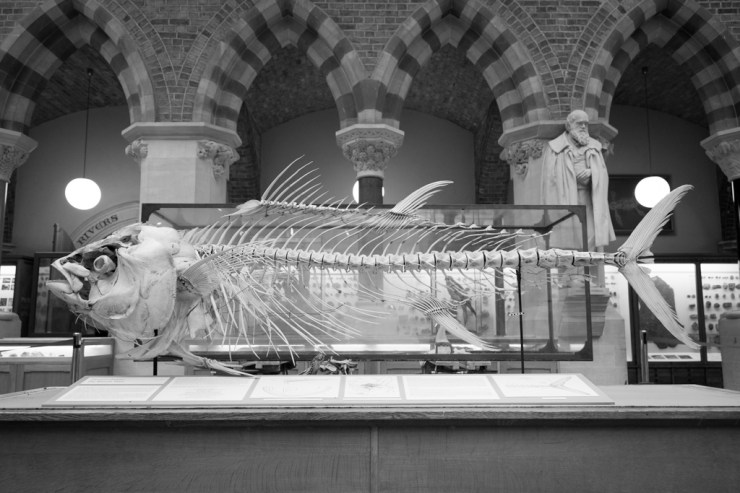
The skeleton of an Atlantic Bluefin Tuna, on display in the Museum
In life, the skeletons of the bony animals are also supported by hard but spongy cartilage and tendons which are not so easily preserved after death. Yet it is the support of the cartilage and tendons, and the form of the surrounding muscle tissue, which gives an animal its natural appearance.
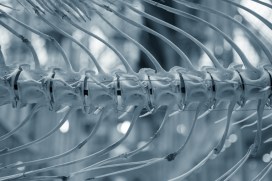
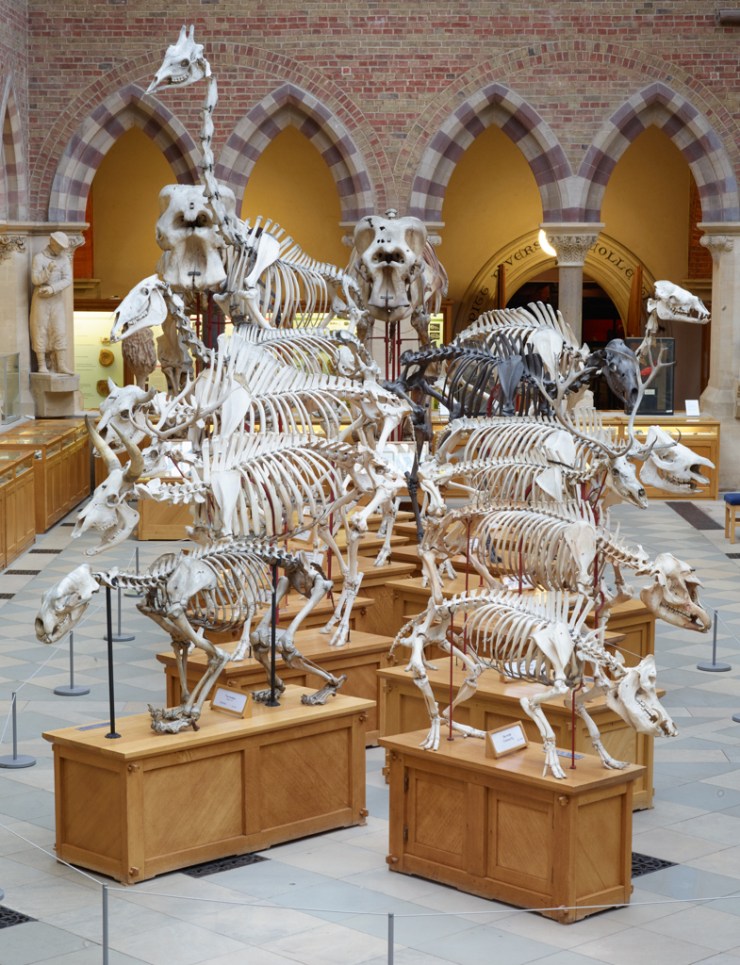
Some articulated skeletons do not account for this non-bony connective tissue. For example, all of the vertebrae in an articulated backbone may be touching each other, whereas in life there would actually be a disc in between each vertebra. Articulated skeletons are often positioned so that parts of the skeleton can be easily seen and accessed, even if the positioning is not realistic or even physiologically possible.
The Museum’s parade of articulated mammal skeletons – no cartilage or tendons in sight…
There are also lots of smaller bones which often aren’t preserved as they are too fragile or don’t attach to other bones in life. Examples include clavicles, or collar bones, penis bones, and the hyoid, a bony structure in the neck that supports the tongue. Some skeletons are composite specimens, so they may be made up of bones from multiple individuals to replace missing or damaged parts. Other parts of skeletons on display in museums may have been reconstructed with plaster or filler.
The way that a specimen is ‘skeletonised’ – the processes used to prepare a skeleton from a carcass – can also have a huge effect on the size and shape of bones, altering the size by up to 10 per cent, which can introduce errors in bone measurement, especially for small-boned bats, rodents, lizards, frogs, and fish.
So while there’s a tendency to assume that skeletons are more ‘real’ than other kinds of preserved specimens, they too have their biases. The next time you look at a skeleton try to imagine what is natural and unnatural about its construction, and ask yourself – is it real?
One of the most common questions asked about our specimens, from visitors of all ages, is ‘Is it real?’. This seemingly simple question is actually many questions in one and hides a complexity of answers.
In this FAQ mini-series we’ll unpack the ‘Is it real?’ conundrum by looking at different types of natural history specimens in turn. We’ll ask ‘Is it a real animal?’, ‘Is it real biological remains?’, ‘Is it a model?’ and many more reality-check questions.
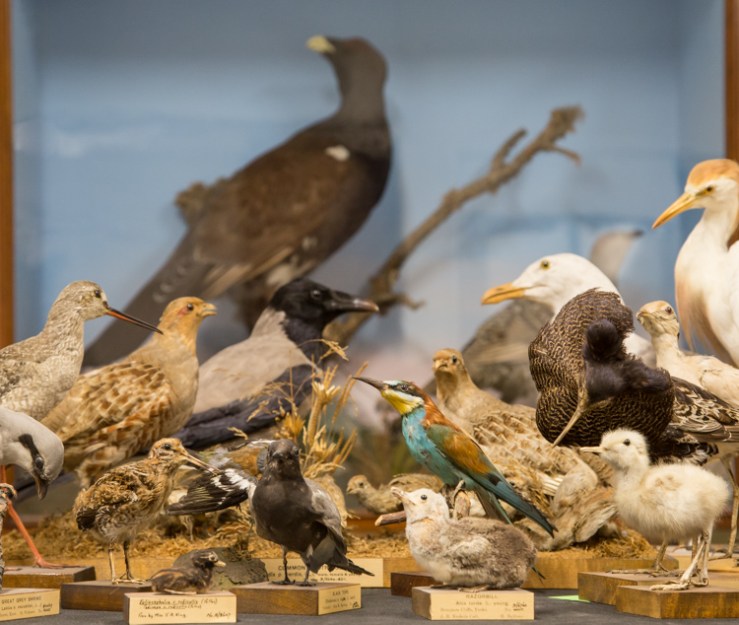
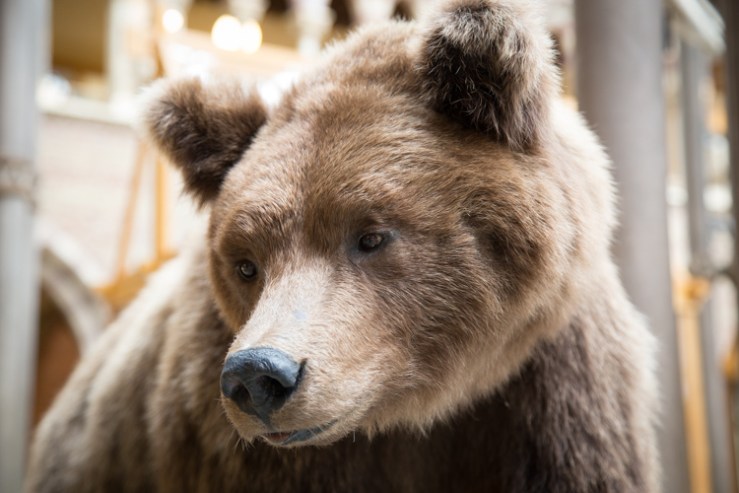
Taxidermy The Museum is well-known for its touchable taxidermy. As of today, we have two large bears, a Black Bear and a Brown Bear, greeting visitors as they enter the main court, as well as taxidermy specimens on our Sensing Evolution touch-tables. For children and adults alike, this close encounter with a taxidermy animal prompts the question – is it real?
Taxidermy, or ‘stuffed’ animals, are specimens that have been specially prepared, preserved and posed to show what the creature may have looked like in life, but real and not real here is tricky. The animal itself is, or was, a real animal – there are no taxidermy unicorns, for example. But the biologically real parts may only be the skin, the skull, and the skeleton inside the paws and feet, depending on the type of animal.
The touchable taxidermy Brown Bear greets visitors to the museum.
Inside taxidermy specimens there may be sculpted statues over which the skin is stretched; for older specimens, a wire and wood framework with paper, wood wool, straw and seeds may be used to fill out the skin. The animal’s squishy parts, which are not easy to preserve –such as eyes, lips and tongues – are normally made of glass or plaster.
Animals that have skins and skeletons that are relatively easy to preserve – including mammals, reptiles, and birds – are generally better suited to taxidermy. Marine mammals such as whales and dolphins, amphibians such as frogs and salamanders, and fish are all less common as taxidermy because their skins are harder to treat and keep stable.
Dogfish and piranha taxidermy which have been painted and varnished in an attempt to make them resemble the living animals. Note the comedic eyes on the shark.
The hard parts of skin, such as crests, wattles and skin patterns in reptiles, are susceptible to discolouring and fading in light, so these areas may be repainted to show what the animals look like in life. This introduces another ‘non-real’ element: paint.
So although there are certainly real parts used in taxidermy, there’s yet another complication in answering the question: the animals are usually posed by a human, so even their posture and appearance could be considered ‘subjective’ and perhaps therefore not quite ‘real’.
In fact, some of our older taxidermy may have been prepared by taxidermists who hadn’t ever even seen a living example of the animal they were working on. This can lead to inaccurate positioning and posing, as in the taxidermy kiwi on display in our main court.
















 More Than A Dodo