Tomorrow is the official launch of the Dodo Roadshow. Our 8 day adventure from Land’s End to John O’Groats kicks off at the southern tip of the country, before zooming on to 4 other museums during the day. It’s certainly a busy one to get us going!
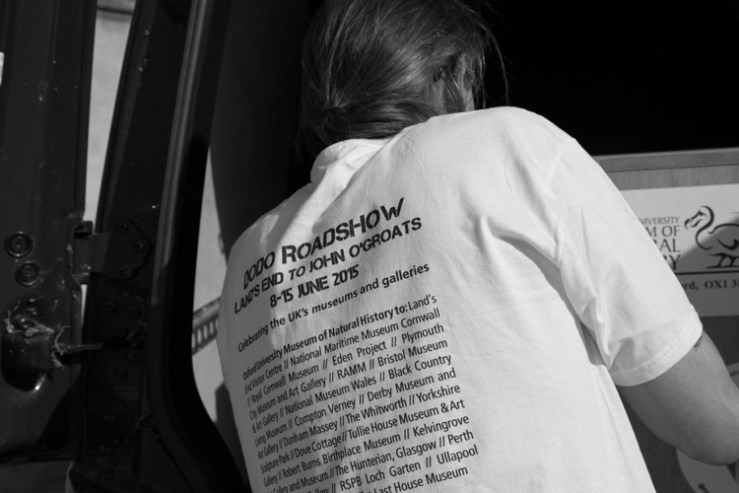
The ambitious itinerary on the back of Darren’s t shirt
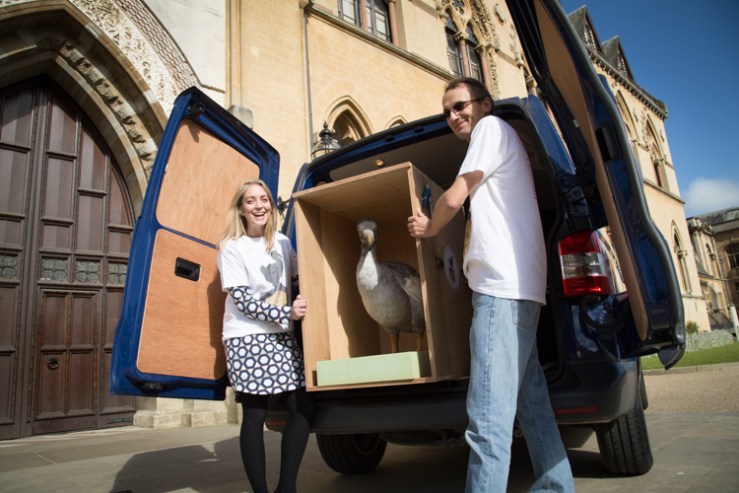
Ellie Smith and Darren Mann, part of the first leg team have packed up the Museum van with the essentials. They’ll be joined by Julia Parker and will head down to Cornwall today. Next stop Land’s End!
Ellie and Darren lift the Dodo into the van
Rachel Parle, Interpretation and Education Officer
We are definitely more than just a Dodo, but sometimes we do like to celebrate our famous specimen. This month we’ll be doing that in two exciting ways: putting the real Dodo remains on display, and taking Dodo bits and pieces on an epic tour – the Dodo Roadshow.
The Oxford Dodo display in the centre court of the Museum tells the story of the famous specimen that’s been under the care of Oxford University since the 17th century. But it doesn’t contain the real head and foot remains of the original animal: this uniquely precious specimen has to be kept behind the scenes, so it’s rare to get even a glimpse… until now!
Gently placing the Oxford Dodo into the Presenting case
As you’ll probably know by now, we’ve been shortlisted for the Art Fund Prize Museum of the Year 2015. To mark this, we’re embarking on a unique and ambitious tour of the country. Beginning at Land’s End on 8 June, the Dodo Roadshow will travel the full length of Britain in the colourful Museum van. Staff will journey all the way to John O’Groats in just one week, visiting over 20 museums and galleries along the way.
Oh, and we’ll be taking a Dodo with us too. While the original head is on display in the Museum, we’ll get the striking Dodo model out on the road, and we’ll also take along real Dodo foot and limb bones, from the same original animal as the head. These will be used as part of a ‘show and tell’ with visitors at each stop.
The Dodo model (right) which will be joining us for the adventure
But it’s not just about the Dodo. In a bid to celebrate the rich diversity of museum collections in the UK, the Dodo will meet with star objects from every museum and gallery on the tour too. And in a small expression of cultural heritage exchange, the Dodo will ‘interview’ these star objects for a series of Q&A articles, which you’ll be able to read about right here on the blog.
We wanted to do something special to celebrate our nomination for the Art Fund Prize for Museum of the Year 2015. Getting out on the road to visit museums and galleries far and wide seemed like a great way to talk about the huge breadth of collections that we have in the UK, both in natural history and well beyond.
The Dodo Roadshow is a chance for some people to meet the iconic Oxford Dodo, and for the Dodo – and us – to meet equally important objects in other museum collections.
If you live in Oxford or have been reading our blog for a while you may remember a project we created called Goes to Town: twelve specimens escaped from the Museum, set themselves up in locations around Oxford city and provided a treasure-hunt style trail around town. They then returned in time for our reopening party in 2014.
It was a fun project with many elements so we are very pleased indeed to say that it picked up the winning trophy in last night’s Museum + Heritage Awards show, in the marketing campaign category. Here’s the first video we made to promote Goes to Town:
The Museum has recently received specimens of the enigmatic deep-sea vent snail, Chrysomallon squamiferum, the scaly-foot snail. In this post, Dr Chong Chen explains why this species is so extraordinary.
*
This is no ordinary snail. First of all, it lives in deep-sea hydrothermal vents in the Indian Ocean, more than 2,500 metres deep, just beside black smokers that are churning out superheated water exceeding 350°C. Second, it is the only known gastropod with a suit of scale armour. Thirdly, the scales as well as the shell are mineralised with iron sulfide. That’s right – these snails make a skeleton out of iron, and are the only animal so far known to do so.
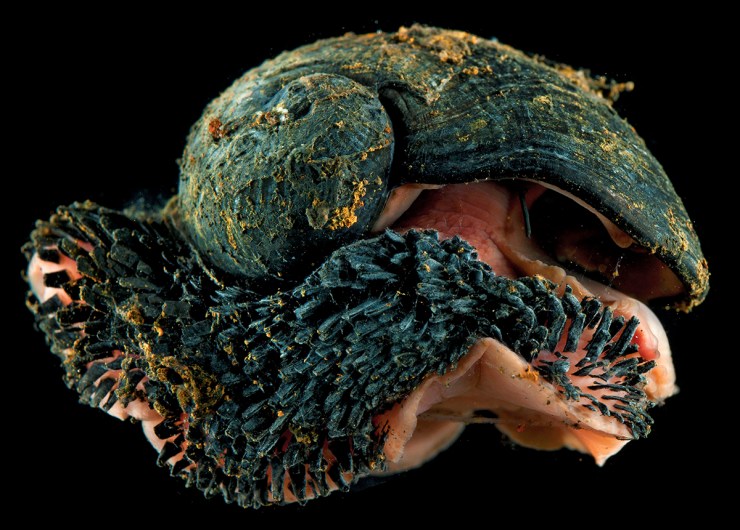
A specimen of Chrysomallon squamiferum photographed live (Photo: David Shale)
Hydrothermal vents were first discovered in the Galápagos Rift as recently as 1977. This is just off the Galápagos Islands whose fauna famously inspired Charles Darwin in the development of his theory of natural selection. Vents are deep-sea ‘hot springs’ fuelled by geological activity; the hot erupting fluid is usually acidic and contains various metals, as well as hydrogen sulfide. This is what makes rotten eggs smell bad, and is toxic to most organisms. Some bacteria, however, are able to use it to produce energy in a process known as chemosynthesis.
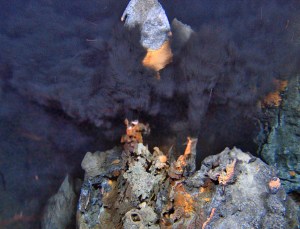
Hydra, an active ‘black smoker’ vent chimney in Longqi field, Southwest Indian Ridge
Over geological timescales many remarkable organisms have adapted to live in these ‘toxic utopia’, and flourish by exploiting the energy produced by these bacteria. The scaly-foot snail has also harnessed the power of chemosynthesis, housing endosymbiotic bacteria – bacteria living inside another creature to mutual benefit – in an enlarged part of its gut. This produces the energy it needs. In another words – it has a food factory inside its body and doesn’t even need to feed! This is likely the reason it can grow to about 45mm in size, when most of its close relatives without endosymbionts are only 15mm or smaller.
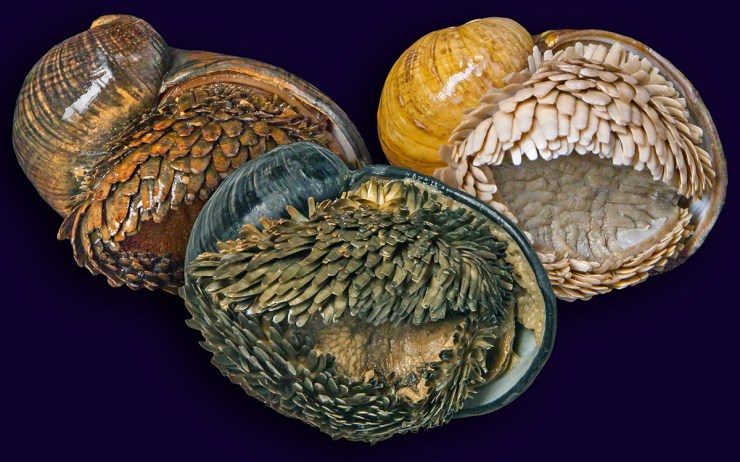
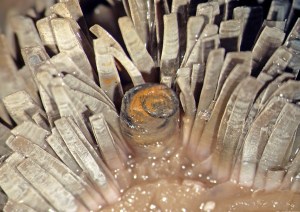
Close-up of the scales, also showing the reduced operculum in middle
Scaly-foot snails were first discovered in 2001, at the Kairei vent field in the Indian Ocean. Its discovery came as a great surprise as even among those animals specialised for living at vents, it was very, very strange. And cool. Although the shell of a snail is well-known to be modified into a great variety of forms, this is not the case with hard parts on the foot, and apart from an operculum (the ‘trap-door’ serving as a lid when the animal retracts to its shell) no other gastropods have other mineralised structures on the foot. Yet C. squamiferum has thousands of scales!
The shell, although not particularly exciting in form, isn’t exactly ordinary either as the outermost layer is made of iron sulfide. And so are the scales. So this entire animal is covered in iron compound, mainly pyrite (FeS2, or ‘Fool’s gold’) and greigite (Fe3S4). As greigite is magnetic, the animal actually sticks to magnets. The function of the scales is postulated to be either protection or detoxification but their true use remains a mystery.
The three vent fields where Chrysomallon squamiferum is known from
So why blog about the ‘scaly-foot’ now, if it has already been known to science for more than a decade? Well, actually, despite numerous studies and publications on its strange biology this species has never been formally described and named, until now. A recent paper by Dr Chong Chen (Department of Zoology, University of Oxford) and colleagues finally gave it the scientific name you see here – Chrysomallon squamiferum.
The Museum received a set of five specimens as part of the description process, which will serve as key references for scientists who wish to study this extraordinary species in the future.
Here’s a video of the Longqi hydrothermal field featuring Chrysomallon squamiferum in their natural habitat:
In just under a month we’ll be opening a brand new exhibition called ‘Sensing Evolution’. It will be a dramatic overhaul of our touchable displays, with many new touchable specimens for you to explore. Touchable taxidermy is always one of the most popular features in the Museum, but it’s been a real challenge sourcing some larger pieces for this new display.
Bethany Palumbo, our Conservator of Life Collections, has been busy researching far and wide to find the ideal specimens.
**
As well as the touchable tables that will form the major part of Sensing Evolution, we wanted an animal which would make a big impression when you arrive in the Museum. This specimen must also be obtained from an ethical source.
Mieke arrives at the Museum with the deer
Based on its availability and abundance, we decided to go for a farmed Red Deer, (Cervus elaphus) which is one of the largest deer species. The specimen, a male, was collected and prepared by taxidermist Mieke De Leeuw, from Taxidermieke in Belgium.
Work began with tanning the skin and preparing the armature. We had a few special requests. The first was that the specimen would able to fit into our walk-in freezer, should it require freezer treatment to eradicate insect pests, such as webbing clothes moth. Another request was that the specimen be reinforced as much as possible – strong enough to withstand potentially decades of affection and curiosity from museum visitors. Mieke was enthusiastic about the mount and the unusual challenges it presented.
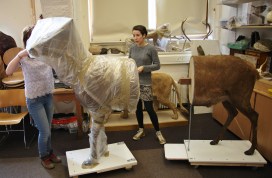
Packing up ready for freezing. All new arrivals are frozen to ensure pests aren’t brought into the Museum.
In order for it to fit into our freezer, it was necessary for the specimen to come apart into three pieces. For this Mieke devised a locking pin system, which would be completely invisible on the finished specimen. The beautiful antlers are also removable using a similar system.
Vulnerable areas of the deer were reinforced to withstand years of attention
She reinforced the specimen in weaker areas, such as the ears and the tendons of the legs, which were strengthened using metal rod. Once all the skin was glued into place, it was pinned down to keep it stable while it dried.
The deer is unpacked at the MuseumWalter puts finishing touches to the deer
Last week Mieke and her family drove from Peer, in Belgium, to deliver the specimen to us. They showed us how to assemble the beautiful specimen, before we took him all apart again for freezing.
We thank the deer’s creators, Mieke and her husband Walter, for their hard work and skill in producing such a wonderful feature for the ‘Sensing Evolution’ display.
I’ve been to see the dinosaurs at the Pitt Rivers Museum!
It’s a common exclamation, but alas, there are no dinos in the Pitt Rivers, nor totem poles in the Museum of Natural History. Rather, there are two museums with a shared front door, and a fair amount of confusion.
To address this perpetual museum muddle we present a short play, Welcome to My Museum, where the Victorian founders of each institution come to life to discuss ‘two marvellous museums under one roof’.
A small grant from the Oxford University Museums Partnership allowed a collaboration between us, the Pitt Rivers Museum, Pegasus Theatre, and Film Oxford to produce two versions of the play – one for public performance and another for a film adaptation, which is the one you can watch below.
Ciaran Murtagh (left) as General Augustus Henry Lane-Fox Pitt Rivers and Andrew Jones as Henry Acland
Working with Pegasus Theatre, Rachel Barnett scripted an imagined conversation between the founders of the two museums, Henry Acland and General Augustus Henry Lane-Fox Pitt Rivers. Pegasus helped to source actors and costumes and even a prop-maker for Pitt Rivers’s fine pufferfish helmet.
Film Oxford spent several late nights with a very patient rent-a-crowd, immortalising their adaptation of the play on film. The public performance was well attended, with over 250 visitors dropping in to watch General Pitt Rivers rudely interrupt Henry Acland’s speech welcoming visitors to his museum. Pitt Rivers rightly points out that there must be two museums as the building has two gift shops and even two differently-branded pencil sharpeners for sale in them – ‘scientifically incontrovertible’ proof!
So if you think that you have ever been to the Pitt Rivers Museum to see the dinosaurs, or the Museum of Natural History to look at the totem-pole, watch the film below and you will discover that our building is actually ‘two sublime museums under one roof’.














 More Than A Dodo