Where Do We Come From? What Are We? Where Are We Going?


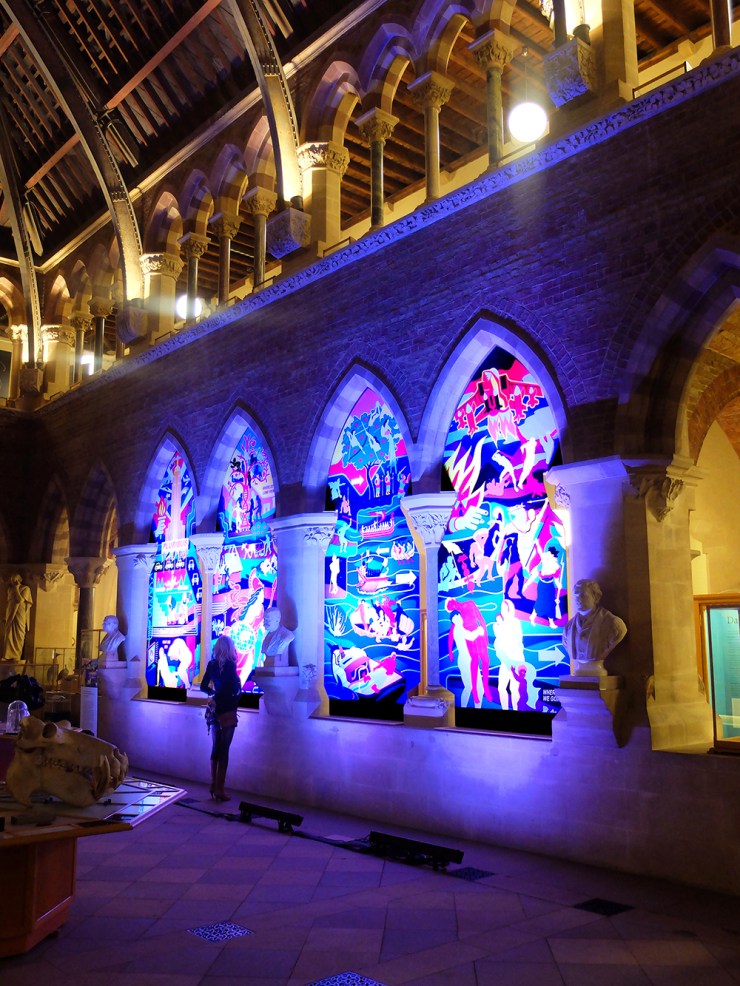
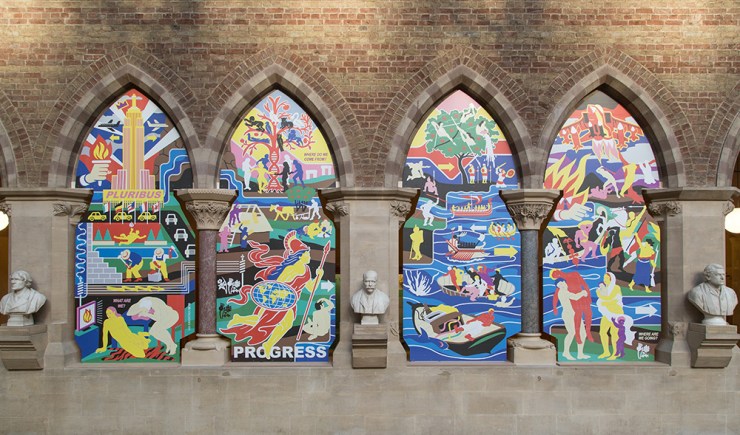
These are some of the big questions asked in our current special exhibition, Settlers. It’s also the title of a new artwork by Ian Kirkpatrick that has just been commissioned by the Museum.

You may remember, back in July we put out a call for artists to respond to the main themes of the upcoming Settlers exhibition. We received an incredible response, with almost 100 proposals, so needless to say we were spoilt for choice! After several rounds of shortlisting, discussion and deliberation, we chose Ian Kirkpatrick, a Canadian artist now based in York.

Lit up for the Settlers exhibition launch.
Credit: Ian Kirkpatrick

We were excited by Ian’s bold iconography and references to the history of art and design, while using shapes and colours usually seen on contemporary street signage. His approach to the themes and issues around migration, genetics and settlement were innovative and brave. We also couldn’t wait to see how his work would look in our Victorian neo-Gothic building.

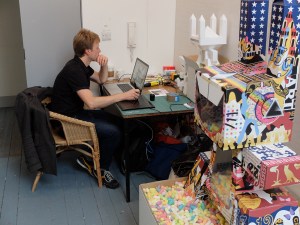
Ian working in his studio. Credit: Ian Kirkpatrick

Over a period of four months, Ian researched, planned and created his spectacular final piece Where Do We Come From? What Are We? Where Are We Going? Here he explains a little about his artistic process:
 

Most of my projects begin with a period of research – often looking at historical events or interesting facts related to the brief. I often sketch out a very rough layout of the design in my notebook, then create the actual artwork directly onto the iPad or computer. Because I use vector-based software, I can easily rearrange or modify graphics – so the design is constantly shifting until the artwork is finished.
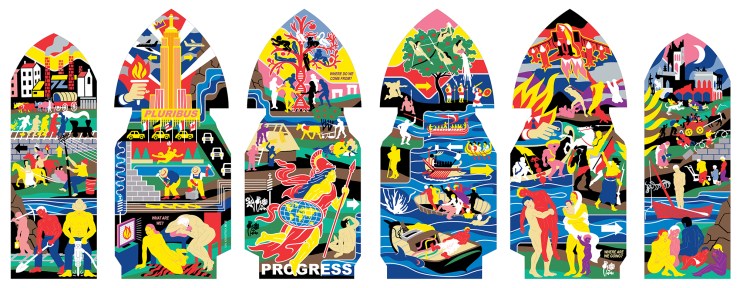
Ian Kirkpatrick’s final design. The two smaller panels (L and R) can be seen on display in the Settlers exhibition gallery.

Ian created a series of six panels that explores the social and natural causes behind human migration, both in ancient times and in the present day. It presents historical and modern peoples moving across a landscape in response to conflict, climate change and urbanisation, and remixes imagery from classical paintings alongside iconography from Great War postcards, Roman coins and the Bayeux Tapestry.
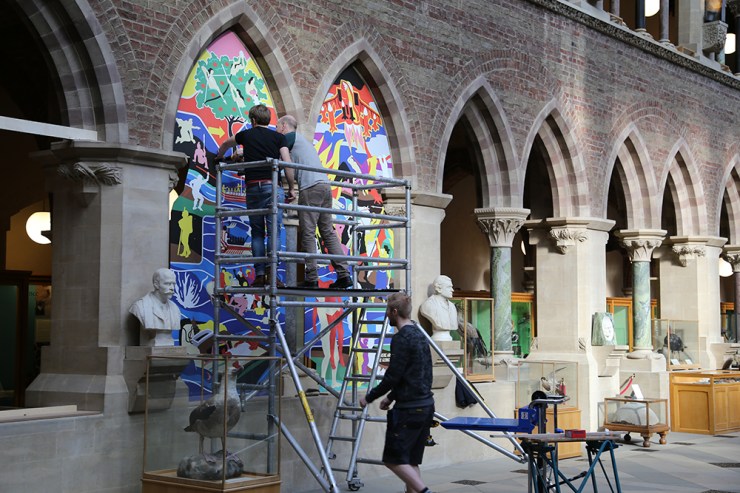
Ian, Peter Johnson and Adam Fisk installing the main panels of the artwork.

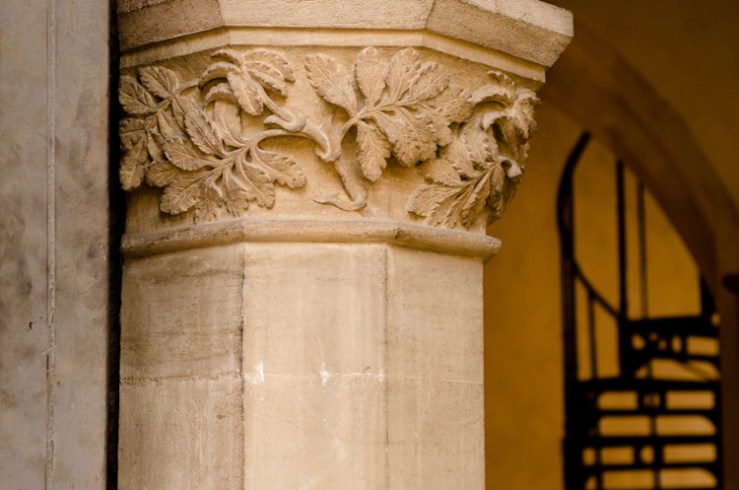
Of course, in a building like ours, the installation of such a large, bold piece of work would never be easy. Peter Johnson, the Museum’s Building Manager, came up with an ingenious solution to hold the panels into the arches, without damaging the masonry by drilling or glueing.
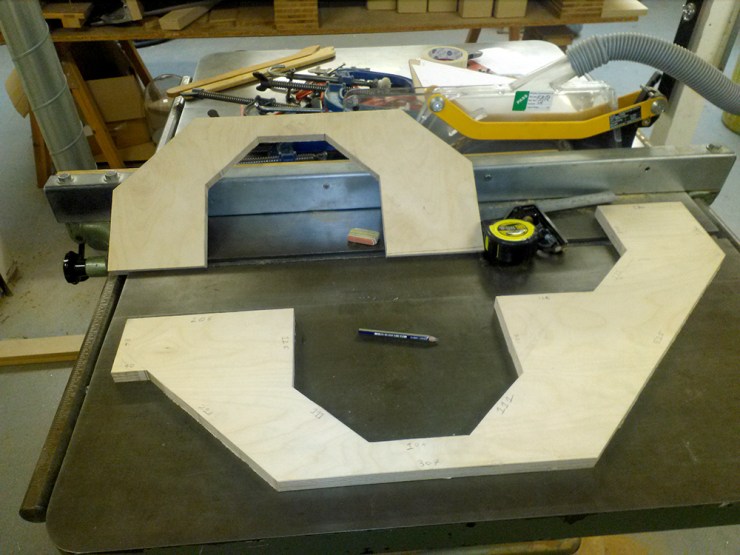
Pieces prepared in the workshop, to sit on the capitals and support the artwork

Hand-cut pieces of plywood were made to snugly fit round the capitals, so that the Dibond aluminium sheets don’t rest on the stone.
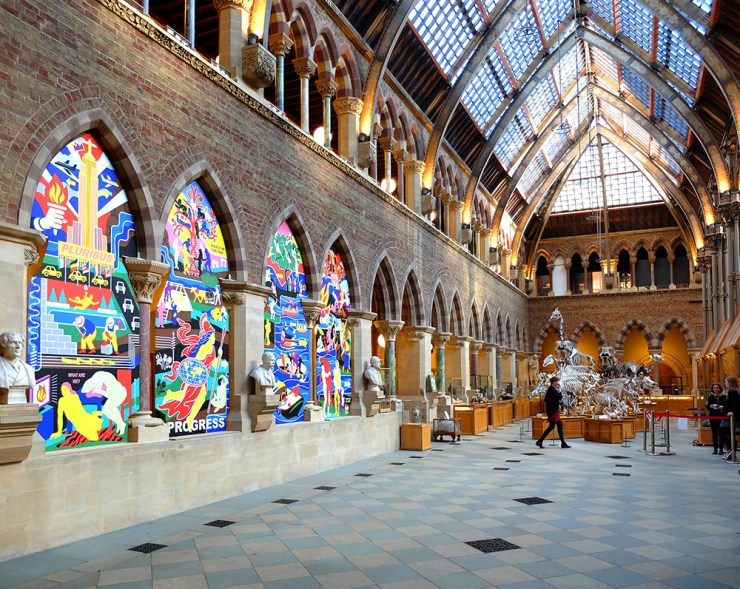
Credit: Ian Kirkpatrick

So, standing back and looking at the finished piece, looking resplendent in the winter sunshine and attracting the attention of hundreds of museum visitors, how does Ian feel?

The project was a lot of work – but it’s also been very satisfying to see it finally installed. Although the piece initially started as a comment on contemporary British settlement, it evolved into something that explored global migration throughout all of history.  Trying to find a way to tackle a theme that big, while still remaining visually coherent, is quite tricky!  But I was really pleased with the results and love seeing the finished piece housed within the magnificent neo-Gothic architecture of the Museum!
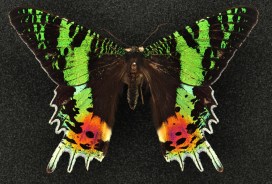
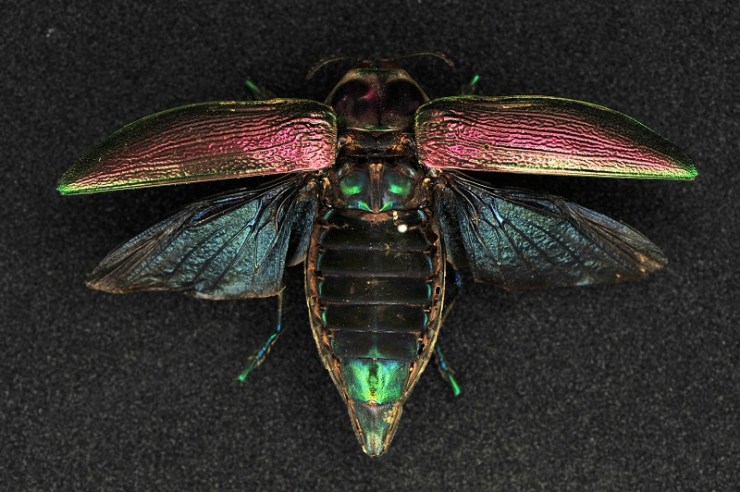
 

All that glitters…

The latest display in our changing Presenting… series showcases some of the incredible colours seen in many insects. Zoe Simmons, collections manager in our Life Collections, explains how such wonderful hues are created.

Reflected and refracted light creates the many bright and shining colours found in some insects. The dazzling natural display shown in the specimens here is formed through a combination of embedded pigments and sculpted surfaces on each insect’s external skeleton.

Some species can be variable in colour. Here a pair of Lamprima, a genus of Stag Beetles, shows off the range of colours present in the species.

Different pigment chemicals are responsible for different colours. Carotenoids produce yellow, orange and red hues, while bilins may be green, or blue if linked with proteins. They reflect and absorb different wavelengths of light, and the wavelengths that are reflected are the ones that we see as colour. Typically humans can see wavelengths of 390-700 nanometres, with the lower wavelengths perceived as blue, and the higher ones as red.

Many of the Leaf Beetles (Chrysomelidae) exhibit metallic colours.

Many insects also have multiple thin layers over their upper surfaces to help protect them and prevent dehydration. Variations in thickness and chemical composition of these layers can interfere with the transmission of light, refracting and scattering it back.

Some of the most striking metallic colours are found in the genus Chrysina, where species can be rose, silver or gold.

The shape of the surface layer can reflect light in a multitude of directions, with micro-folds, grooves, pits, hairs and scales all helping to produce complex colours and effects.

The formation and purpose of these colours is scientifically interesting, with research having applications in areas such as nanotechnology. But these insects are also simply beautiful examples of the spectacular diversity of the natural world.

Sunset moths (Uraniidae) are so called because of the dazzling array of colours on their wings. As day-flying moths they are brightly coloured like many butterfly species.

Cathedral to nature

To mark National Poetry Day 2017, former Museum poet-in-residence Kelley Swain writes about her residency, getting to know the Museum, and the Guests of Time anthology.  

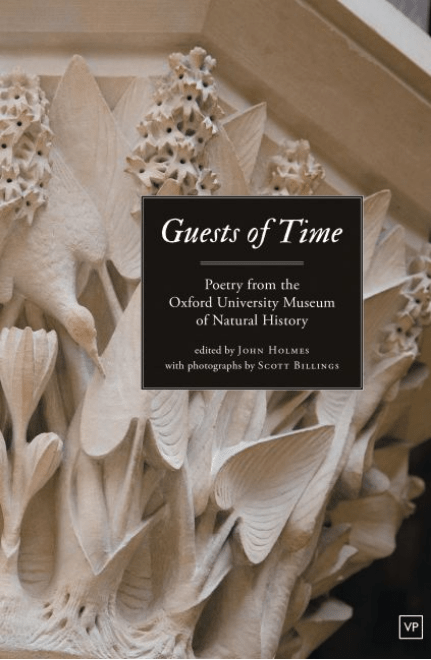
Throughout 2016, I was one of three fortunate writers to be invited into the Oxford University Museum of Natural History’s first poetry residency. It was our task to engage how we wished with the collections, curators, history and architecture of the Museum, and produce seven new poems each in the first third of the year. The next two-thirds comprised editing and publishing the residency anthology, Guests of Time, and running poetry engagement events.

Kelley Swain - Guests of Time launch blog
Kelley Swain reading from the Guests of Time anthology at the launch event  – December 2016

But this wasn’t the first time poets were inspired by the Museum. The building opened in 1860, an exemplary Victorian ‘cathedral to nature,’ heavily influenced by art critic John Ruskin who involved Pre-Raphaelite artists in its design and decoration.

Guests of Time
Guests of Time anthology

Guests of Time includes new work from the resident poets (myself, John Barnie, and Steven Matthews,) as well as contemporary Victorian poetry related to the Museum. This includes ‘The Lay of the Trilobite’ by May Kendall, a student at Somerville College, Oxford, and ‘A Year and a Day’ by Lizzie Siddal, who was invited to contribute designs for decorative carvings in the building (though, ultimately, decorative work was cut short due to lack of funds).

DSC_6103

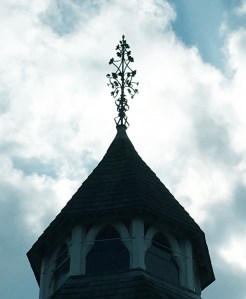
Continuing to spend time getting to know the building and its contents, I’ve been able to more fully appreciate the astonishing attention to detail throughout, and the sometimes seemingly ‘superfluous’ garnishes in which the architects indulged, such as this decorative ironwork on one of the Museum towers.

IMG_1654 (2)
Decorative ironwork on one of the Museum towers

It is not a weathervane; it is not, of course, any kind of antennae. It is beautiful, seemingly unnecessary, yet somehow integral. It was the Victorians (Darwin, always, is a good example,) who began to understand that many things in nature considered ‘superfluous,’ (such as the blue decoration of a male bowerbird’s bower,)  had in fact evolved through mate preference (sexual selection) or another competitive advantage (camouflage, fitness).

1024px-Bower_01_Pengo
Blue decoration of a male bowerbird’s bower

Oxford University held an architecture competition to choose a design for the building. The winning team included architect Benjamin Woodward, iron-master Francis Skidmore, and sculptors James and John O’Shea. The Victorians were striving, in Ruskin’s words, towards ‘truth to nature’. They were selecting for what Darwin called ‘grandeur in this view of life’. We do well to remember that no attention to detail, however small, is superfluous: in nature, in architecture, in poetry. On a grander scale, the arts are as essential to humankind as is blue to a bowerbird.


Paint it green

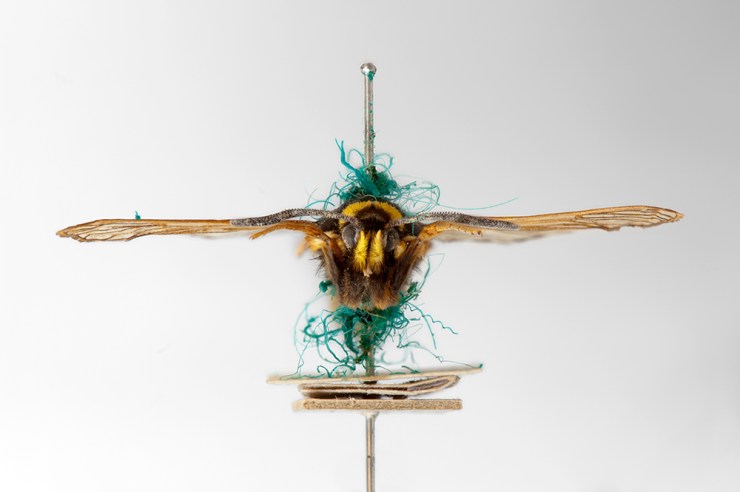
In the process of researching or conserving old pinned insects, it’s common to find a green deposit clustered around the pin. This is known as verdigris and is a natural patina created when the metal oxidizes over time. Katherine Child is Image Technician in the Museum’s Life collections and takes photos of insects for researchers, students, artists and publications. She is also an artist in her own right, so when she witnessed verdigris being removed during a conservation project, she came up with an inspired idea.

A clearwing moth before conservation, showing verdigris spreading where the metal and the insect fats, or lipids, react.

A few years ago I read a book called Colour: Travels Through the Paintbox, by Victoria Finlay, and was interested to learn that verdigris was once used as a pigment. Verdigris, which I now know translates from French as ‘Green of Greece’, is a word that’s been in my vocabulary since I was small.  I loved its rich bright blue-green colour, which is often seen on old copper piping or copper statues.

Verdigris forms when copper or a copper alloy reacts with water, oxygen, carbon dioxide or sulphur.

L: Three years’ worth of verdigris, ground and ready to make into paint.
R: A second attempt at mixing the paint, this time using linseed oil.

As early as 5thcentury AD, it was used in paint-making, and until the late 19th century it was the most vibrant green pigment available. But it was unstable – Leonardo da Vinci warned that it ‘vanishes into thin air if not varnished quickly.’ These days synthetic pigments provide a more constant alternative.

Despite its past uses, verdigris is a big problem in pinned insect collections. Nowadays stainless steel pins are used, but pins containing copper still remain in old collections and these react with air and insect fats. The more fatty the insect, the more verdigris tends to form and, if left, it can damage a specimen irreparably.

Comprising around five million or so insects, the Hope Entomological Collections here in the Museum take quite a bit of looking after. A few years ago a project to catalogue and conserve many of its butterfly and moth specimens was undertaken and the removal of verdigris and repining of insects was part of this.

With paint-making in mind, I asked that the beautiful, but problematic, substance be saved.  About three years on I finally got around to using the pigment, which I had also been adding to while photographing the collections.

I chose a variety of differently shaped moths to paint (most of the verdigris came from moths, so moths seemed the most apt subject). To narrow my options further I went for green moths. Some of the specimens I chose had verdigris on their pin, so I was able to take pigment and use it to paint the very specimens from which it came!

Katherine tested out the newly made verdigris paint in her sketchbook.

After a first failed attempt to make watercolour paint (during which pigment and water remained stubbornly separate due to the greasy insect fats still present), I tried again, this time using linseed oil to make oil paint – and it worked! Traditionally a flat bottomed tool called a muller was used to press pigment into the water or oil. Not having one of these, I used the flat end of a pestle and a mortar which did the trick.

A Miscellany of Moths, the finished verdigris painting.

The paint went surprisingly far and, following on from the 14 green moths, I plan to use up the remainder to paint beetles.

Katherine’s Miscellany of Moths painting can be seen on display in the Museum’s Community Case until 18th October.

Drawing amongst the dinosaurs

For the past few years the Museum has been working with second year students on the BA (Hons) Illustration course at the University of Plymouth. As part of a module on interpreting information, students are given information on research that is going on in the Museum or related departments and asked to interpret this information visually. This year one of the students, Sally Mullaney, took on the project ‘Key to the Past: exploring the life and work of Charles Lyell’. Sally continued her work with the museum on a week’s placement during the summer, and was supervised by Eliza Howlett, Earth Collections Manager.

Sally Mullaney talks about how she interpreted the project and her experience here at the Museum.

Charles Lyell Map FINAL small
Illustrated map of Lyell’s European travels on which we can mark the fossil localities by Sally Mullaney

“For the past two months on my illustration course at Plymouth University, I’ve been working with the Museum of Natural History on an illustrated timeline of geologist Charles Lyell. At first I was pretty daunted at the amount of travelling and ‘geologising’ he did in his life throughout the Victorian era. But after I spent time reading his letters and journals, I really got a feel for what Lyell was like. His musings and good humour shine through in his many letters to various siblings, professors and his wife, Mary. This really made the Charles Lyell project a pleasure for me to do, and I was thrilled when the museum asked me back to work for a week’s placement continuing with Lyell.”

LBEC003 small
Charles Lyell and Captain Cooke spend a night in a shepherd’s hut in the Pyrénées, 1830 by Sally Mullaney

After a weekend of sightseeing Oxford’s many attractions (the museum being one of them!), Jade, a fellow student from Plymouth, and myself reported to the front desk to begin our week.  We were welcomed warmly with a cup of tea overlooking the main court of the museum, and were briefed about the week to come. I was also given the opportunity to work with the Public Engagement team to create a new logo for the Family Friendly Sunday events, as well as the continued work on Lyell which would be a map illustrating his travels and collections.

MuseumLogo BW small
New logo for family friendly activities by Sally Mullaney


The week really flew by and I managed to complete the projects with a little time to spare, which I spent sketching in the court amongst the dinosaurs! The building is such an incredible place to work in, and it has been a pleasure to be working in such a fantastic museum – I’ll definitely be visiting again!”

sketchbook 1 small
Pianist and the T. rex, 30 July 2017 by Sally Mullaney

Sally’s characterful and charming illustrations of Charles Lyell’s bring his geological travels across Europe to life. Charles Lyell (1797-1875) was a student of William Buckland at Oxford, and went on to become the foremost geologist of his day. The Museum is lucky to house a large proportion of the Charles Lyell Collection, comprising of over 16,000 documented fossil specimens. A number of the specimens in the collection would have been collected in Europe during his travels. LBEC004 small

Lyell was a close and influential friend of Charles Darwin. Lyell’s important Principles of Geology was one of the few geological books that Darwin took with him on his voyage with HMS Beagle, and it helped shape his hypothesis for the mechanism of coral atoll formation amongst other things.

Last year the Museum undertook the large task of starting to make Lyell’s collection publicly accessible by cataloging and taking high resolution images of the specimens. The collection will be available online via a user-friendly database in the foreseeable future – watch this space!

You can learn all about the project, the collection and the man himself via this dedicated blog.


A model ancestor

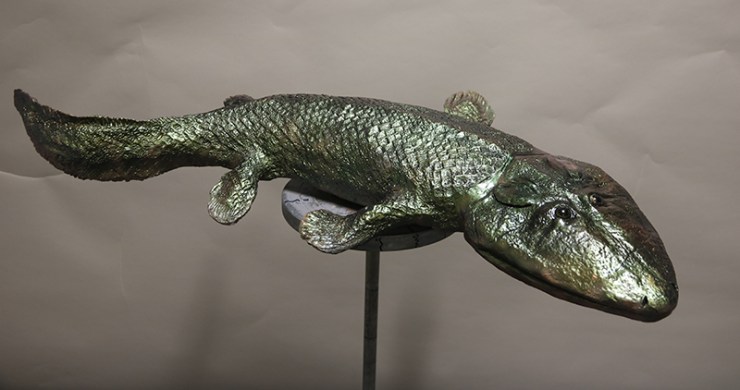
This bizarre creature, somewhere between fish and early four-legged land animals, is called Tiktaalik. The more scientists learn about this 375 million year-old beast, now long extinct, the more it intrigues them. Recent discoveries suggest its strong pelvis and hind limbs allowed it to move effectively through water, but also to clamber on the river bed and possibly onto mud flats.

Education Officers here at the Museum often use Tiktaalik as an example of how animals moved out of water and onto land and how that relates to the history of life on Earth. Until now, this has been a bit of a challenge: our education activities all focus on using specimens, but only a few fossilized bones remain from this ancient animal. Enter Robyn Hill, model maker! Here she explains how she tackled the task of bringing Tiktaalik to life:

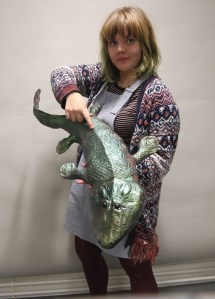
Robyn brandishes her Tiktaalik model

For the last 3 years I have been studying model-making at Arts University Bournemouth. For a final year project we were required to find a client and create a model in 7 weeks. One of my fellow students put me in contact with Chris Jarvis, an Education Officer at the Museum of Natural History, who gave me the project. He’s been very supportive and incredibly enthusiastic about the collaboration. The whole experience has been a boost in confidence as this was the first model of this type and scale I had made.

The model will be used as a tool to illustrate the story of the Tiktaalik during schools workshops. The Tiktaalik is important in the evolutionary timeline as it is the cross over between historic fish, such as the Coelacanth, and the first four-legged animals, the tetrapods.

Robyn used clay to flesh out an armature she made from steel, aluminium wire and chicken wire.

I decided to make the model out of fibreglass as it would withstand more wear and tear, such as being stroked by school children, and it is light enough to be carried by a single person when holding up and demonstrating.

The head was probably the easiest part to model, because I could use the direct evidence from fossil remains. Then it was a case of imagining where the muscles and flesh would lie over the skull. I used written explanations of the creature alongside illustrations to help me create the final look.

To make this mould, Robyn applied silicon to the clay sculpture, followed by a fibreglass jacket to add support. She then filled them with fibreglass for the final model.

When posing Tiktaalik I looked into how much the body would realistically curve. I referred to the fossil remains and animations of how it would have moved, alongside images of preserved footprints. Tiktaalik was one of the first animals with a neck, which is something I hope I illustrated in my design.

Once it was released from the mould, Robyn sanded and filled the model, then sprayed it with colour.

The Coelacanth is a living relative of Tiktaalik and has a similar type of scales, so I used images of this animal to help my research. I also looked at fish which live in similar conditions. I was experimental with the paint, as no one is certain what colour its scales would have been. I used changing pigments over a detailing layer of airbrushed cellulose paint.

On the final model, you may see a few scars: some of these I made on purpose, some made by mistake, but I believe it gives the creature more character, because it was a predator and would have had to fight for its place!