Young volunteers Genevieve Kiero Watson and Poppy Stanton tell the tale of the Museum’s resident Wool Carder Bee and their investigative bee work in our Life Collections…
A small guardian patrols its territory among the luscious bed of Lamb’s-ears that grow at the front of the Museum. This feisty critter, the Wool Carder Bee (Anthidium manicatum), is just one of the roughly 270 bee species that buzz around Britain. Having spotted this unusual hovering bee we seized the opportunity to identify, photograph and explore the species a little further.
The male of this solitary bee species is fiercely territorial, fighting off other males as well as any other insects it considers to be intruders. Techniques used in combat vary from skilful aerial hovering to ferocious wrestling. But perhaps its greatest weapon is a series of stout spines found at the tip of the abdomen. These are used to bully an intruder into submission, or even to kill it. In so doing, the male protects the precious supply of pollen for the smaller females which in turn collect it on stiff bristles on the undersides of their abdomens.
Females, being slightly less aggressive, are in charge of constructing the nests, which are built in existing cavities such as beetle holes. Hairs shaved off plants, such as the favoured Lamb’s-ear, are used to create the brood cells for the next generation.
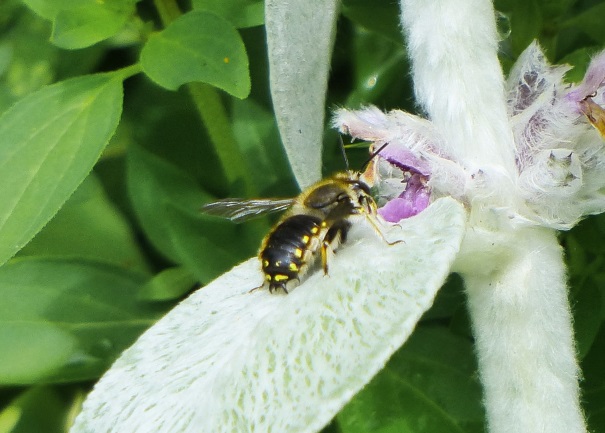
Male Wool Carder Bee on Lamb’s ear in the Museum’s front garden
The Museum houses many specimens of the Wool Carder Bee and our job was to pull out the data from each one to help with an ongoing online survey about this species. Although making friends with hundred-year-old bees was enjoyable, trying to comprehend the miniscule handwritten labels accompanying them was altogether more trying.
Every label explains where and when the bee was captured, who collected and identified it, and gives the reference for its current collection. All this on a slip of paper no bigger than half a stamp.
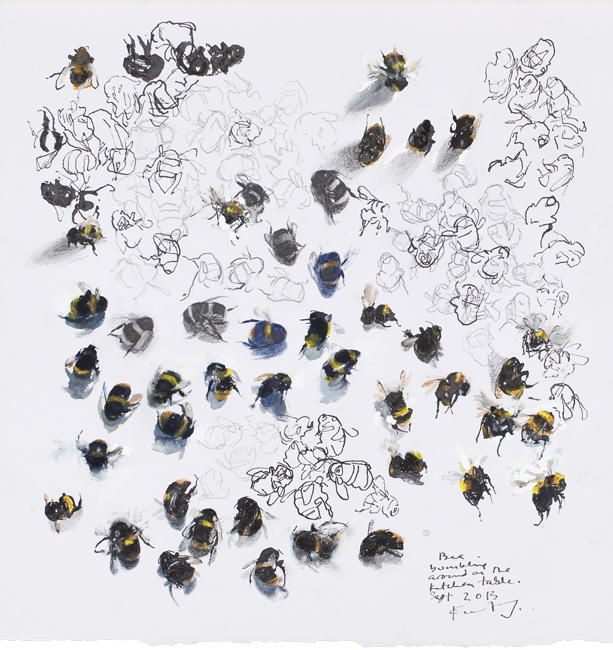
One of the Museum’s Wool Carder Bee specimens, circled, featured in a display of all 270 species of British bee in the Bees (and the odd wasp) in my Bonnet exhibition by artist Kurt Jackson
After recording data from 120 labels we began to find the grid reference of the location each was originally collected. This too was challenging as many place names have changed in the last hundred years. Ultimately, the information will be used by the Bees, Wasps & Ants Recording Society (BWARS) to improve the distribution map for the Wool Carder Bee.
Why not see if you can spot the Wool Carder Bee in your garden? Characteristics to look out for include small spines on the tip of the abdomen and lateral lines of yellow spots on either side of the abdomen. The bees themselves are about 11-13mm long for females, and 14-17mm for males. Good luck!
This is the first in a short series of articles to accompany the new Stone Age Primates temporary display at the Museum, created with the Primate Archaeology group at Oxford University. Here, Michael Haslam, ERC Senior Research Fellow in Primate Archaeology, outlines the importance of this emerging field of study.
Humans evolved over millions of years. You can see displays about this in natural history museums all over the world, usually with skulls of extinct ancestors such as Homo erectus. Alongside these bones there are often stone tools of various shapes and sizes, showing how our technology has also changed over time. Ultimately, human tool use has led all the way from sticks and stones to the computer, phone or tablet that you’re using to read these words.
However, for all those millions of years other members of our family were evolving too. What if we had an archaeological record for non-human animals as well? The Primate Archaeology project at Oxford University exists to answer this question.
‘The Rise of Modern Humans’ display in the Museum
Primates, the group that humans belong to, also includes apes and monkeys, as well as more remotely related animals such as lemurs. Yet when we see these animals in museums, they very rarely have a set of their own extinct ancestors on display, or any examples of the technologies that they have developed.
Why not? For one thing, it is difficult to find fossil ancestors of animals that live mostly in tropical forests because their bones aren’t preserved well in that environment. And most primates, like most animals, don’t use tools in the wild, so there is nothing left behind to tell us about their past behaviour.
But there is another reason. We view the human past as a series of ancestors evolving towards the way we are now; yet we tend to see monkeys and apes as unchanging over time. If asked to imagine a chimpanzee three million years ago, you would probably picture something that looks like a chimpanzee today. But modern chimpanzees didn’t exist back then, just as modern humans didn’t.
Wild chimpanzee at Bossou, Guinea. Photo by Michael Haslam.
The main reason we think of humans as changing and evolving is because of the archaeological evidence that we’ve collected. As we discovered more and more bones and stones it became clear that dozens of human ancestor species have lived on Earth, including close relatives such as the Neanderthals in Europe and Asia.
A hammerstone used by a capuchin, on display in the Museum
So what would we find if we looked for the archaeology of other primates? They don’t build cathedrals, or use pottery or metal, and they don’t leave behind written messages like the Egyptians, Maya or Romans did. That’s a problem. But the solution to the problem is actually the same one that archaeologists have always used for human ancestors: find the stone tools.
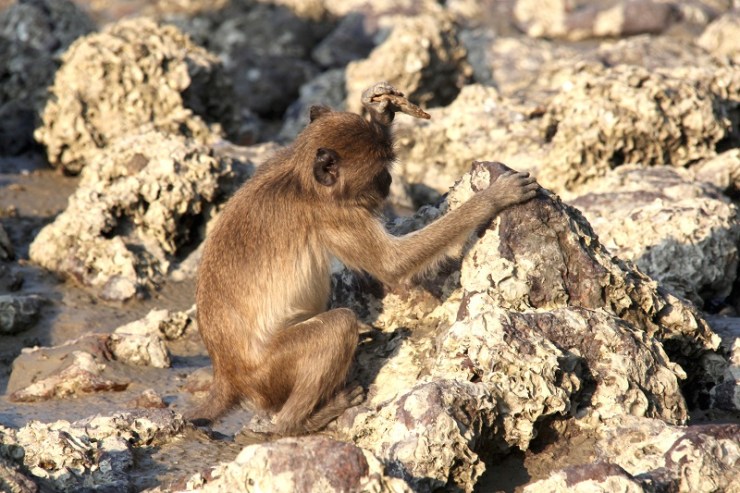
There are three types of wild primate that use stone tools: the chimpanzees of West Africa (Pan troglodytes verus); the Bearded Capuchin monkeys of Brazil (Sapajus libidinosus); and the Burmese Long-tailed Macaques of Southeast Asia (Macaca fasciaulria aurea). They mainly use stones as hand-held hammers, to break open hard foods such as nuts and shellfish. The capuchins also use stones to dig in the hard ground, which helps to protect their fingers when searching for roots or spiders to eat.
Wild long-tailed macaque using a stone tool at Laem Son National Park, Thailand. Photo by Michael Gumert.
The Primate Archaeology Project was set up at Oxford University in 2012, supported by the European Research Council. Since that time, our team has spent many months watching these animals use stone tools in the wild. We record how they select certain sizes and types of stones (you wouldn’t use a soft sponge as a hammer, and neither would they!), and how they carry their tools around from job to job like a modern tradesman. We used these observations to work out what primate tools look like today, and then we went digging into the past.
We found macaque tools buried in beach sands in western Thailand, and ancient capuchin tools in the forests of northeast Brazil. In both cases, we recognized the tools because they were similar to ones still in use today. Importantly, we also found that the tools were damaged in very particular ways by the monkeys that had used them, because hitting hard things together usually means that one of them gets broken.
Primate archaeology excavation, Serra da Capivara National Park, Brazil. Photo by Michael Haslam.
We used radiocarbon dating to work out that the archaeological capuchin tools were at least 600 years old. That means that there were monkeys sitting around in Brazil with stone hammers, cracking and eating nuts, before Christopher Columbus ever left Europe. Previous excavations in the Ivory Coast have found even older primate tools – chimpanzees there were using stone hammers more than 4,000 years ago!
Primate archaeology is still a new research field, with more questions than answers, but then so was human archaeology when it began. We really don’t know what technology apes and monkeys were using during the millions of years that they have evolved, but we are taking the first steps towards solving that mystery.
Stone Age Primates display in the Museum
Working with the Museum, the Primate Archaeology project team has put together a new temporary display, ‘Stone Age Primates’, to sit alongside the current human evolution cases in the Museum. In the display you can learn more about the research and see tools used by primates past and present. You can also follow the group on Twitter @primatearch.
Have you created a ‘vision of nature’ that you could share with us? During 2016, the Museum has seen some wonderful work inspired by nature and the natural environment, as part of our Visions of Nature year. To take the idea further we’d like to showcase work by our visitors and online readers too.
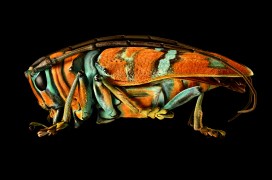
Visions of Nature kicked off with Kurt Jackson’s Bees (and the odd wasp) in my Bonnet exhibition, a celebration of the diversity of bees through Jackson’s textured paintings, mixed media sculptures and beautiful ceramics. This was followed in May by Microsculpture, a showcase of photographer Levon Biss’ extraordinary portraits of insects from our collections.
And later this autumn our three poets in residence will round off the year with a poetic vision of nature, inspired by their time here.
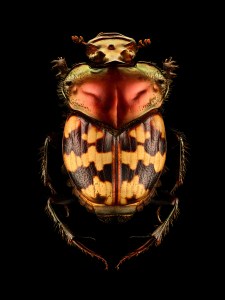
Splendid-necked Dung Beetle (Helictopleurus splendidicollis) from the Microsculpture exhibition by Levon Biss
The Museum’s court is often alive with visitors engaging artistically with the collections, sketchpad or camera in hand. The Visions of Nature year is the perfect opportunity to share your work with us. Whether it’s paintings, photographs, sculptures, drawings, or textiles, we would love to see what has inspired you, either in the Museum or out there in the natural world.
To show us your vision of nature, whether old or new, just Tweet or Instagram a photo of your work using #visionsofnature and tag @morethanadodo too so that we’ll definitely see it. Alternatively, you can email your photos to communications@oum.ox.ac.uk.
Then we’ll choose a rolling selection of submissions to exhibit throughout the rest of the year on the Visions of Nature website. If your image is selected we’ll get in touch to make sure you are happy for us to do this.
by Juliet Hay, Earth Collections preparator and conservator
I feel myself very lucky to have a job that involves working with the fossil remains of long-extinct animals. One of the things my colleagues and I are currently working on is a plesiosaur – a marine reptile that lived in the sea millions of years ago.
This particular specimen was found in a clay pit near Peterborough by members of the Oxford Clay Working Group in 2014, and is a near-complete example of its kind. The palaeontologists who found the specimen named it Eve, although we don’t know if it was male or female, and perhaps never will.
The discovery of large fossil vertebrates like this is rare, so we are fortunate to have had the specimen donated to the Museum by the quarry owners Forterra.
Juliet at work on the plesiosaur skull
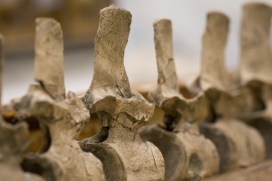
The plesiosaur is 165 million years old and, when alive, was around 5.5 metres long. It had a long neck, a barrel-shaped body, four flippers and a short tail. The find is particularly exciting as the skull was also discovered. It is encased in a clay matrix, which is relatively easy to remove, but the work has to be carried out under magnifying lenses and microscopes.
As the skull is quite small relative to the size of the body, the features are very delicate and it is a painstaking process to remove the sediment without damaging the fossil bone or losing any tiny fragments. Fortunately, pictures of the skull have been produced using CT scanning technology, and the images are proving invaluable as an aid to assist in its preparation. It’s a bit like having a jigsaw puzzle with the picture on the lid to refer to!
A belemnite hooklet at 12x magnification, found with the plesiosaur remains and possibly part of Eve’s last meal
The clay covering the skull is being sieved and examined and tiny hook-shaped fossils have been found. These came from the arms of squid-like creatures called belemnites, which may have formed a large part of the plesiosaur’s diet.
It is too early to say for sure, but Eve could represent a species new to science, as some features, such as the shape of the flipper bones and some of the surfaces of the bone in the skull, are quite unusual. Further research needs to be done before the findings can be published in scientific journals – watch this space.
And if you’re visiting the Museum before 25 July, you can see some of the fossilised remains of Eve for yourself, in our Presenting… display case.
Today we are excited to be opening our new special exhibition, Microsculpture: The Insect Photography of Levon Biss. You may well have already heard about Microsculpture, and have perhaps watched the video showing how Levon Biss made these incredible portraits of insects from the Museum’s collection.
As we open the show in the Museum’s main court we wanted to give a little more insight into the process that Dr James Hogan, an entomologist in our Life Collections, went through to select and describe the specimens for the project. So I put a few questions to James to explain the making of Microsculpture from his point of view.
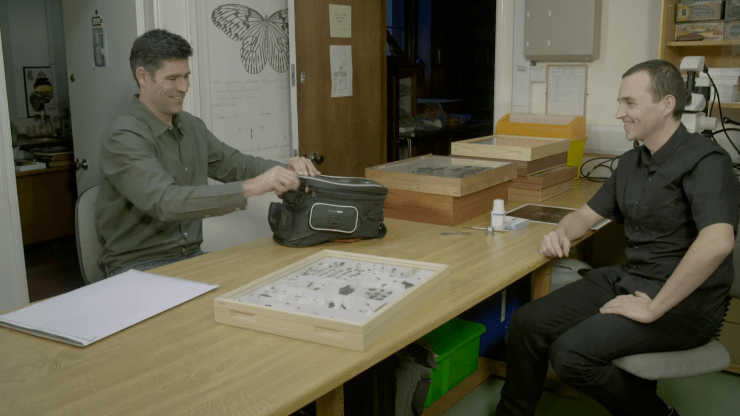
James Hogan (right) selecting specimens with Levon Biss
There are 23 specimens on show in the exhibition: how did you choose these particular ones? We wanted a wide variety of specimens that would all show some interesting surface detail. Some were also chosen for their spectacular colours, interesting shapes or strange appearance.
Splendid-necked Dung Beetle (Helictopleurus splendidicollis) from Madagascar. Length: 10 mm
But perhaps 95 per cent of the specimens we initially considered were rejected because we had some pretty strict criteria; very hairy specimens, which includes most bees, were out as the image processing was too difficult; the specimens had to be intact, so no broken antennae or legs.
Probably the biggest problem was finding specimens which were clean enough. Because Levon’s technique reveals so much detail, any dirt on the specimen is glaringly obvious. And the whole idea was to look at the surface structures, which are obviously very small and easily obscured by any dirt.
How did you prepare them for their close-ups? All the specimens needed a bit of preparation work before being ready for Levon’s photography. First they needed to be remounted on the end of long pins to allow more clearance space for the lighting setup. Some of the specimens are very small and fragile and this is the stage where damage is most likely to occur.
After remounting, all the insects needed at least some degree of cleaning under the microscope. For this I used a range of fine paintbrushes; we also make our own tools from micro-pins bent into different points and hooks. Again, I had to be careful to not damage the specimens – easily done by over-enthusiastic cleaning!
Where do the specimens come from? The specimens in the exhibition are from the Museum’s very large insect collection, stored behind the scenes in many different rooms. The insects in the show are from all over the world, from a back garden in England to a remote island near Antarctica. Some were collected over 150 years ago while others were collected very recently by Museum staff.
Of particular historical significance is the Tricolored Jewel Beetle (Belionota sumptuosa) which was collected by the Victorian naturalist and explorer Alfred Russel Wallace, co-publisher of the theory of evolution with Charles Darwin in 1858.
Tricolored Jewel Beetle (Belionota sumptuosa), collected by Alfred Russel Wallace in Seram Island, Indonesia. Length: 25 mm
How big are the actual specimens in comparison with the photos? The actual specimens are mostly pretty small, ranging from 6 mm to about 30 mm. Some of the larger printed photographs will be about a thousand times larger than the specimen!
Orchid Cuckoo Bee (Exaerete frontalis) from Brazil. Length: 26 mm
What do you hope people will get out of the pictures in the exhibition? To me insects are beautiful creatures and Levon has done an outstanding job of revealing this. I hope the photographs will spark people’s interest in insects and inspire more people to study them.
The photographs certainly pose some interesting questions, and reveal that there is so much we don’t know, particularly about the functions of all their strange and varied adaptations.
Is it valuable to showcase specimens from the collections in this way? One of the most exciting parts of this exhibition for me was the opportunity to show part of the Museum’s collection which visitors don’t normally see.
The collection is used all the time by scientists, artists and educators, but unfortunately most of it is unsuitable for display because the specimens are so small. Levon’s ultra-high resolution photography has in a way solved this problem, allowing us to showcase some of these spectacular, but tiny and fragile creatures in all their beauty.
There can be many reasons for a museum’s decision to install a temporary exhibition, but the most powerful is that its visitors have asked for it. While working in the Museum’s shop, Magdalena Molina is often quizzed about the building’s iconic roof, which can be admired as they browse. “What’s it made from? Who designed it? How does it get cleaned?” The most popular question of all is, “Where can I find out more?”.
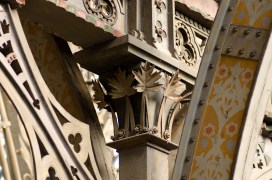
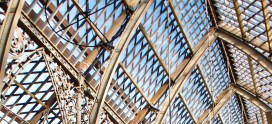
A detail from the roof’s rafters. Credit: Mike Peckett.
Magdalena is an experienced designer, who has worked on various exhibitions, so she approached the Museum with her ideas for a creative, artistic display all about the roof. An exhibition to satisfy the interests of curious visitors.
As a designer I feel inspired by the exquisite design and architecture of the roof of the Museum. Assisting in the shop, I have received a lot of comments from visitors who are fascinated by the building.
Visitor exploring the exhibition
The exhibition, Lives at the Top: celebrating the museum roof, has just opened. It allows visitors to discover the people behind its creation, secrets of its beautiful design and find out how it has been maintained for generations to come.
It begins with the origins of the Museum building, with an architectural competition won by Woodward and Deane, soon followed by the architect’s tragic early death.
Magdalena with one of the Curiosity Boxes
The story continues with the 2013 roof renovation project and moves on to current museum concerns such as pests living up in the rafters. There are also 6 ‘Curiosity Boxes’ to explore, which use mirrors and magnifiers to look at the roof in a new, imaginative way.
Magdalena hopes that visitors will:
Follow the story which celebrates the people involved in the life of this astonishing roof, and playfully engage with the interactive designed boxes to help them explore different perspectives of the roof.
Magdalena is encouraging visitors to join the celebration of beautiful roofs, ceilings and architectural details, by sharing their photos with us… and the world! Inspired by the Lives at the Top exhibition, we’ve put together a special board on the Museum’s Pinterest account. If you would like to appear on the board, simply share your photo on Twitter or Instagram and tag with #lookingupMNH.
Lives at the Top is open until 13th November 2016.
A scene from the 2013 renovation. Credit: Mike Peckett
















 More Than A Dodo